
The short answer
How does the animated film’s ending change the political argument of Orwell’s novel?
Read the evidence
Sources, interpretation and production roles
The records answer different questions about this work. The final exercise is an original teaching model.
| Record or question | Supported reading | Boundary or contrast |
|---|---|---|
| BFI archival account | Explicitly contrasts the novel’s and film’s endings. | The comparison is not a claim of a new complete textual edition or film viewing. |
| Funding and resistance records | Show political backing alongside some resisted requests. | A patron’s involvement does not allocate every creative decision. |
| Credits and development material | Identify distributed writing, music, colour and visual planning. | Adaptation extends beyond changing a final sentence. |
The altered ending changes the political possibility
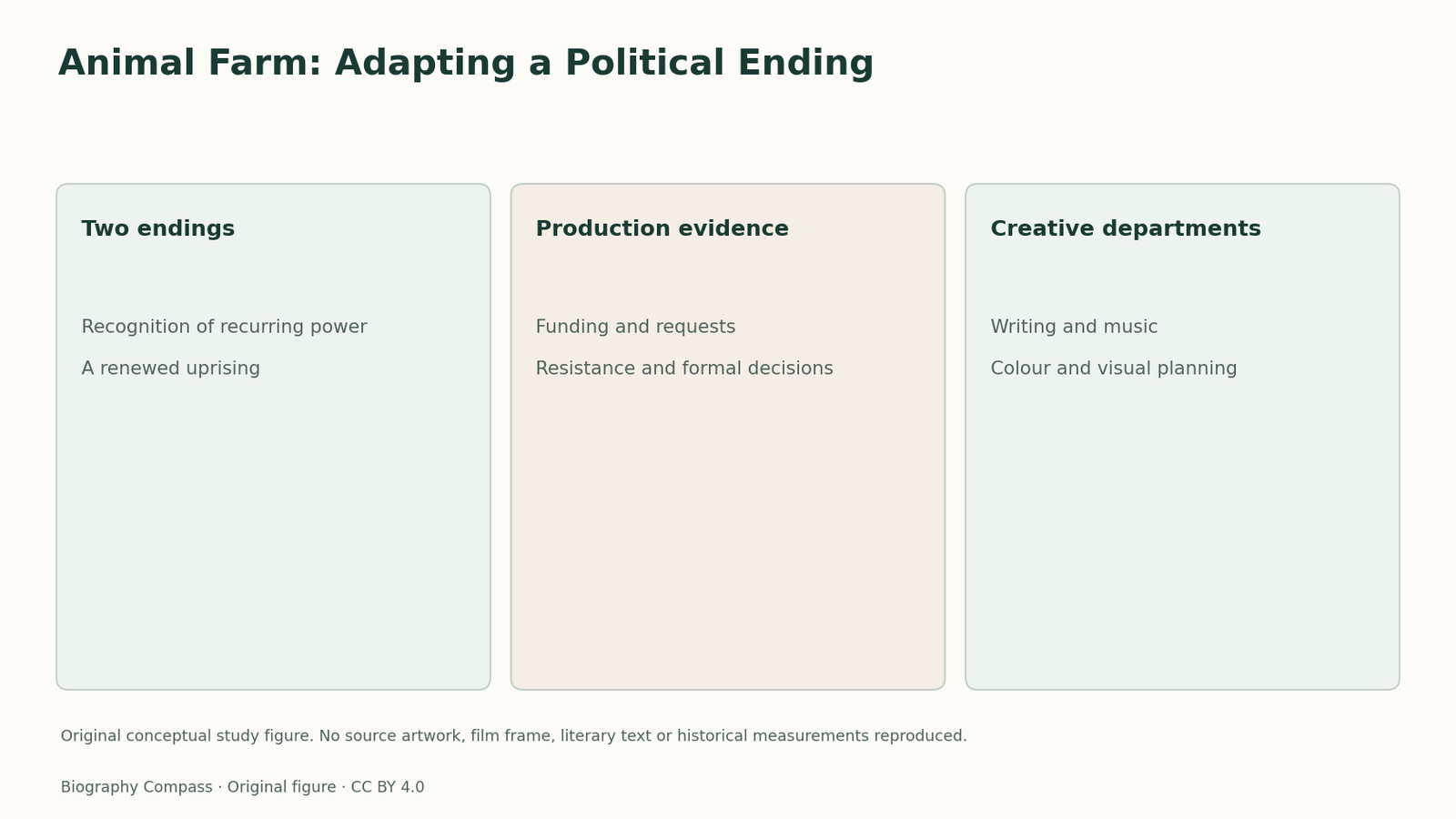
The 1954 animated Animal Farm was directed by John Halas and Joy Batchelor from George Orwell’s novel. The BFI’s production history describes a significant alteration: the novel’s bleak return to an indistinguishable ruling order becomes a film finale in which the other animals rise against the pigs. This comparison is grounded in that inspected archival account, not in a claim to have reviewed every frame or the entire novel for this article. The change matters because it opens a possible further revolution where the source ends with a more closed recognition of power. An ending does not merely finish the events; it sets the limits of what the story lets its audience imagine next.
Funding context is relevant without explaining every decision
The BFI discusses covert CIA part-funding, but also warns that the financing story has overshadowed the creative work. It notes that Halas and Batchelor resisted some requests from their backers. These observations make a simple instruction-and-obedience account inadequate. A sponsor can shape a project’s possibilities without becoming the author of every image, and resistance to one request does not prove complete artistic independence. The relevant analytical task is to distinguish documented intervention, an actual formal change and speculation about motives. The surviving records can support the first two more securely than an all-purpose claim that a political patron determined the whole film.
Sources for this section: [3]
Visual development contributes to an adaptation’s argument
The same production history identifies Mátyás Seiber’s musical contribution, a tension chart, colour planning, farm research and mood sketches. These records extend adaptation beyond the screenplay. Music can establish pressure and release; colour can organise contrast; drawings can translate an emotional relation into a spatial one. The BFI catalogue also records several writing contributors alongside the two directors. Thus an interpretation of the ending should sit within a production that distributed work across departments. A political reading and an account of craft are complementary questions, rather than competitors for the single true explanation of the film.
An original endings comparison
Invent a story in which workers replace an unfair committee, but the replacement begins using the same privileges. Write two final outlines: one ends with observers unable to distinguish old and new leaders; the other ends as the workers organise again. A reference answer identifies different horizons of action: recognition of recurring domination in the first, and a renewed possibility of collective intervention in the second. Neither outline by itself proves why an actual filmmaker made a choice. This original model demonstrates what a changed ending can do before a researcher moves to funding letters or production papers. It uses no dialogue, characters or images from Orwell’s novel or the 1954 film.
Sources for this section: [3]
Continue the chronology
Related history guides
Biography context
Explore United Kingdom through connected lives
Connected biographies
People and related creative practices
1912–1995
John Halas
Animation director, producer and studio co-founderJohn Halas moved from Hungarian animation and design to a British studio partnership with Joy Batchelor that joined commercial production to artistic ambition.Read biography1914–1987
Norman McLaren
Animator and experimental filmmakerHe composed with movement and sound.Read biography1914–1991
Joy Batchelor
Animation writer, designer, director and producerJoy Batchelor brought illustration, writing and design into a long British animation partnership, from sponsored shorts to Animal Farm and Ruddigore.Read biographyQuick answers
Common questions
- Does the film preserve the novel’s ending?
- The BFI production account describes a changed finale in which the animals rise against the pigs.
- Does funding alone explain the film?
- The inspected history also records resistance and extensive creative development; it does not assign every decision to the sponsor.
Primary and institutional sources
How this history was checked
Sources include production records, institutional collections and the specifically identified passages discussed here. Interpretations and teaching models are distinguished from credits and publication facts. This article was reviewed on 7 November 2026.