
The short answer
Removing background music need not remove sound design. Adoor’s account gives two different planning choices: attention to a surrounding world and a musical phrase held open across a story.
Process and new decisions
Compare the working decisions
Keep the documented process and the new design choices visible in separate columns.
| Working question | Selected record | Original task |
|---|---|---|
| Environment | Ambient recording | Assign time, place and action. |
| Theme | Deferred completion | Define what is withheld. |
Chronology
A timeline of the turning points
Character and sound
Kodiyettam.
Composer brief
Elippathayam.
Two stated choices
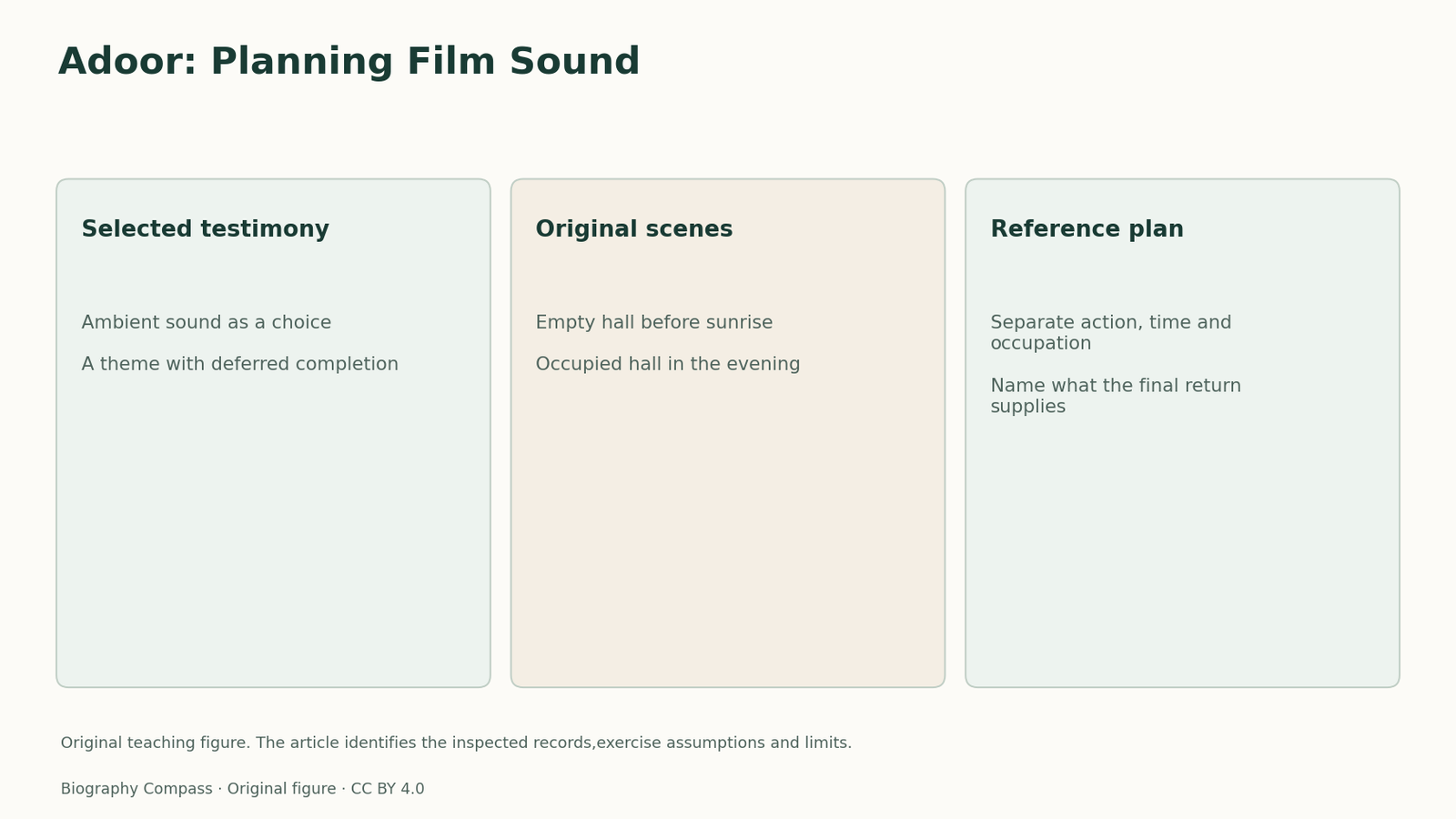
For Kodiyettam, Adoor described recording ambient sounds rather than adding an emotional background score. For Elippathayam, his brief to M. B. Sreenivasan asked for a falling, unfinished impression that would resolve only at the end. These are his reported intentions, not a listening analysis undertaken here.
Sources for this section: [1]
Specify the function before a sound
A cue plan can separate location, time, action and dramatic function. “Bird sound” is too broad if the scene depends on a change between morning and night. Conversely, a repeated theme needs a description of what is withheld and what finally changes. The plan should name the contrast before a composer or recordist chooses the material.
Environmental sound and music can coexist, but they do not have interchangeable jobs. Ask whether a cue tells us where we are, draws attention to a physical event, or supplies an emotional instruction. A plan becomes clearer when the maker can explain why one function belongs at a particular moment.
Sources for this section: [1]
Original two-scene task
Scene A: a fictional caretaker unlocks an empty hall before sunrise, checks a window and leaves a chair facing the door. Scene B: the hall is occupied that evening, but the chair remains empty. List three possible environmental cues and their functions. Then propose a wholly original theme plan with three appearances: incomplete, interrupted and completed. Supply no melody or copied scene.
Sources for this section: [1]
Reference answer
An environmental plan might identify the lock as action, sparse outside activity as time and changing room resonance as occupation. These are proposals, not a factual account of any real hall. The theme plan could withhold a final event, break off before it on the second appearance, and supply it only on the third. The written plan must identify the withheld event; “make it sad” would not do that.
Neither solution is automatically better. Compare what the audience must infer in each one. A second maker should be able to revise the cues while preserving the stated function. That is the practical value of a brief: it can guide collaboration without pretending to be the completed score.
Sources for this section: [1]
Continue the chronology
Related history guides
Biography context
Explore India through connected lives
Connected biographies
Follow the working life

Quick answers
Common questions
- Must I compose a tune?
- No. Describe the cue’s function and the change required at its return.
Primary and institutional sources
How this history was checked
The selected translated interview supplies the sound and composer briefs; the reported career profile places them within a broader practice. This article was reviewed on 31 October 2026.