
The short answer
The Spare Room places friendship under the pressure of serious illness and daily care. Its narrator shares the author’s first name, but Garner chose to publish a novel. That decision matters to how readers approach the book’s emotional honesty, selected incidents and relationship to lived experience.
Chronology
A timeline of the turning points
Contemporary reception
Sean O’Beirne reviews the new novel for Readings.
A return to fiction
The Spare Room appears after Garner’s reported work Joe Cinque’s Consolation.
A later edition
Text’s current paperback record supplies this date for ISBN9781921520280, not the original novel year.
An ordinary guest room becomes a demanding place of care
The publisher describes Helen preparing for a three-week visit from Nicola, a friend travelling from Sydney to Melbourne while seriously ill. A domestic arrangement becomes a relationship of practical dependence. Hosting now involves more than supplying a bed and pleasant company.
This narrow setting gives ordinary tasks unusual weight. Time, space and attention are no longer freely shared; one person needs help while the other must decide what she can give. The book’s premise asks what friendship becomes when affection has to survive repeated, exhausting obligations.
Compassion and anger are not presented as opposites
Sean O’Beirne’s contemporary review emphasises a narrator capable of care, mistakes and fierce irritation. The account does not require a faultless helper to make the relationship meaningful. Frustration is part of the pressure the story examines.
That perspective also makes judgment uncomfortable. A caregiver may feel responsible for another person without controlling her choices or understanding every fear behind them. The novel’s moral difficulty lies in living with those limits, rather than assigning one character permanent goodness and the other permanent blame.
Calling the narrator Helen does not abolish fiction
In her BookBrowse interview, Garner explained that a friend’s death had prompted the book but that she wanted the freedom of fiction rather than the obligations of memoir. She also said retaining the name Helen allowed her to acknowledge the narrator’s uncomfortable anger.
These are connected decisions, not contradictory labels. Drawing on experience does not turn every selected scene into a transcript. Garner’s explanation is evidence about her approach; it is not permission to identify every fictional person, conversation or action with an independently verified event.
The conflict concerns belief and dependence, not medical instruction
Nicola arrives seeking treatment she believes will cure her, while Helen responds with growing doubt and distress. The publisher frames that clash within a friendship, and the contemporary review explores how it strains the narrator’s patience.
This is a description of a literary situation, not an assessment of an individual reader’s care. A character’s confidence, the narrator’s suspicion and a publisher’s synopsis are different kinds of statement. They do not constitute clinical evidence or advice about treatment, and the book should not be used here as a health guide.
Original publication and later paperback dates should stay separate
Readings published its review of the new novel in March 2008, and the National Portrait Gallery lists The Spare Room as a 2008 book. Text’s current page, however, dates the paperback with ISBN9781921520280 to 28 September 2009.
Both records can be accurate because they describe different stages of publication. The later paperback did not become Garner’s first novel, nor did a 2009 edition move the original work out of 2008. The distinction also separates this novel from her reported courtroom books and later published diaries.
Continue the chronology
Related history guides
Biography context
Explore Australia through connected lives
Connected biographies
The writer behind the novel
1942–
Helen Garner
Novelist, journalist, screenwriter and diaristThe Geelong-born former teacher moved between fiction, journalism, courtroom observation, screenwriting and diaries, often examining difficult relationships.Read biographyQuick answers
Common questions
- Is The Spare Room fiction or memoir?
- It is a novel. Garner discussed its roots in experience while explaining her choice to write fiction.
- Why is the narrator called Helen?
- Garner said the shared name helped her acknowledge the narrator’s difficult anger. It does not establish every episode as documentary fact.
- Was it published in 2008 or 2009?
- The novel appeared in 2008. Text’s current page dates a particular paperback edition to 28 September 2009.
- Was The Spare Room Garner’s first novel?
- No. Monkey Grip appeared in 1977; the later book marked a return to fiction after other work.
Primary and institutional sources
How this history was checked
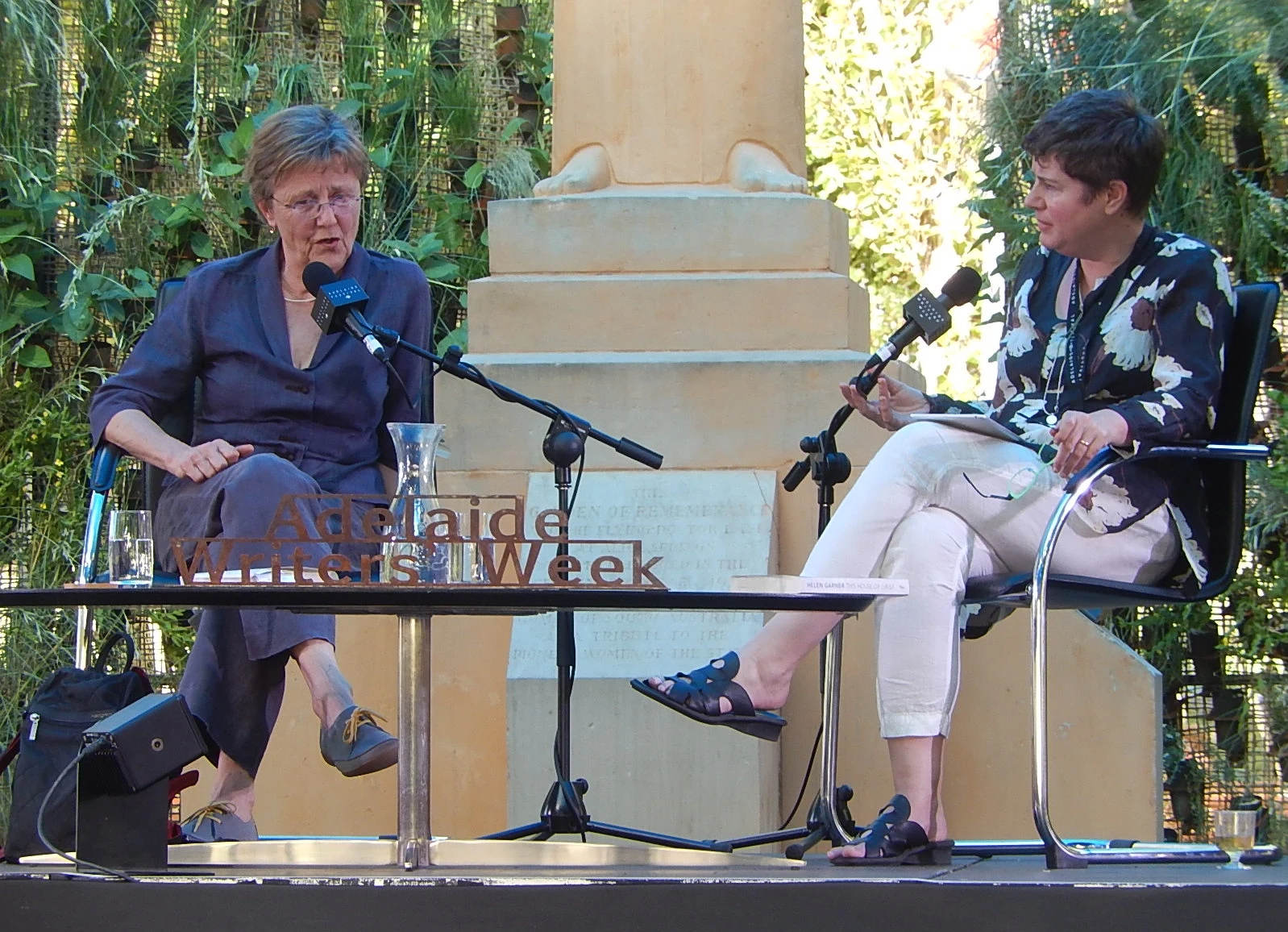
Garner’s interview explains her choice of form; the publisher and a contemporary reviewer supply the broad premise and reception. Institutional bibliography and an ISBN-specific record distinguish original publication from a later edition. Interpretive connections here are a sourced introduction, not a claim to have read the entire novel or independently verified its private-life inspirations. The 2015 festival photograph is not a scene from the story. This article was reviewed on 23 October 2026.
- Text PublishingThe Spare Room: story and paperback edition dated 28 September 2009
- Readings / Sean O’BeirneThe Spare Room: contemporary review, March 2008
- BookBrowse / Helen GarnerHelen Garner interview: The Spare Room, fiction and the narrator’s name
- National Portrait Gallery of AustraliaHelen Garner: fiction, journalism, screenwriting and books; updated 2021
- Text PublishingHelen Garner: author and current book catalogue
- Wikimedia Commons / Michael CoghlanHelen Garner at Adelaide Writer’s Week: Flickr licence review and original before later crops