In this biography
Quick facts
- Born
- 1942
- Birthplace
- Geelong, Victoria
- Country
- Australia
- Nationality
- Australian
- Known for
- Monkey Grip, The First Stone, The Spare Room, This House of Grief and published diaries
- Education
- University of Melbourne; BA in English and French, 1965
- First novel
- Monkey Grip, 1977
- Windham-Campbell Prize
- Nonfiction, 2016
- Baillie Gifford Prize
- How to End a Story: Collected Diaries, 2025
Why this life matters
Garner’s work made the observer’s involvement part of the story, inviting both literary recognition and criticism about how personal judgment shapes accounts of other lives.
Timeline
Key moments
Geelong, university and teaching
Born in Geelong, graduates in 1965 and works as a secondary teacher.
Fiction establishes a readership
Publishes Monkey Grip, The Children’s Bach and Postcards from Surfers.
Reporting and controversy
Receives a Walkley Award; The First Stone prompts arguments about feminism and journalistic practice.
Movement between forms
Joe Cinque’s Consolation, The Spare Room and This House of Grief appear in different genres.
Nonfiction and diary recognition
Receives a Windham-Campbell Prize; How to End a Story wins the 2025 Baillie Gifford Prize.
Teaching and journalism preceded the first novel
Helen Garner was born in Geelong in 1942. She graduated from the University of Melbourne in 1965 with a Bachelor of Arts, majoring in English and French, and worked as a secondary teacher between 1966 and 1972.
Writing also developed through magazines and the women’s movement. The Australian Women’s Register records her contributions to Vashti’s Voice during the 1970s. This background places her literary career within paid work, political discussion and periodical publishing, rather than beginning the story with later prizes or a first novel emerging in isolation.
Fiction grew out of close observation without becoming a transcript of life
Monkey Grip appeared in 1977 and won a National Book Council Award. Its inner-city relationships helped establish Garner’s readership, while subsequent work included The Children’s Bach and the short-story collection Postcards from Surfers. The books differ in form and scale even where they share attention to everyday exchanges.
Her proximity to the material has often raised questions about where the author ends and a narrator begins. In discussing The Spare Room, Garner insisted on the freedom fiction gave her to shape experience. Recognisable settings or an autobiographical starting point do not make every character and event a verified account of a real person.
Nonfiction brought recognition and contested judgments
Garner won a Walkley Award in 1993 for a Time article about the death of Daniel Valerio. In 1995, The First Stone examined a sexual-harassment controversy at Melbourne’s Ormond College and generated a major public argument.
That controversy was not merely a dispute over whether the prose was effective. Sydney Review of Books identifies questions about journalistic access, the author’s personal involvement, concealment of identities and the book’s political treatment of younger feminists. These criticisms belong to the history of its reception. They should not be erased by later honours, or treated as a new adjudication of every allegation involving the people discussed in the book.
Courtroom books and a return to fiction used different methods
Joe Cinque’s Consolation appeared in 2004, followed by the novel The Spare Room in 2008 and This House of Grief in 2014. The movement is not a simple abandonment of fiction for reporting: Garner continued to choose different forms for different material.
The Windham-Campbell citation discusses how This House of Grief includes the observer’s reactions alongside courtroom observation. In The Spare Room, meanwhile, a narrator called Helen cares for a dying friend. Garner’s interview explains why she chose fiction and retained that name. The genres matter when deciding what kind of factual claim a passage makes.
Diaries and collaborative reporting extended the later work
In 2016 Garner received a Windham-Campbell Prize for nonfiction. On 4 November 2025, How to End a Story: Collected Diaries won the Baillie Gifford Prize. The latter award recognised a diary volume, not a new edition of The Spare Room or an overall fiction prize.
Her later bibliography also includes The Mushroom Tapes, written with Chloe Hooper and Sarah Krasnostein and published on 11 November 2025. Joint authorship is part of that record. Across fiction, reported work and diaries, her career has continued to make the writer’s perspective visible, without removing the need to distinguish observation, memory, interpretation and independently established fact.
Quick answers
Frequently asked questions about Helen Garner
- What was Helen Garner’s first novel?
- Monkey Grip, published in 1977.
- Is The Spare Room a memoir?
- It is published as fiction. Garner has discussed the real experience behind it while explaining her decision to write a novel.
- Why was The First Stone controversial?
- Its treatment of a sexual-harassment case prompted debate about feminism, personal judgment, access to sources and journalistic practice.
- Which Garner book won the 2025 Baillie Gifford Prize?
- How to End a Story: Collected Diaries. The prize announcement is dated 4 November 2025.
Keep exploring
Lives connected to this story
- Tim Winton
Compare an Australian novelist working across fiction, younger-reader books and nonfiction, with separate histories of adaptation and recognition.
Sources and further reading
Explore the evidence
These references support the biography and offer further reading. Official records, first-person accounts and independent reporting provide different perspectives; image records document attribution and licensing.
- 1. Australian Women’s Register / Nikki Henningham and Hollie AertsGarner, Helen: education, teaching, publications and archival resources
Education and early-career passages were used. Its compressed film-credit and book-award chronologies are not adopted where the selected records do not resolve them.
- 2. National Portrait Gallery of AustraliaHelen Garner: fiction, journalism, screenwriting and books; updated 2021
This 2021 biography is used for historical publications, not a claim that its final listed book is still the newest. Later awards and joint authorship come from dated primary records.
- 3. BookBrowse / Helen GarnerHelen Garner interview: The Spare Room, fiction and the narrator’s name
- 4. Sydney Review of BooksGut instinct: This House of Grief, including The First Stone controversy
- 5. Windham-Campbell Prizes / YaleHelen Garner: 2016 nonfiction recipient
- 6. Text PublishingThe Spare Room: story and paperback edition dated 28 September 2009
- 7. The Baillie Gifford Prize for Non-FictionHelen Garner named 2025 winner for How to End a Story, 4 November 2025
- 8. Text PublishingHelen Garner: author and current book catalogue
- 9. Text PublishingThe Mushroom Tapes: joint authorship and 11 November 2025 publication
- 10. Wikimedia Commons / Michael CoghlanHelen Garner at Adelaide Writer’s Week: Flickr licence review and original before later crops
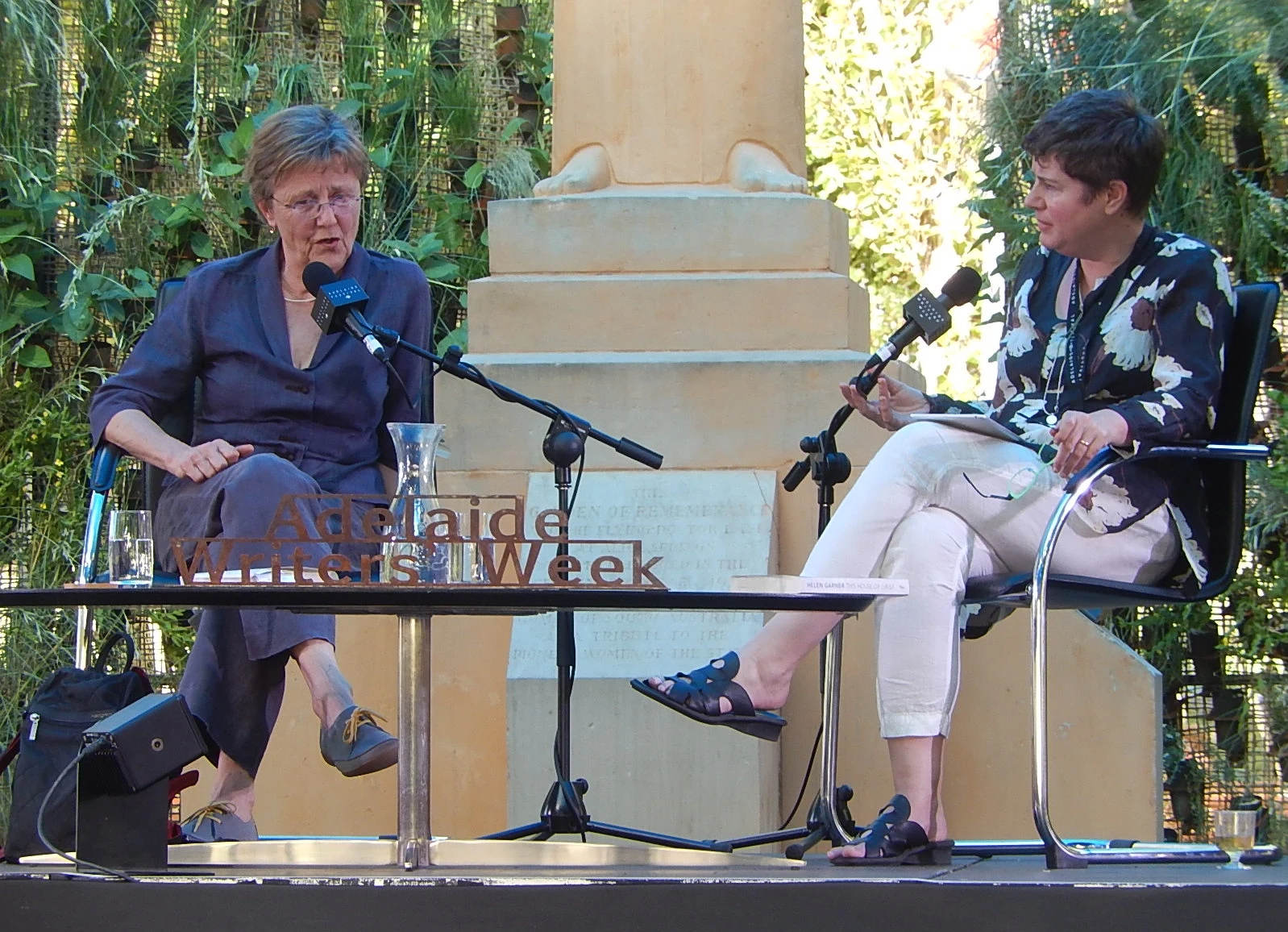
Flickr review confirms Michael Coghlan’s CC BY-SA 2.0 grant. The acquired version is the initial 1598 × 1156 upload, not the subsequent 473 × 1088 or 468 × 532 crops. Garner is on the left; the other participant is retained and not identified by guesswork.