
The short answer
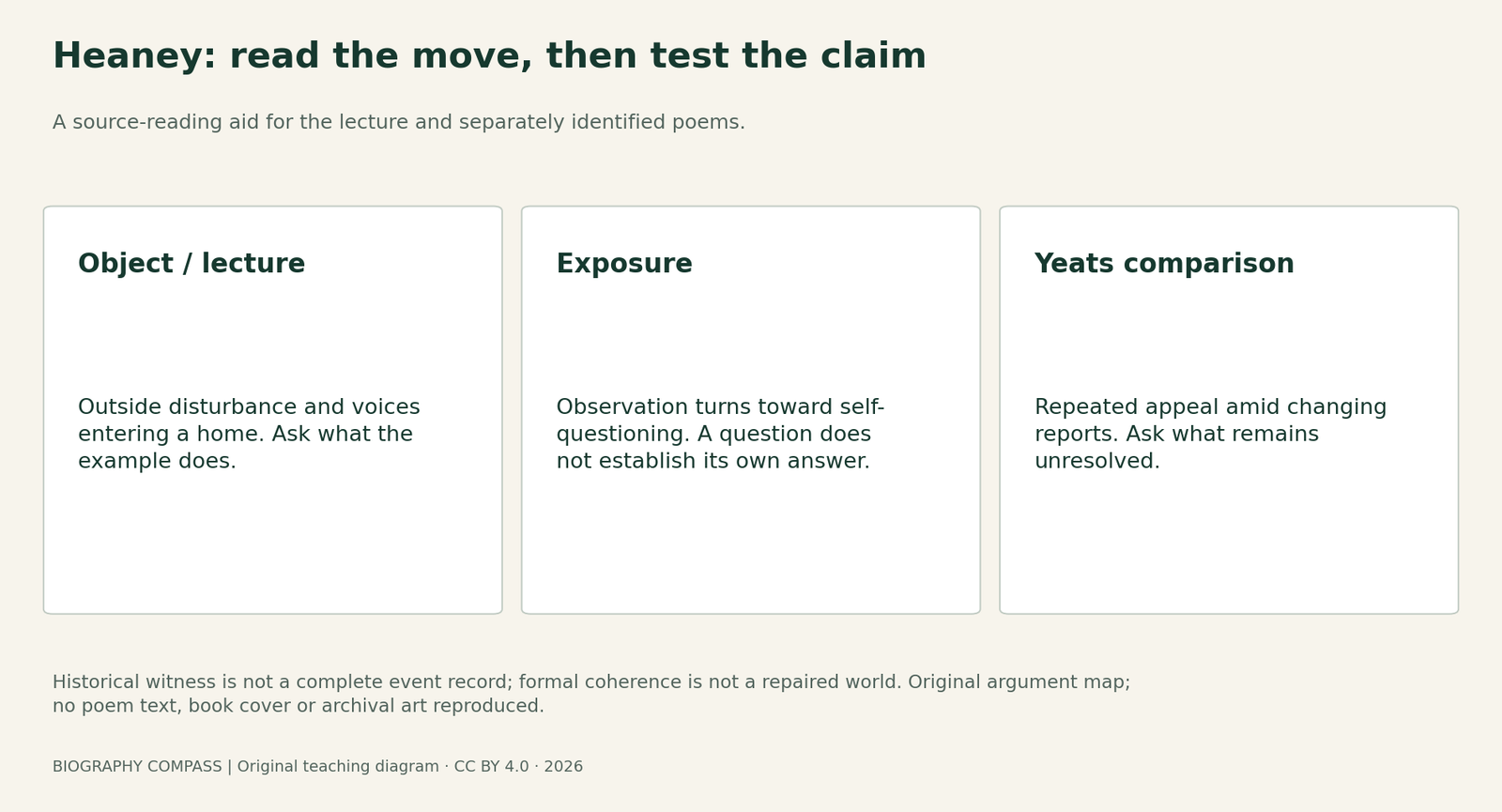
How does Crediting Poetry move from a childhood bucket and radio to an argument about poetic responsibility? Trace the function of an image, then compare two named poems without treating the lecture as a substitute for reading them.
Original evidence comparison
An object, a question and a refrain
Compare what the writing does before treating an image as a message.
| Country | Feature to inspect | Claim and limit |
|---|---|---|
| Bucket and radio | External movement and voices enter domestic space. | Supports a relation between inner life and world; does not prove a complete political theory. |
| Exposure | Landscape observation gives way to questions about obligation. | Stages uncertainty; does not establish that the author had no commitments. |
| Yeats’s nest poem | A repeated appeal persists through reports of destruction. | Makes persistence audible; does not report that civil war has ended. |
Chronology
A timeline of the turning points
The Tower
Yeats collected the civil-war meditation containing the starling’s nest poem.
North
Exposure appeared in Heaney’s collection.
Crediting Poetry
Heaney revisited public responsibility and the resources of form in his Nobel lecture.
Start with the work an object does
Heaney delivered Crediting Poetry on 7 December 1995. Its opening recalls water in a household bucket responding to a train and a radio carrying distant voices into a County Derry home. The objects are not simply decorative proofs of rural authenticity. For this reading, mark what each permits the argument to do: the bucket registers an outside disturbance, while the radio connects intimate space to a wider world. Then ask why the lecture returns to listening and pattern near its end. A useful annotation names an argumentative function, rather than merely identifying a symbol and assigning it a fixed meaning.
Sources for this section: [1]
Separate an ethical question from a demand for a slogan
The lecture considers pressure on a poet living with political violence and public expectations. It resists an easy choice between attention to suffering and the independent powers of art. To test that distinction, make two headings in your notes: what the speaker says poetry must notice, and what he says language and form can accomplish. An example belongs under both headings only if you can explain why. This procedure prevents an attractive account of consolation from becoming a claim that historical damage disappears. It also prevents an account of responsibility from becoming an instruction to endorse a party line.
Sources for this section: [1]
Read Exposure as a voice under pressure
Exposure, published in 1975, places an unsettled speaker in a winter landscape. Questions about audience and obligation interrupt attention to trees, weather and a possible celestial sign. The contrast between an imagined decisive figure and the speaker’s uncertain position makes hesitation part of the poem’s action. This is an original reading of the linked authorised text, not a biographical verdict that Heaney failed a political duty. Check the changes from looking outward to asking inward questions. A claim about indecision becomes stronger when it accounts for the order of those movements, rather than isolating one striking image.
Compare Yeats’s repeated appeal with Heaney’s questions
The Stare’s Nest by My Window, part of Meditations in Time of Civil War in The Tower, repeatedly addresses bees amid damaged masonry, insecurity and killing. Its repeated appeal continues while the surrounding statements change. In Exposure, questions expose the speaker’s instability; in Yeats, recurrence provides something the speaker can keep doing under unstable conditions. This comparison does not require deciding that one poet is hopeful and the other despairing. Both texts complicate that binary. Read for how a repeated request differs from repeated self-questioning, and for what each form allows the reader to experience before reaching a conclusion.
Treat historical witness and lyric form as different tests
A poem can make violence perceptible without serving as a complete record of an event. A formal pattern can offer coherence without proving that the world has become coherent. Those are two useful tests generated by reading these texts together. For each interpretive sentence, identify which test it addresses. If you claim that a poem bears witness, specify the experience or image made visible. If you claim that its form steadies a reader, identify a repeatable feature of the text. Avoid converting a formal effect into an empirical claim about how all readers respond or how political change actually occurred.
Original exercise: challenge a proposed reading
Consider this newly written claim: Heaney begins with homely objects to escape history, Exposure proves that poetry has no public value, and Yeats resolves civil war by imagining a peaceful natural community. Write three short corrections. Each should name a feature of the relevant text, explain how it bears on the proposed claim and state what your evidence cannot establish. Then add one sentence describing a connection among the texts without using any quoted line. The task is an argument audit, not a request to reproduce a poem or guess what the author would have said about a later conflict.
Reference answer: preserve the difficulty
The radio brings distant events into the opening household; it cannot support an uncomplicated story of escape. Exposure’s questions stage pressure on the speaker, but a question does not establish a universal conclusion about the worthlessness of poetry. Yeats’s appeal recurs alongside violence rather than reporting that violence has ended. A defensible connection is that attention, questioning and repetition can keep perception active when certainty is unavailable. Other readings are possible if they explain the same textual features. None of these corrections makes the works historical surveys, and none requires claiming that a poem repairs the political conditions it confronts.
Continue the chronology
Related history guides
How Did Field Day Begin in 1980?
Follow the records behind a theatrical institution, language convention and first production.
Read the timeline1960–2010The Country Girls: Ban and Evidence
Practice distinguishing publication and reception from the terms of a historical legal order.
Read the timelineBiography context
Explore Ireland through connected lives
Connected biographies
Writers and cultural institutions
1939–2013
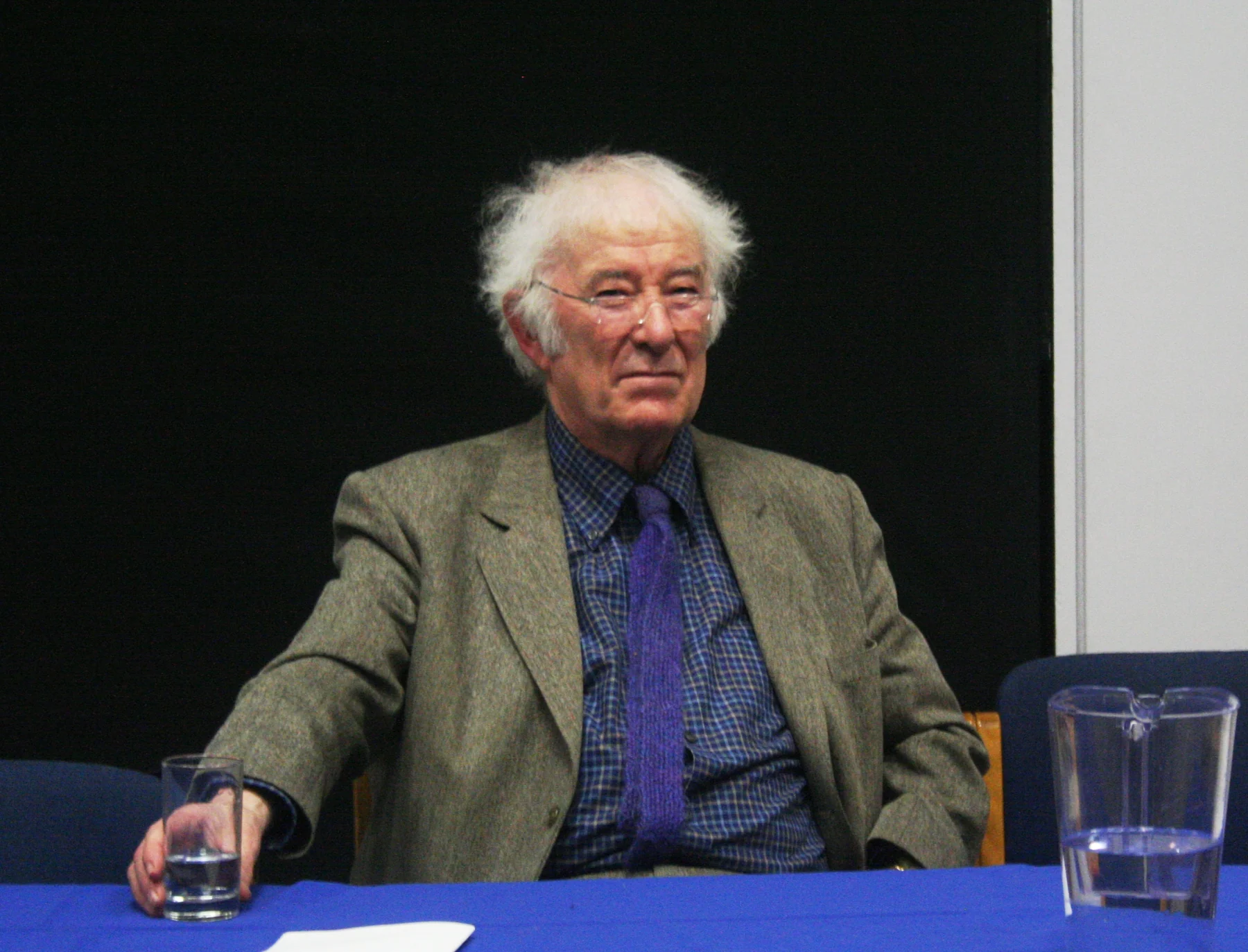
Seamus Heaney
Poet, translator, critic and teacherSeamus Heaney made rural memory, the sound of language and the pressures of history central to an international literary career. His poetry developed alongside criticism, translation, teaching and collaboration in Irish cultural institutions.Read biography1944–2020
Eavan Boland
Poet, essayist, editor and teacherEavan Boland combined poetry and critical prose with decades of teaching. Her work challenged inherited ways of representing women, while her institutional career made room for new writers in Ireland and at Stanford.Read biographyQuick answers
Common questions
- Is this a summary of all Heaney’s poetry?
- No. It is a reading exercise focused on the 1995 lecture, Exposure and Yeats’s named poem. It does not replace the linked texts.
- Does the guide independently verify the lecture’s historical anecdotes?
- No. They are treated as parts of Heaney’s 1995 argument, not as independently established event histories.
Primary and institutional sources
How this history was checked
Read the linked original texts and institutional records alongside the evidence limits below. The comparison, exercise and figure are original teaching aids; literary works and archival artwork are not reproduced. This article was reviewed on 27 October 2026.
- Seamus Heaney; Nobel FoundationCrediting Poetry: Nobel Lecture, 7 December 1995
- Seamus Heaney; Arts Council of Northern Ireland, Troubles ArchiveExposure, published 1975: authorised poem text
- W. B. Yeats; Scottish Poetry LibraryThe Stare’s Nest by My Window, from The Tower 1928
- Nobel FoundationSeamus Heaney: Bibliography