In this biography
Quick facts
- Born
- 13 April 1939
- Died
- 30 August 2013
- Birthplace
- Mossbawn, County Derry, Northern Ireland
- Country
- Ireland
- Nationality
- Not independently established
- Known for
- Death of a Naturalist, North, Beowulf and the 1995 Nobel Prize in Literature
- First major collection
- Death of a Naturalist, 1966
- Nobel Prize
- Literature, 1995
- Translation
- Beowulf, 1999
- Final lifetime collection
- Human Chain, 2010
Why this life matters
Heaney gave a sustained account of how a poem can attend to violence and public responsibility while preserving imaginative freedom and formal precision.
Timeline
Key moments
Mossbawn
Born on 13 April in rural County Derry.
University and teaching qualification
Completed his Queen’s degree and then teacher training.
Death of a Naturalist
Faber published his first major collection.
Move to Wicklow
Left his Queen’s lectureship and moved with his family to Glanmore.
International teaching
Began regular Harvard teaching; elected Oxford Professor of Poetry in 1989.
Nobel lecture
Delivered Crediting Poetry on 7 December.
Death
Died on 30 August.
A rural childhood met the opportunities of education
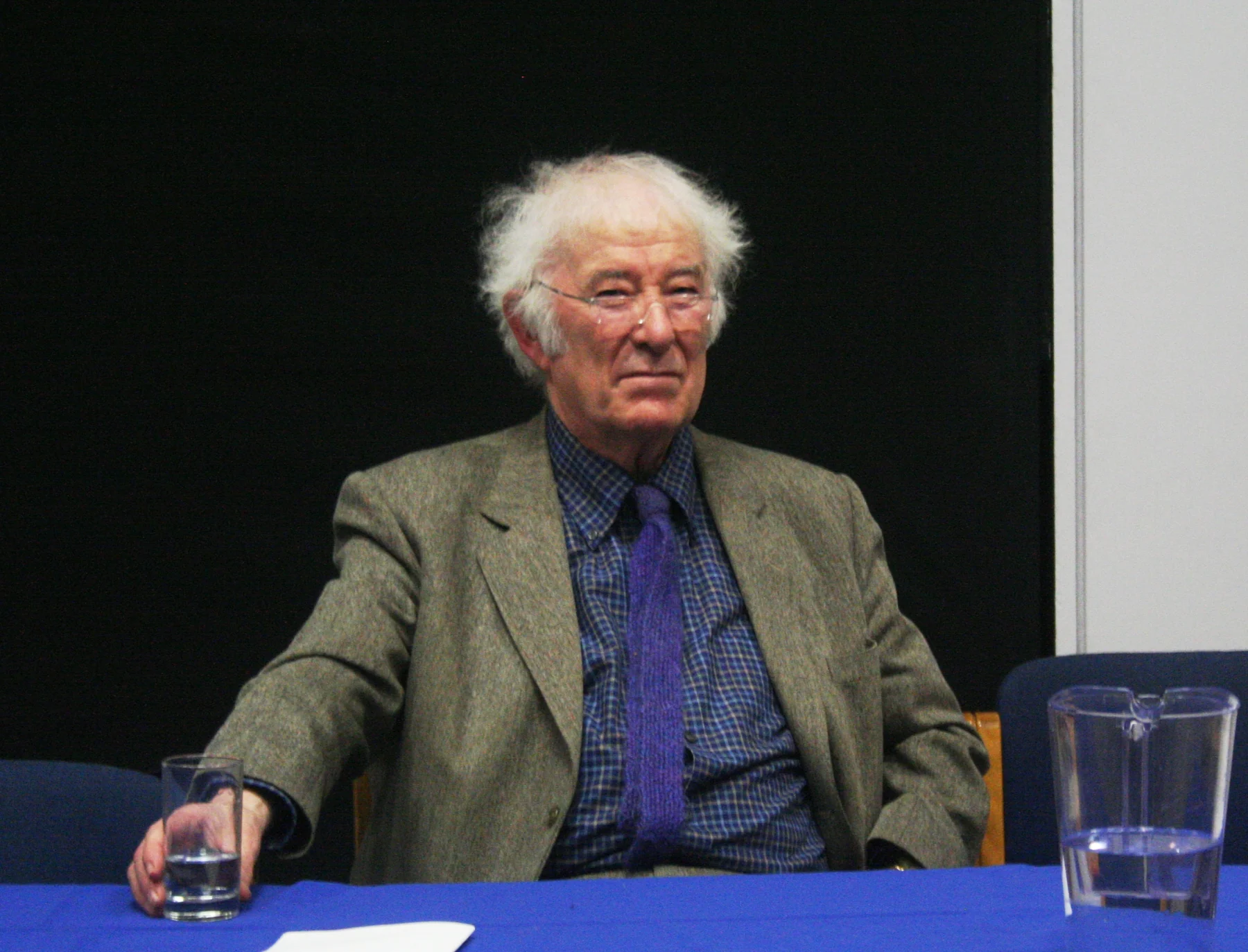
Seamus Heaney was born on 13 April 1939 and grew up at Mossbawn in County Derry, the eldest of nine children. His father combined farming with cattle dealing, while his mother’s family had connections with the linen industry. A scholarship took him to St Columb’s College in Derry in 1951. He studied English at Queen’s University Belfast and then trained as a teacher. These moves joined close knowledge of farm work and household speech to sustained reading. The childhood material later entered his poems through selection and craft, rather than as an unmediated record of country life.
A poet developed among other writers
Heaney’s early career belonged to an active Belfast literary environment, not an isolated discovery of talent. The Nobel biographical account places his emergence beside poets including Michael Longley and Derek Mahon. He became a lecturer at Queen’s in 1966, the year Faber published Death of a Naturalist. That collection gave an unusually prominent place to remembered labour, family relationships and sensory experience. Its publication can be dated from the bibliography; its imaginative work cannot be reduced to a list of events in the author’s childhood. The relation between lived material and poetic form remained a continuing concern.
Family life and teaching shaped the conditions of writing
He married Marie Devlin in 1965, and they had three children. After a visiting year at Berkeley, he left his Queen’s lectureship in 1972 and moved to Glanmore in County Wicklow. The family later settled in Dublin. He taught at Carysfort College before beginning a regular arrangement with Harvard in 1982; the Oxford poetry professorship followed in 1989. These positions provided both an audience and working conditions for poems and essays. The estate also stresses Marie’s place in their shared life, an essential correction to a career narrated solely through individual prizes and appointments.
Collections and translations made different demands
The bibliography marks a changing sequence: North in 1975, The Spirit Level in 1996, and Human Chain in 2010. Alongside poetry, Heaney produced criticism and translated works from other literary traditions. His Beowulf appeared in 1999, while The Redress of Poetry collected Oxford lectures in 1995. A translation, an essay and a lyric collection should not be treated as interchangeable achievements. Each involves a different relation to inherited language and to readers. Following those forms across the career offers a better starting point than assuming that a rural subject fixed his range permanently.
Sources for this section: [3]
Cultural participation accompanied the poems
Heaney worked with Field Day, the company founded by Brian Friel and Stephen Rea. His version of Sophocles’ Philoctetes became The Cure at Troy, produced in 1990. The Nobel lecture of 1995 made public responsibility an explicit question: how could poetry register historical suffering without giving up its own resources? His discussion moves through memories, objects and named literary examples. That public argument belongs beside his practical contribution to theatre and teaching. It shows a writer considering how art enters civic life, without claiming that a poem can itself settle a conflict or replace political institutions.
An archive keeps attention on work in progress
Heaney died on 30 August 2013. The National Library catalogue preserves a different kind of evidence from a completed book: manuscript and annotated typescript drafts associated with Death of a Naturalist. The catalogue identifies material available for further study; it does not by itself establish every stage of revision. Such records direct attention back to labour, choice and alteration. His legacy includes widely read books and public honours, but also models of teaching, translation and critical argument. The most productive way to approach it is to read particular works closely while keeping their dates, forms and documentary histories distinct.
Quick answers
Frequently asked questions about Seamus Heaney
- Was Heaney only a poet of rural childhood?
- His bibliography includes later collections, criticism, translations and theatre work. Rural memory was an enduring resource within a much wider career.
Keep exploring
Lives connected to this story
- Brian Friel
Read the playwright and Field Day cofounder with whom he worked.
- Edna O’Brien
Read the novelist whose lifetime-achievement award Heaney presented in 2009.
Sources and further reading
Explore the evidence
These references support the biography and offer further reading. Official records, first-person accounts and independent reporting provide different perspectives; image records document attribution and licensing.
- 1. Estate of Seamus HeaneyLife and Legacy
Read early life, family, Glanmore and international work passages; rural birthplace and 13 April date supported.
- 2. Nobel FoundationSeamus Heaney: Biographical, supplied for the Nobel Prize
Read the supplied biographical text, including teaching, family and Field Day. Its 1995 perspective is not treated as current reporting; Stephen Rea’s name is corrected against company records.
- 3. Nobel FoundationSeamus Heaney: Bibliography
Original bibliography successfully retrieved as HTML via Node after web 403. Named collection and translation entries read.
- 4. Seamus Heaney; Nobel FoundationCrediting Poetry: Nobel Lecture, 7 December 1995
Read the opening objects/radio argument, responsibility and Exposure passages, roadside narrative, St Kevin discussion, Yeats comparison and conclusion. No poem reproduced.
- 5. National Library of IrelandManuscript and annotated typescript drafts, Death of a Naturalist
Indexed catalogue description read; live catalogue returned 403. Draft manuscripts themselves were not accessed.
- 6. RTÉ ArchivesDeath of Seamus Heaney: 30 August 2013 broadcast record
Broadcast catalogue text read for death date; no claim to viewing the video.