
The short answer
How can a researcher establish that a particular novel was banned while avoiding claims that only its original order could prove? Read publication, administrative procedure, later registers and literary reception as separate bodies of evidence.
Original evidence comparison
Four documents, four different questions
A reliable account connects records without making one stand in for all the others.
| Country | Question answered | Limit |
|---|---|---|
| Publication record | Which work, publisher and first publication year? | A catalogue is not the prohibition order or full novel. |
| Government announcement | Was this named debut banned? | Does not give the order’s complete terms or procedural history. |
| Enacted legislation | What general procedure and powers did the historical statute describe? | Does not prove which steps occurred in the particular case. |
| 2010 register | What did the official register report at that later date? | Absence cannot establish that a historical ban never existed. |
Chronology
A timeline of the turning points
Publication and prohibition
Library and government records identify the debut and its ban.
Expiry framework changes
The enacted amendment supplies rules for certain orders; it does not itself narrate this title’s case.
Register snapshot
The Board’s published register describes its state at 31 December.
Archive acquisition
The NLI acquired further later-career manuscripts and correspondence.
Begin with a specific book and edition
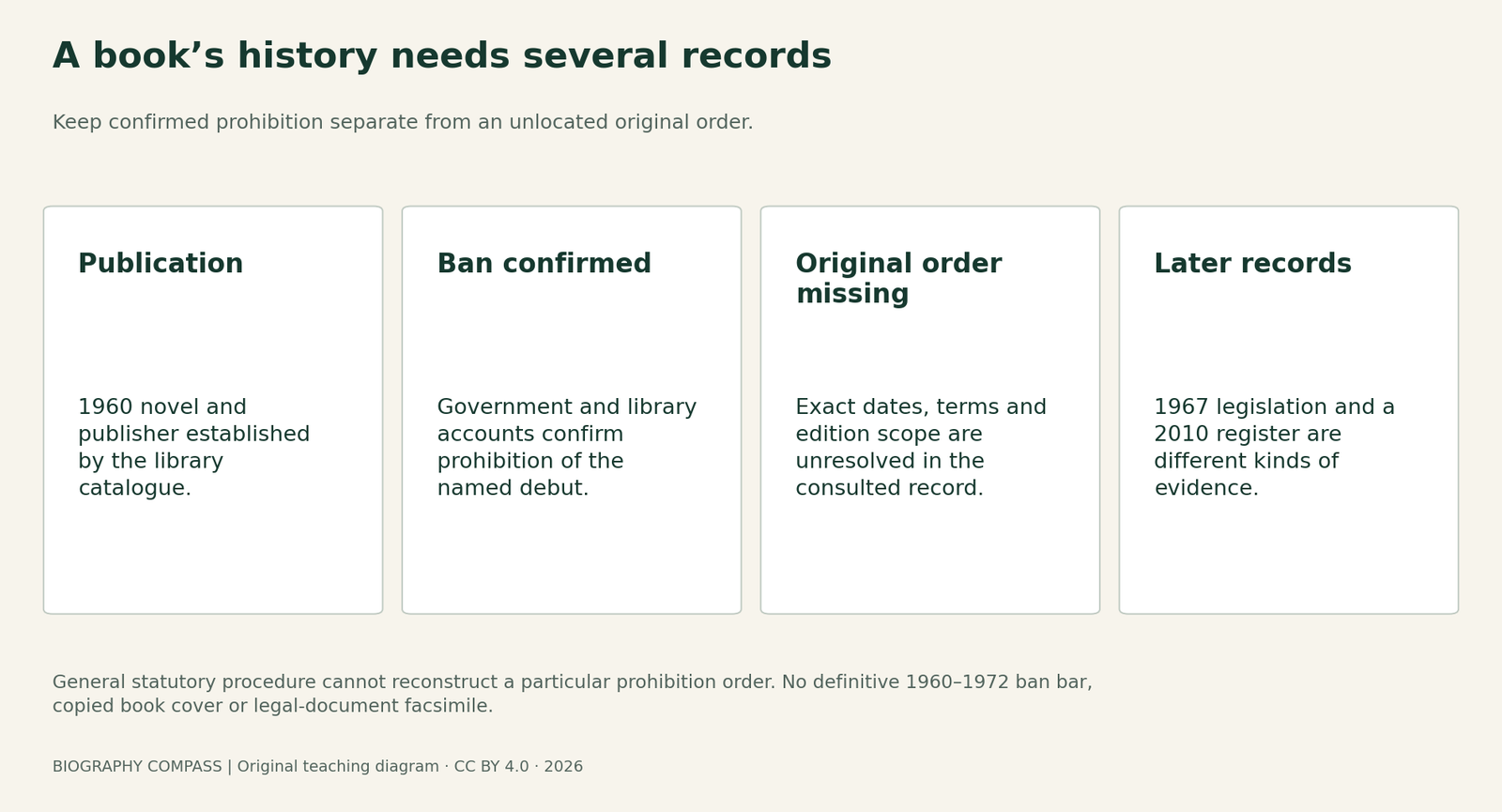
The NLI catalogue identifies The Country Girls as originally published by Hutchinson in London in 1960. Its record describes a later edition, so the reprint’s date must not replace the first publication date. A 2021 government archive announcement explicitly records the novel’s Irish ban and the controversy around its treatment of women’s sexuality. These records support a restrained account of publication and prohibition. They do not reproduce the original order. The distinction matters because the name The Country Girls can refer to the first novel or, in later editions, to the trilogy containing it. Specify the object before drawing conclusions.
Read the historical procedure in the enacted law
The 1946 Censorship of Publications Act provides a relevant historical framework. Sections 6 and 7 address examination and prohibition; section 8 provides for appeals. The text describes matters the Board was to consider, including literary merit and likely readership. It therefore supplies a procedure and powers, not a verdict about O’Brien’s particular novel. Read the words naming the decision-maker, the action and the relevant publication before attaching a historical claim to them. These are observations about the statute as enacted. They are not a statement of present law, legal advice or a reconstruction of an unaccessed Board discussion.
Sources for this section: [4]
An order is a further link in the evidence chain
Sections 13 and 16 of the 1946 Act distinguish publication in Iris Oifigiúil from the making and registration of an order. The register was to identify a book, relevant editions, author, publisher and dates. The original Country Girls order or contemporaneous register entry was not located during this bounded research. Consequently this guide does not give an exact effective date, order number or edition scope. General statutory powers cannot fill those gaps. Nor does the legislation establish who complained about this particular book. A claim about a named complainant would need a complaint, correspondence or another directly relevant record.
Sources for this section: [4]
Later reforms and registers have their own dates
Section 2 of the 1967 Act provided for the expiry of certain indecency or obscenity orders after a specified twelve-year period, with transitional provisions; the Act also allowed further orders. This does not establish a particular title’s complete administrative history. The Board’s register correct to 31 December 2010 says no books remained prohibited solely for indecency or obscenity in its first part, while listing other categories separately. It is a snapshot of that register at that date. The absence of an older novel cannot prove that the novel had never been banned, and it does not identify which intervening event removed its entry.
Reception and fiction require different kinds of reading
In her 1984 interview, O’Brien discussed the emotional relationship between her own experience and her first novel while retaining the importance of style and narrative. That account helps resist a second evidential shortcut: assuming that a character’s words are the author’s confession. The government and library’s later archive accounts show how a once controversial writer entered institutional collections. The shift is significant, but a commemorative announcement is not the same document as a prohibition order, and preservation is not a complete history of reception. Reading the novel itself remains necessary for sustained claims about its language, structure or characters.
Original exercise: repair a museum label
This newly written label says: In 1960 Ireland banned O’Brien’s entire body of writing forever, criminalised every act of reading it and thereby proved what the novel meant. Identify four unsupported jumps. Then design a source list for a corrected label: one record for publication, one for confirmation of the novel’s ban, one for the historical mechanism and one still-needed record for the specific order. Finally explain why the 2010 register cannot by itself supply the missing 1960 details. Do not calculate a precise expiry date from the general twelve-year rule without the order and any later administrative changes.
Reference answer: make the claim as specific as its evidence
The library establishes a 1960 Hutchinson novel; the government confirms that novel’s ban. Neither record establishes a blanket prohibition of everything O’Brien ever wrote. The historical statutory provisions concerning sale and distribution do not support the label’s sweeping statement about every act of reading. A legal classification cannot settle a literary interpretation. The order or contemporaneous register entry remains necessary for its particular terms and dates, and later changes would require their own records. A defensible short label names the novel, publisher and year, records the ban, explains the source limit and directs readers to separate literary study of the work.
Continue the chronology
Related history guides
Biography context
Explore Ireland through connected lives
Connected biographies
Writers and cultural institutions
1930–2024
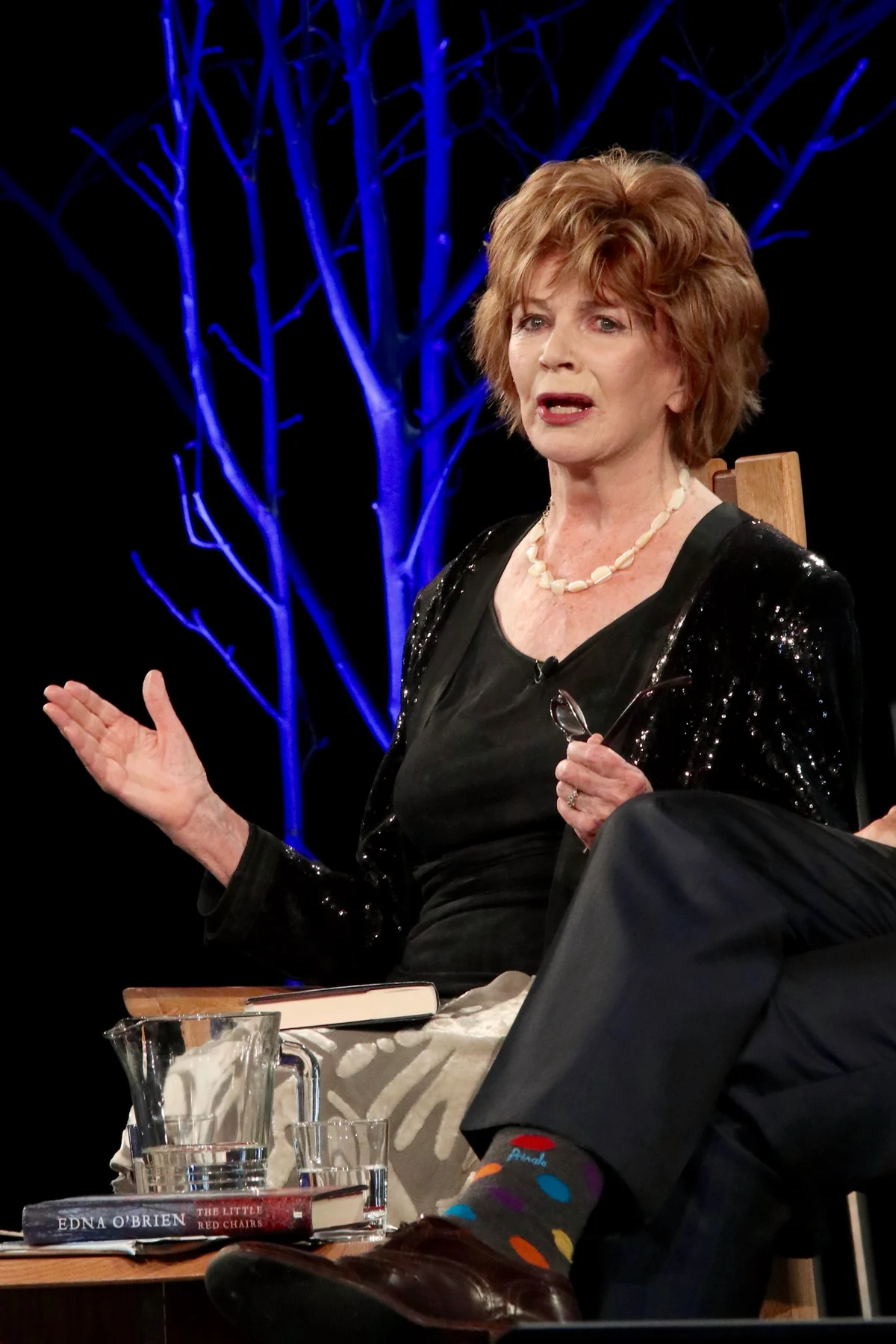
Edna O’Brien
Novelist, short-story writer, memoirist and playwrightEdna O’Brien wrote fiction, memoir, biography and drama across more than six decades. The Country Girls made women’s experience central to an early controversy, but her career continued through new subjects, forms and painstaking revision.Read biography1944–2020
Eavan Boland
Poet, essayist, editor and teacherEavan Boland combined poetry and critical prose with decades of teaching. Her work challenged inherited ways of representing women, while her institutional career made room for new writers in Ireland and at Stanford.Read biographyQuick answers
Common questions
- Was the original 1960 prohibition order read?
- No. Government and library evidence confirms the novel’s ban, while the missing original order limits claims about exact dates, editions and procedural steps.
- Does the 2010 register describe the law or register today?
- No. It is explicitly correct to 31 December 2010 and is used only as a dated historical record.
Primary and institutional sources
How this history was checked
Historical statutes are read as enacted, alongside library and government records. The original title-specific prohibition order was not located. The comparison and exercise are original teaching aids, not current legal advice or a substitute for the novel. This article was reviewed on 27 October 2026.
- National Library of IrelandThe country girls: catalogue record noting original Hutchinson 1960 publication
- Government of Ireland; Department of CultureAcquisition of Edna O’Brien’s Papers, 2009–2021
- The Paris ReviewEdna O’Brien, The Art of Fiction No. 82, interviewed by Shusha Guppy, Summer 1984
- Oireachtas; electronic Irish Statute BookCensorship of Publications Act 1946, as enacted, sections 6–8,13–16
- Oireachtas; electronic Irish Statute BookCensorship of Publications Act 1967, No.15, as enacted, sections 2–4
- Censorship of Publications Board; copy preserved by Index on CensorshipRegister of Prohibited Publications, correct to 31 December 2010
- National Library of IrelandNational Library mourns the passing of Edna O’Brien, 29 July 2024