
The short answer
Why was predicting residue-distance distributions different from experimentally determining a protein structure?
Read the evidence
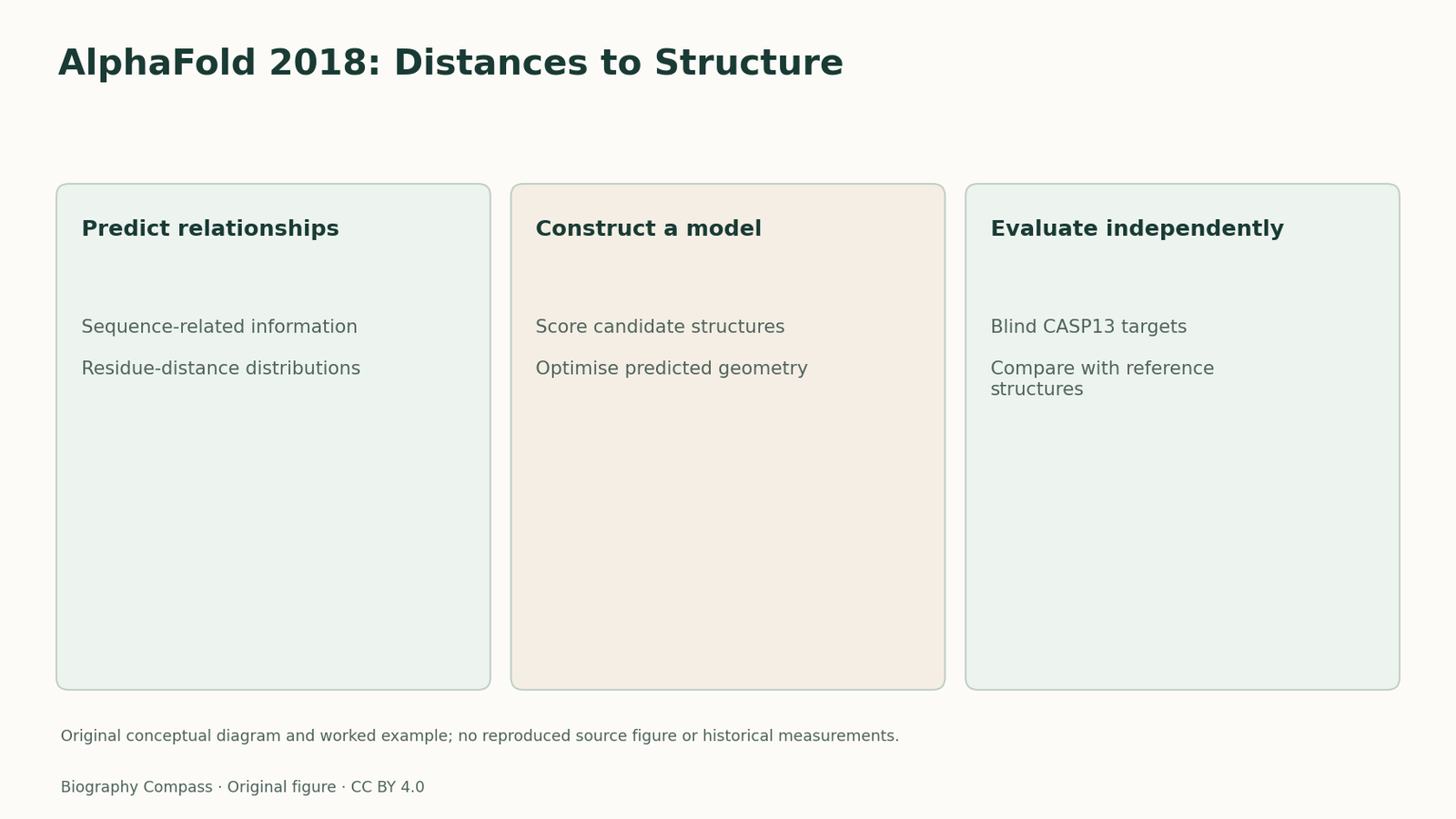
Prediction inputs and evaluation outputs
The original system’s predicted geometry and the blind assessment served different purposes.
| Record or test | What it establishes | What remains different |
|---|---|---|
| Predicted distance distributions | Constrain candidate molecular arrangements. | Are not direct experimental distances. |
| Structure optimisation | Finds a model compatible with a scoring framework. | Does not independently validate its own predictions. |
| CASP13 comparison | Tests submitted models against reference structures. | Is distinct from the later 2020 publication date and 2021 architecture. |
The original AlphaFold answered a prediction problem
AlphaFold’s CASP13 work in 2018 addressed the relationship between an amino-acid sequence and a protein’s three-dimensional structure. The corresponding paper appeared in 2020. The dates refer to different events: a blind assessment and a later publication. The system predicted distributions of distances between pairs of residues, providing more information than a simple indication that two residues were near each other. Those predicted relationships helped guide the construction of a candidate structure.
Sources for this section: [3]
A distance distribution is not a ruler reading
The team’s contemporary account explains that predicted distances and angles contributed to scoring candidate structures. Optimisation then searched for structures compatible with those predictions. The distances were therefore computational outputs inferred from available information, not measurements made by an instrument inside the target protein. This distinction does not reduce their usefulness. It identifies the kind of record they are and explains why the programme still required evaluation against independently determined structures.
Sources for this section: [5]
A blind assessment provides a separate comparison
The primary abstract describes CASP13 as a blind assessment and reports performance against reference structures. The value of that arrangement is that a submitted model can be evaluated against a target answer that was not available to the predictor. It tests predictive performance more meaningfully than agreement with the system’s own scoring function. The original AlphaFold should also be distinguished from the substantially different 2021 system. A history that combines their methods into one undated algorithm obscures what each research stage actually contributed. The evaluation asks whether a model matches an independently established target, rather than whether its picture appears plausible to an observer.
An original geometry exercise
Imagine three points representing residues in a simplified teaching model. One proposal places every pair close together; another allows one pair to be farther apart. A binary contact list may leave more ambiguity than separate distance ranges for the three pairs. Which record supplies the richer geometric constraint? The distance ranges do, but they remain predictions until compared with an independent structure. Now suppose a candidate perfectly satisfies its own predicted ranges. That internal consistency is useful, yet it does not prove that the predictions match the real protein. This original exercise uses no protein coordinates or historical performance figures. It separates the information used to build a model from the evidence used to evaluate it.
Continue the chronology
Related history guides
Top7 2003: Designing and Testing a Fold
Follow Top7 from a designed sequence to experimental folding evidence and an X-ray structure, with a worked exercise separating design from validation.
Read the timeline2021AlphaFold 2: Confidence and Accuracy
Read AlphaFold2’s local confidence scores alongside experimental accuracy, with a worked exercise on strong domains, uncertain linkers and model interpretation.
Read the timelineBiography context
Explore United Kingdom through connected lives
Connected biographies
Researchers and related approaches
1976–
Demis Hassabis
Artificial-intelligence researcher and DeepMind co-founderDemis Hassabis moved through computer games, cognitive neuroscience and artificial-intelligence research before helping lead the team behind AlphaFold.Read biography
1912–1954
Alan Turing
Mathematician, cryptanalyst and computing researcherAlan Turing investigated what a rule-following machine could compute, helped British wartime cryptanalysis and later worked on practical computing and biological pattern formation. His career connects mathematical limits, collaborative engineering and the damage caused by criminalising homosexuality.Read biographyQuick answers
Common questions
- Was the original AlphaFold paper published in 2018?
- Its CASP13 assessment took place in 2018; the detailed Nature paper was published in January 2020.
- Is a predicted residue distance an experimental measurement?
- No. It is a computational estimate used to construct and assess a model; experimental structures provide a separate comparison.
Primary and institutional sources
How this history was checked
The 2020 publication and its institutional abstract record describe the 2018 assessment. The team’s earlier explanation clarifies how predicted geometry was used. This article was reviewed on 7 November 2026.
- Academia EuropaeaDemis Hassabis: curriculum vitae
- The Royal SocietyDemis Hassabis: fellowship biography
- Senior and colleagues / NatureImproved protein structure prediction using potentials from deep learning
- UCL DiscoveryImproved protein structure prediction: accepted-manuscript abstract record
- Google DeepMindAlphaFold: Using AI for scientific discovery
- Nobel Prize OutreachDemis Hassabis — Facts