
The short answer
What do AlphaFold confidence scores estimate, and why are they not a laboratory validation of function?
Read the evidence
Three questions about a protein model
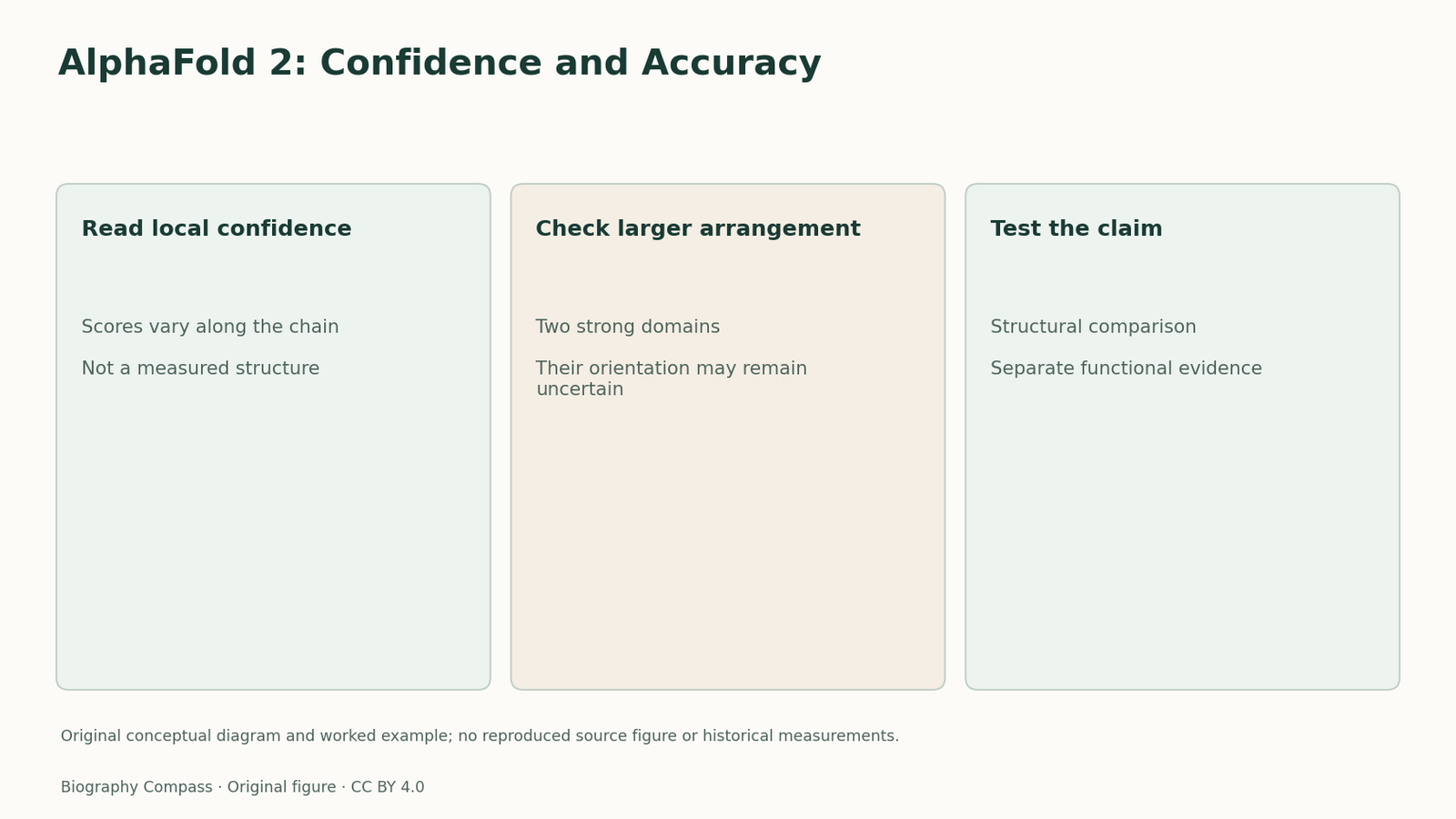
Local prediction, overall arrangement and biological function should be assessed separately.
| Record or test | What it establishes | What remains different |
|---|---|---|
| Local confidence | Estimates reliability around individual residues. | Does not guarantee domain-to-domain orientation. |
| Experimental structural agreement | Compares a prediction with an independently determined structure. | Is not identical to the model’s confidence estimate. |
| Functional evidence | Tests a proposed biological role or interaction. | Cannot be inferred from confidence colouring alone. |
A predicted structure comes with uncertainty
The 2021 AlphaFold2 paper reported substantial improvements in protein-structure prediction. An important part of using such a model is reading its confidence information rather than treating every visible segment as equally reliable. A rendered protein chain can look continuous even when the system has very different confidence in neighbouring regions. The scientific question is therefore not only whether a model was produced, but which aspects of its geometry are supported by the prediction and what independent comparisons can test them.
What pLDDT describes
The predicted local distance difference test, or pLDDT, is a per-residue confidence measure on a scale from 0 to 100. It estimates agreement with local experimental structure rather than reporting a laboratory measurement. The EMBL-EBI training material explains that low values can reflect insufficient predictive information or regions that are naturally flexible or disordered. Those possibilities matter because an uncertain segment should not automatically be interpreted as a failed rigid structure. The score describes a model’s local confidence, not a direct observation of a protein’s behaviour.
Local confidence is different from domain placement
High confidence within two domains does not guarantee confidence in their orientation relative to each other. The training material explicitly distinguishes local structure from larger-scale arrangement. AlphaFold provides additional measures for other aspects of uncertainty, but no confidence colour by itself establishes biochemical function. This is why a proposed binding mechanism needs more than a visually convincing model. Structural confidence, agreement with experimental geometry and evidence for a functional claim remain related questions with different endpoints.
An original two-domain exercise
Imagine a fictional prediction containing two well-formed domains joined by a low-confidence linker. A student writes that the entire molecule is a single rigid assembly because both domains look precise. What should be checked? First, separate confidence within each domain from confidence in their relative arrangement. Second, consider whether the linker’s uncertainty could reflect flexibility rather than a fixed shape that the system failed to draw. Finally, ask what evidence supports any proposed biological interaction. The supported answer is that strong local predictions do not settle every large-scale or functional claim. This exercise uses no real protein coordinates and no invented AlphaFold score values; it teaches how to read different kinds of uncertainty without turning confidence into experimental proof.
Continue the chronology
Related history guides
AlphaFold 2018: Distances to Structure
Explore the original AlphaFold’s residue-distance predictions and CASP13 assessment, distinguishing a computed model from an experimental structure.
Read the timeline2003Top7 2003: Designing and Testing a Fold
Follow Top7 from a designed sequence to experimental folding evidence and an X-ray structure, with a worked exercise separating design from validation.
Read the timelineBiography context
Explore United Kingdom through connected lives
Connected biographies
Researchers and related approaches
1985–
John Jumper
Computational researcher and AlphaFold developerJohn Jumper moved from physics into computational chemistry and helped develop the AlphaFold system that transformed the accuracy of protein-structure prediction.Read biography
1918–2013
Frederick Sanger
Biochemist and sequencing-method researcherFrederick Sanger developed ways to determine the order of components in proteins and nucleic acids. His two chemistry Nobel Prizes mark different stages of a research career whose continuity was the problem of sequence and whose methods depended on many collaborators.Read biographyQuick answers
Common questions
- Does a high pLDDT prove function?
- No. It concerns predicted local structural reliability, while a functional claim needs appropriate independent evidence.
- Must a low-confidence linker be a rigid structure predicted incorrectly?
- No. Low confidence can also be associated with genuine flexibility or intrinsic disorder.
Primary and institutional sources
How this history was checked
The 2021 primary paper provides the prediction framework; the openly licensed EMBL-EBI material explains local confidence and its limits. The exercise is newly written. This article was reviewed on 7 November 2026.
- University of Chicago Data Science InstituteJohn Jumper: education and research profile
- University of ChicagoHow an accidental chemist honed his approach at UChicago on the way to a Nobel Prize
- Jumper and colleagues / NatureHighly accurate protein structure prediction with AlphaFold
- EMBL-EBI Training, with Google DeepMindpLDDT: Understanding local confidence
- Tunyasuvunakool and colleagues / NatureHighly accurate protein structure prediction for the human proteome
- Nobel Prize OutreachJohn Jumper — Facts