
The short answer
Harvard Business School existed before George Fisher Baker’s major gift. The school began in 1908; the five-million-dollar gift belongs to 1924. The historical question is therefore how a donation changed an established institution’s physical and financial possibilities. A contemporary newspaper report, an archival finding aid and a building inventory describe different stages. Their dates can be placed in sequence rather than collapsed into a single “founding.” This comparison clarifies the respective roles of donor, university decision-makers, architects and the people who used the completed campus.
A worked comparison
What each part contributes
Use the specific distinctions developed in the study.
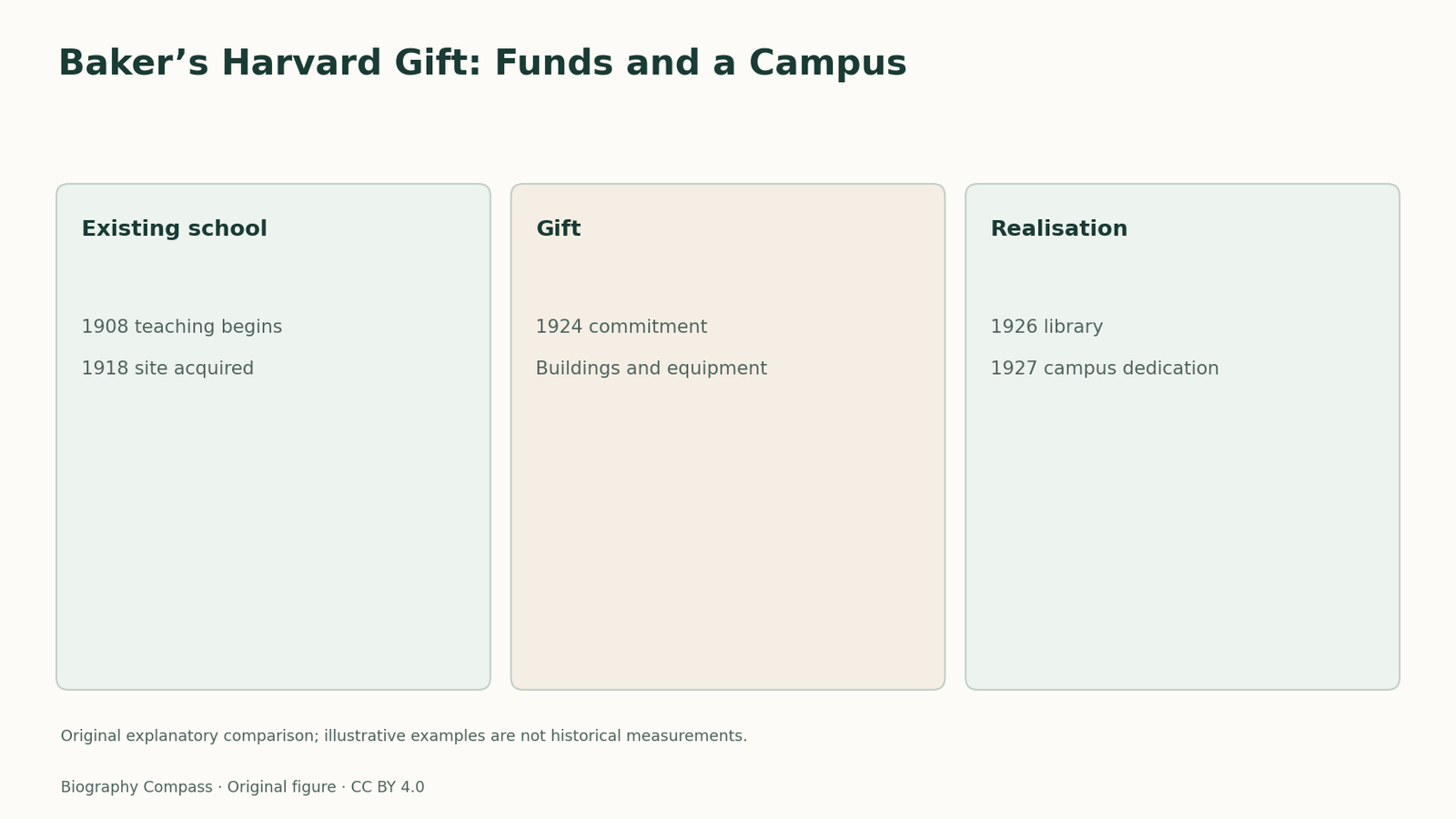
| Part or record | What it establishes | Why the distinction matters |
|---|---|---|
| 1908 school | Institution already established | Not founded by the 1924 gift |
| 1924 gift | Accepted building programme | Funding commitment |
| 1926/1927 | Library construction/campus dedication | Different physical and ceremonial milestones |
Did Baker found the business school?
Harvard Business School existed before George Fisher Baker’s major gift. The school began in 1908; the five-million-dollar gift belongs to 1924. The historical question is therefore how a donation changed an established institution’s physical and financial possibilities. A contemporary newspaper report, an archival finding aid and a building inventory describe different stages. Their dates can be placed in sequence rather than collapsed into a single “founding.” This comparison clarifies the respective roles of donor, university decision-makers, architects and the people who used the completed campus.
What the contemporary announcement authorised
The Crimson’s 2 June 1924 report places the gift on 23 April and reproduces the Corporation’s acceptance. The stated programme included an administration building, library, other necessary buildings, equipment and furnishings. It described a permanent foundation for the school’s work. That gives specific evidence about the intended use of the money. It does not say that every dollar was an unrestricted endowment invested forever, nor that a new university or school was created by the donation. Reading the governing body’s resolution is more useful than inferring a legal structure from the word “foundation.”
Sources for this section: [3]
Planning and building are separate stages
The Harvard planning inventory dates acquisition of the site to 1918 and construction of Baker Library to 1926. The gift thus entered an institutional planning history already in progress. McKim, Mead & White supplied architectural work; the university determined educational and administrative needs. A building’s construction year answers a narrower question than a whole campus’s dedication. The distinction matters when interpreting photographs and anniversary claims: a building can be substantially constructed before an event ceremonially marks the completion or opening of a larger programme.
What the archive can establish
The Baker family papers finding aid dates the campus dedication to 4 June 1927 and identifies the donor and his son as participants. The collection extends beyond that occasion and includes different generations. It is a route into correspondence and financial records, not a statement that every box has been examined for this article. Its most useful immediate contribution is a precise separation of people and milestones. A 1924 gift, a 1926 building and a 1927 dedication can all be accurate, because they refer to different actions.
Make a four-column timeline
Use four headings: prior institution, funding commitment, physical construction, dedication. Place 1908,1924,1926 and 1927 respectively under them, while noting that the construction date refers specifically to the library. The answer explains why “Baker founded Harvard Business School in 1924” is wrong. A second question asks who designed the campus: the answer is McKim, Mead & White, not the donor. This small timeline is a practical method for reading the history of other university gifts, where named buildings can easily obscure an institution’s earlier life and multiple contributors.
Continue the chronology
Related history guides
ROM: Collecting, Establishment and Opening
Trace ROM’s collecting, construction,1912 establishment and 1914 opening, identifying Walker, curators, donors, the university and the province.
Read the timeline1881–1882Boston Symphony 1881: Funding a Season
Read the Boston Symphony’s 1881 plan for players, training, concerts and prices, with a worked comparison of admission income and institutional costs.
Read the timelineBiography context
Explore United States through connected lives
Connected biographies
People and wider context
1840–1931
George Fisher Baker
banker and educational benefactorGeorge Fisher Baker was a banker and educational benefactor, known for First National Bank of New York and Harvard Business School’s campus.Read biographyQuick answers
Common questions
- What did Baker’s 1924 gift create?
- It supported a new campus’s buildings and equipment for an existing business school. The school began in 1908; campus dedication followed in 1927.
Primary and institutional sources
How this history was checked
Read the cited original records, institutional accounts and later interpretations. The comparison and exercise explain the specific evidence used in this study. This article was reviewed on 8 November 2026.
- Harvard Business SchoolGeorge Fisher Baker papers donation announcement
- Baker Library, Harvard Business SchoolBaker family papers finding aid
- The Harvard Crimson,2 June 1924George Fisher Baker Gives Five Million to Business School
- Harvard University Planning and DesignBaker Library/Bloomberg site record