
The short answer
The Boston Symphony Orchestra’s 1881 plan combined paid musical work, repeated rehearsal and a schedule of public concerts. A contemporary account in Grove’s Dictionary reproduces the substance of Higginson’s 30 March newspaper announcement. Its practical question was how a city could support high-quality orchestral music with admission prices intended to remain modest. The proposal described sixty players and twenty Saturday-evening concerts between October and March. It therefore concerned a recurring institution, not simply sponsoring one distinguished visiting concert or buying instruments for occasional performances.
A worked comparison
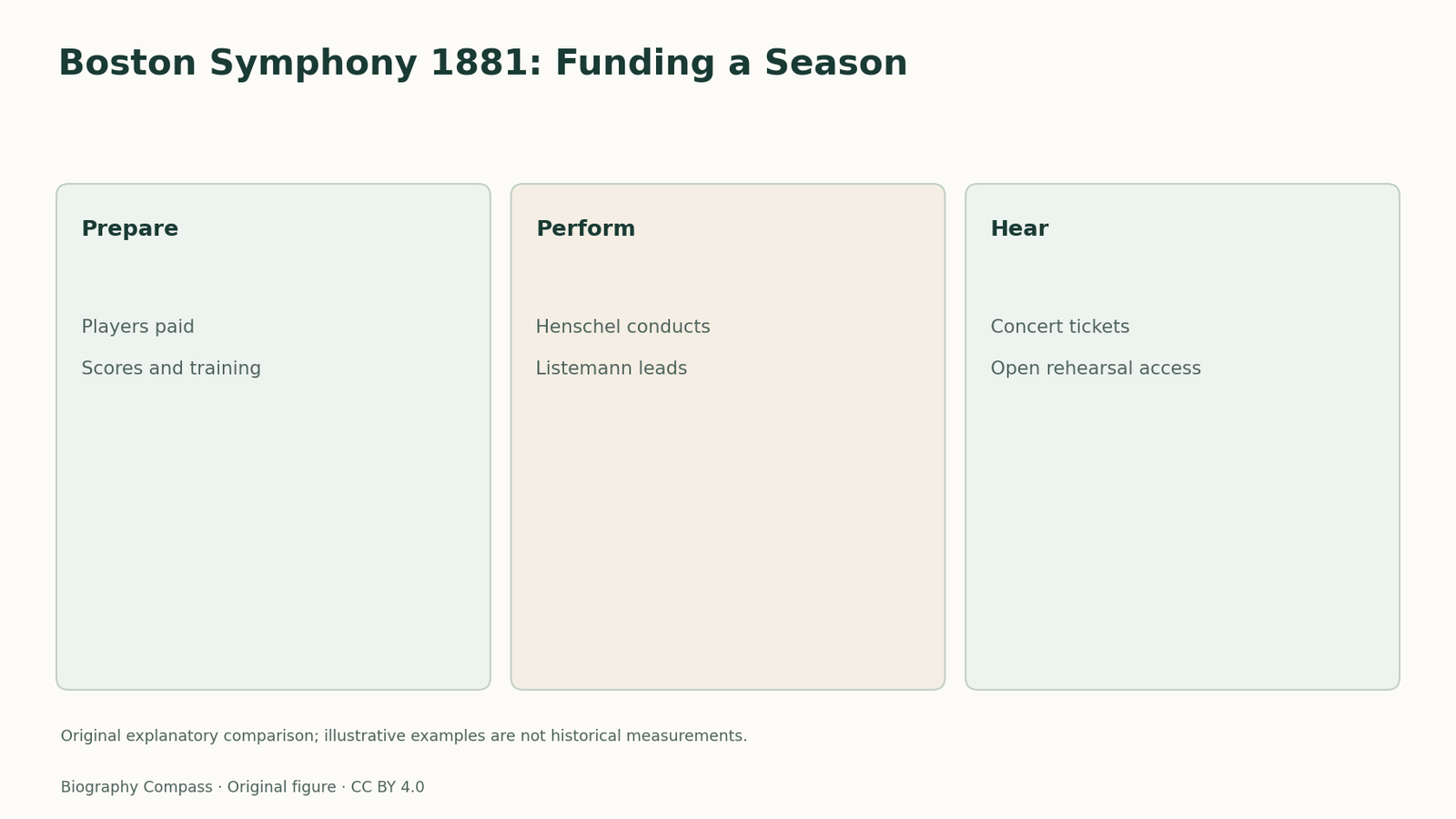
What each part contributes
Use the specific distinctions developed in the study.
| Part or record | What it establishes | Why the distinction matters |
|---|---|---|
| Founder | Financial and organisational support | Higginson |
| Conductor and leader | Rehearsal and musical direction | Henschel and Listemann |
| Audience | Different ticket and rehearsal options | Admission income is not total cost |
What did the founding plan actually promise?
The Boston Symphony Orchestra’s 1881 plan combined paid musical work, repeated rehearsal and a schedule of public concerts. A contemporary account in Grove’s Dictionary reproduces the substance of Higginson’s 30 March newspaper announcement. Its practical question was how a city could support high-quality orchestral music with admission prices intended to remain modest. The proposal described sixty players and twenty Saturday-evening concerts between October and March. It therefore concerned a recurring institution, not simply sponsoring one distinguished visiting concert or buying instruments for occasional performances.
Sources for this section: [3]
Paying for preparation as well as performance
The announcement included training within the musicians’ remuneration. That detail is central: the concert heard by an audience was the visible end of repeated preparation. A library of music was also acquired. Funding rehearsals and supplying scores helped turn a group of hired players into an ensemble able to perform a planned repertory. The contemporary account later describes three rehearsals for each concert, but that later practice should not automatically be read back as a numerical clause in the original announcement. Proposal and reported development are separate stages.
Sources for this section: [3]
The people named in the record
Grove identifies Georg Henschel as conductor and Bernhard Listemann as leader and solo violinist. Those titles assign different responsibilities from Higginson’s financial and organisational role. The first concert on 22 October 1881 included music by Beethoven, Gluck, Haydn, Schubert, Max Bruch and Weber. Such a programme required coordination among the conductor, orchestral sections and any participating soloists. A founder’s biography explains how resources were secured; it cannot replace the performance record when asking who prepared or played the music.
Sources for this section: [3]
Access and the cost structure
The original public terms included single tickets ranging from twenty-five to seventy-five cents and a separate admission to an open rehearsal. The plan therefore offered more than one way to hear the orchestra. Cheap admission did not make musical labour cheap or eliminate the need for patronage. The structure separated what a listener paid at the door from the larger resources required to sustain the institution. Grove celebrates the outcome; its favourable tone should be recognised while its concrete details about ticket categories and schedules remain useful evidence.
Sources for this section: [3]
An original ticket-price exercise
Using only the published single-ticket range, suppose sixty listeners each bought a twenty-five-cent ticket: receipts would be fifteen dollars. At seventy-five cents each, the same number would yield forty-five dollars. The three-to-one difference illustrates how access policy changes receipts, but neither figure estimates an actual concert’s income, attendance or deficit. The source gives a price range, not a complete budget. The correct conclusion is that performance planning and financial planning were connected, while a price list alone cannot establish the orchestra’s total annual cost or the size of Higginson’s subsidy.
Sources for this section: [3]
Continue the chronology
Related history guides
Baker’s Harvard Gift: Funds and a Campus
Trace Baker’s 1924 Harvard gift from the governing resolution through library construction and campus dedication, separating money from institutional founding.
Read the timeline1905–1914ROM: Collecting, Establishment and Opening
Trace ROM’s collecting, construction,1912 establishment and 1914 opening, identifying Walker, curators, donors, the university and the province.
Read the timelineBiography context
Explore United States through connected lives
Connected biographies
People and wider context
1834–1919
Henry Lee Higginson
banker and musical benefactorHenry Lee Higginson was a banker and musical benefactor, known for Establishing the Boston Symphony Orchestra.Read biographyQuick answers
Common questions
- Did a cheap ticket mean that running the orchestra was inexpensive?
- No. The plan paid musicians for concerts and preparation. A ticket price shows what a listener paid, not the complete institutional cost.
Primary and institutional sources
How this history was checked
Read the cited original records, institutional accounts and later interpretations. The comparison and exercise explain the specific evidence used in this study. This article was reviewed on 8 November 2026.
- University of Glasgow Whistler Etchings ProjectHenry Lee Higginson biographical record
- Bliss Perry, Atlantic Monthly PressLife and Letters of Henry Lee Higginson,1921
- George Grove, A Dictionary of Music and MusiciansSymphony Orchestra, The Boston
- Frances Anne Wister,1925Twenty-five Years of the Philadelphia Orchestra