
The short answer
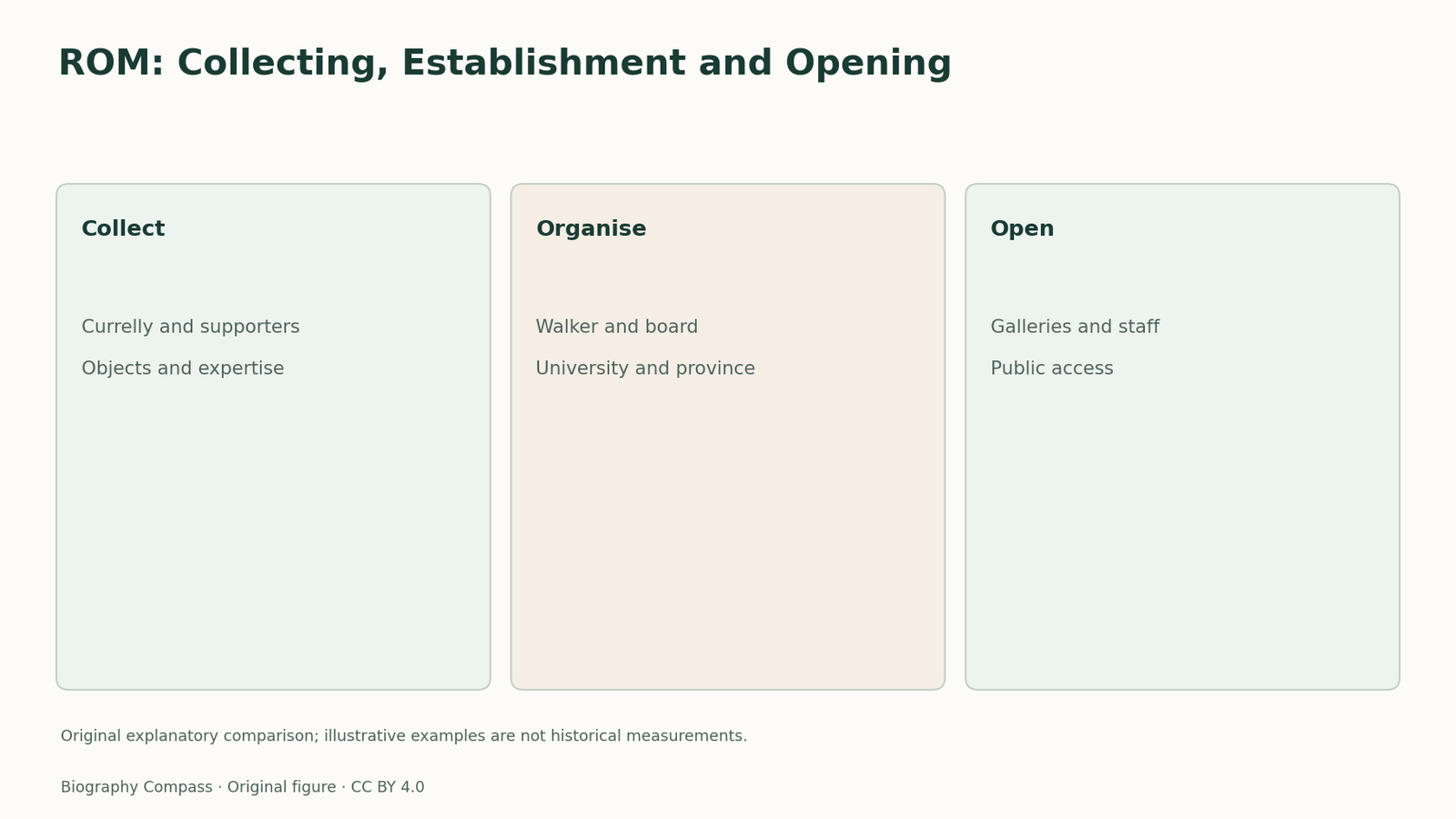
The Royal Ontario Museum’s early history contains several dates that answer different questions. Advocacy, collecting, construction, legal establishment and public opening did not happen as one event. Byron Edmund Walker’s role was especially important in organisation and governance. The museum’s institutional timeline identifies other necessary participants, including the University of Toronto, the Province of Ontario, collectors and donors. Comparing those stages offers a more useful account than assigning an entire museum to one founder or treating a completed outer building as an already functioning public collection.
A worked comparison
What each part contributes
Use the specific distinctions developed in the study.
| Part or record | What it establishes | Why the distinction matters |
|---|---|---|
| 1906 collecting | Objects acquired for future museum | Not public opening |
| 1912 establishment | Legislation and governance | Different from construction |
| 1914 opening | Public museum access | Institution begins welcoming visitors |
What actually founded the museum?
The Royal Ontario Museum’s early history contains several dates that answer different questions. Advocacy, collecting, construction, legal establishment and public opening did not happen as one event. Byron Edmund Walker’s role was especially important in organisation and governance. The museum’s institutional timeline identifies other necessary participants, including the University of Toronto, the Province of Ontario, collectors and donors. Comparing those stages offers a more useful account than assigning an entire museum to one founder or treating a completed outer building as an already functioning public collection.
Sources for this section: [4]
Collections preceded the public opening
The museum dates Charles Currelly’s appointment as an official collector for the university to 1906. Its account then describes donor interest stimulated by visits to his work in Egypt. These are acquisition and relationship-building stages. A collection could begin to take shape before galleries were ready to receive visitors. The distinction also raises a substantive question for later research: an object’s acquisition history and its subsequent museum display are separate records. The founding timeline identifies who organised collecting, but it does not supply the complete provenance of every object.
Sources for this section: [4]
Buildings and legal establishment
The museum’s timeline places construction of the first wing in 1910–1912 and the Ontario legislation in 1912. It describes financial participation by both university and province. Legal establishment created an institutional framework, while construction supplied space; neither alone explains how galleries were staffed and collections arranged. The initial organisation comprised five museums covering archaeology and branches of natural history. Walker’s first chairmanship belonged to that collective structure. This article reports the institution’s chronology rather than claiming to have independently read every clause of the 1912 Act.
Sources for this section: [4]
Opening and later governance
The public opening followed in 1914. The Toronto Public Library’s anniversary account likewise distinguishes the 1912 legislation from the 1914 opening. Later official testimony to the Ontario legislature describes the university relationship and the separate 1968 independent-agency arrangement. Those later changes should not be projected back onto the founding moment. Institutional continuity does not require every governance rule to remain unchanged. The museum could retain collections and public purposes while changing the relationship between its board, university and provincial government.
Build a milestone key
Assign a symbol to each kind of event: a box for a collection, a building for construction, a document for legislation, and an open door for public access. Place 1906,1910–1912,1912 and 1914 respectively beside those symbols. The answer reveals why a sentence saying “the museum opened in 1912” confuses establishment with opening. Now assign people to tasks: Currelly collected, Walker chaired, public institutions financed and authorised, and staff prepared the museum. This original classification exercise gives readers a method for analysing other cultural institutions without reducing their histories to a donor’s name.
Continue the chronology
Related history guides
Munitions Reports: What Output Counts
Compare the Imperial Munitions Board’s reported items, material weights and work inprogress, using the original output statement reproduced in 1921.
Read the timeline1902–1921Cawthron: From Bequest to Research
Trace Cawthron’s 1902 will, trustees’ decisions, specialist appointments and 1921 opening through Easterfield’s account of how the research institute formed.
Read the timelineBiography context
Explore Canada through connected lives
Connected biographies
People and wider context
1848–1924
Byron Edmund Walker
banker and cultural institution organiserByron Edmund Walker was a banker and cultural institution organiser, known for Canadian Bank of Commerce and Toronto’s museum institutions.Read biographyQuick answers
Common questions
- Why do 1912 and 1914 both appear in ROM’s founding history?
- The institution was legally established in 1912 and opened publicly in 1914. They are different milestones, not interchangeable dates.
Primary and institutional sources
How this history was checked
Read the cited original records, institutional accounts and later interpretations. The comparison and exercise explain the specific evidence used in this study. This article was reviewed on 8 November 2026.
- David Kimmel, Dictionary of Canadian BiographyWalker, Sir Byron Edmund
- Parks CanadaWalker National Historic Person
- Royal Canadian Institute for SciencePresidents
- Royal Ontario MuseumHistory of Philanthropy at ROM
- Toronto Public LibraryThe Royal Ontario Museum’s 98 thbirthday
- Legislative Assembly of OntarioCommittee testimony,10 September 2009