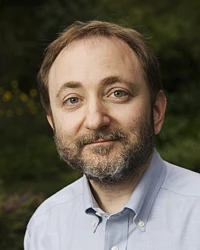
In this biography
Quick facts
- Born
- 1960
- Birthplace
- New Haven, CT, USA
- Country
- United States
- Nationality
- Not independently established
- Known for
- Discovery of RNA interference with Andrew Fire and investigation of cellular silencing mechanisms
Why this life matters
Mello's contribution helped turn an unusual experimental effect into a mechanistic research programme, one in which trigger identity, spread and persistence could be investigated as related but separable phenomena.
Timeline
Key moments
Birth
Born in New Haven, CT, USA.
Nobel recognition
Received the Nobel Prize in Physiology or Medicine.
A model organism and an experimental community
Craig Mello was born in New Haven in 1960. His Nobel autobiography describes a fascination with the natural world and a research education that led through Boulder and Harvard. At Harvard he worked with Dan Stinchcomb in a shared worm-research setting that included Victor Ambros. Studies of DNA introduction and gene regulation in Caenorhabditis elegans later helped create the conditions for his collaboration with Andrew Fire. The organism supplied a tractable system in which delivery, gene activity and inheritance could be compared.
The animal was doing more than passively receiving RNA
Mello's account describes effects that could spread from an injection site and appear in progeny. Such observations encouraged an active-response interpretation. His collaboration with Fire then connected the powerful trigger with double-stranded RNA, leading to the 1998 report of RNA interference. Mello explicitly recalls that he initially considered the duplex an amplification intermediate rather than the trigger itself. That distinction makes the discovery history informative: changing an explanation in response to a preparation test was part of the work, not an embarrassment to remove from it.
A regulatory question larger than the first trigger
Mello and Fire shared the 2006 medicine prize. His later technical account follows the cellular machinery that mediates silencing and asks how RNA can influence gene-expression patterns beyond an immediate interaction with one messenger. Those questions do not justify claiming that any environmentally acquired trait is inherited indefinitely or that the DNA sequence must have changed. Mello's contribution helped turn an unusual experimental effect into a mechanistic research programme, one in which trigger identity, spread and persistence could be investigated as related but separable phenomena.
Quick answers
Frequently asked questions about Craig C. Mello
- What is Craig C. Mello known for?
- Discovery of RNA interference with Andrew Fire and investigation of cellular silencing mechanisms.
Keep exploring
Lives connected to this story
- Andrew Z. Fire
Compare the related experimental question and research career.
- John B. Gurdon
Compare the related experimental question and research career.
Sources and further reading
Explore the evidence
These references support the biography and offer further reading. Official records, first-person accounts and independent reporting provide different perspectives; image records document attribution and licensing.
- 1. Nobel Prize OutreachCraig C. Mello — Facts
Source scope: Birth/death and award metadata; short official work summary.
- 2. Nobel FoundationCraig C. Mello — Biographical
Source scope: Selected historical passages, as recorded in the research evidence ledger; not a full-document reading claim.
- 3. Nobel FoundationCraig C. Mello — Nobel lecture
Source scope: Selected historical passages, as recorded in the research evidence ledger; not a full-document reading claim.
- 4. Fire and colleagues / NaturePotent and specific genetic interference by double-stranded RNA in Caenorhabditis elegans
Source scope: Shared primary abstract: treated animals and progeny; no copied counts or indefinite-inheritance claim.
- 5. Craig Mello / Nobel lecture reprintReturn to the RNAi World: Rethinking Gene Expression and Evolution
Source scope: Discovery narrative and distinction between RNA-triggered silencing and broader evolutionary hypotheses; hypotheses labelled rather than presented as established universal mechanisms.