
The short answer
A publisher’s decision to proceed and a court’s later disposition are different historical events. Reading them in order reveals both the uncertainty of the decision and the limits of what the judgment established.
A bounded comparison
Keep the measures separate
The question changes when the object, unit or reporting period changes.
| Record or measure | What it establishes | What it does not establish |
|---|---|---|
| Publication record | When the newspaper proceeded. | A prior Supreme Court assurance of harmlessness. |
| Per curiam | The Court’s disposition and burden. | Every justice’s complete reasoning. |
| Concurrence | One justice’s stated reasoning. | A substitute majority holding. |
Chronology
A timeline of the turning points
Publication
The newspaper proceeds.
Judgment
The Court resolves the proceedings.
Publication came before the final judgment
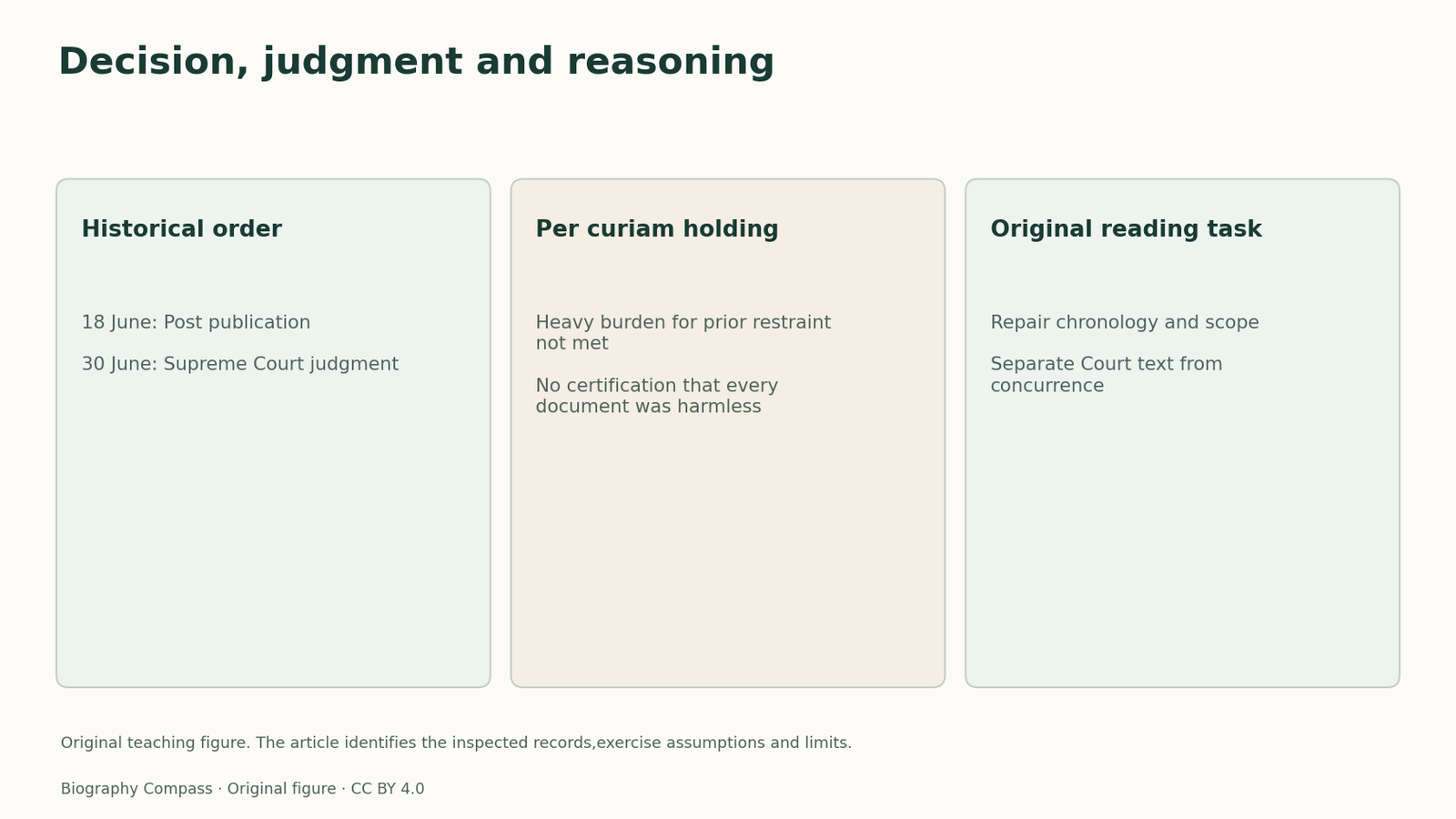
The Post began publishing on 18 June 1971. The D.C. Circuit’s historical account follows the litigation generated by that decision.
The Supreme Court decided the combined cases on 30 June. The sequence rules out a caption in which the newspaper first waits for the final Supreme Court judgment and only then begins publication. The decision to publish was made while legal consequences remained unsettled.
What the per curiam text resolved
On printed page 714, the Court’s short per curiam text says the government had not met the heavy burden required to justify a prior restraint. It directs the relevant judgments and stays accordingly.
That holding concerns the justification for stopping publication in these proceedings. It should not be inflated into a factual finding that every document was harmless, a complete endorsement of every disclosure practice, or a general assurance about all possible later liabilities. A precise historical claim can be important without becoming unlimited.
Sources for this section: [3]
A concurrence shows why the distinction matters
In his separate concurrence on printed page 731, Justice White expected harm from publication yet agreed with the judgments because the heavy burden for prior restraint had not been satisfied.
This is an individual justice’s reasoning, not a replacement for the per curiam holding. It is nevertheless a powerful check on a simplistic inference: joining the result did not necessarily mean believing the papers harmless. The need to distinguish the two kinds of text survives even when both lead to the same disposition.
An original caption-repair exercise
Revise this invented caption: “Graham waited until the Supreme Court declared every Pentagon document safe, then the Post published.” Identify one chronological error and one error about the scope of the judgment. Add a sentence explaining what a separate concurrence can and cannot establish.
Reference answer: the newspaper had already begun publishing before the final judgment. The Court rejected the government’s showing for prior restraint; it did not certify every document as safe. A concurrence can establish the authoring justice’s stated reasons and concerns, but should not be silently attributed to the Court as a whole. The exercise compares selected historical records and does not offer present legal advice.
Continue the chronology
Related history guides
Biography context
Explore United States through connected lives
Connected biographies
The connected careers

Quick answers
Common questions
- Did the judgment declare every document harmless?
- No. The government failed to justify prior restraint; that holding did not certify every document as safe.
Primary and institutional sources
How this history was checked
Compare the publication chronology, the Court’s short disposition and an individual concurrence. The exercise uses selected records rather than a complete documentary archive. This article was reviewed on 31 October 2026.
- Historical Society of the D.C. CircuitPentagon Papers, 1971
- US National Archives / The Text MessageThe Pentagon Papers: State Department supports court action
- US Supreme Court / GovInfoNew York Times Co. v. United States, 403 U.S. 713
- Cornell Legal Information InstituteNew York Times Co. v. United States: case dates