
The short answer
A target describes a future state. A progress report measures a stated period against a baseline. This comparison asks what the later record can establish, and why adding percentage changes produces a misleading answer.
A bounded comparison
Keep the measures separate
The question changes when the object, unit or reporting period changes.
| Record or measure | What it establishes | What it does not establish |
|---|---|---|
| Commitment | 2030 target. | An achieved state. |
| Progress report | Change against a 2020 baseline. | A complete inventory reconstruction from one page. |
Chronology
A timeline of the turning points
Commitment
Future objective announced.
Report
Historical progress compared.
The promise and the later report
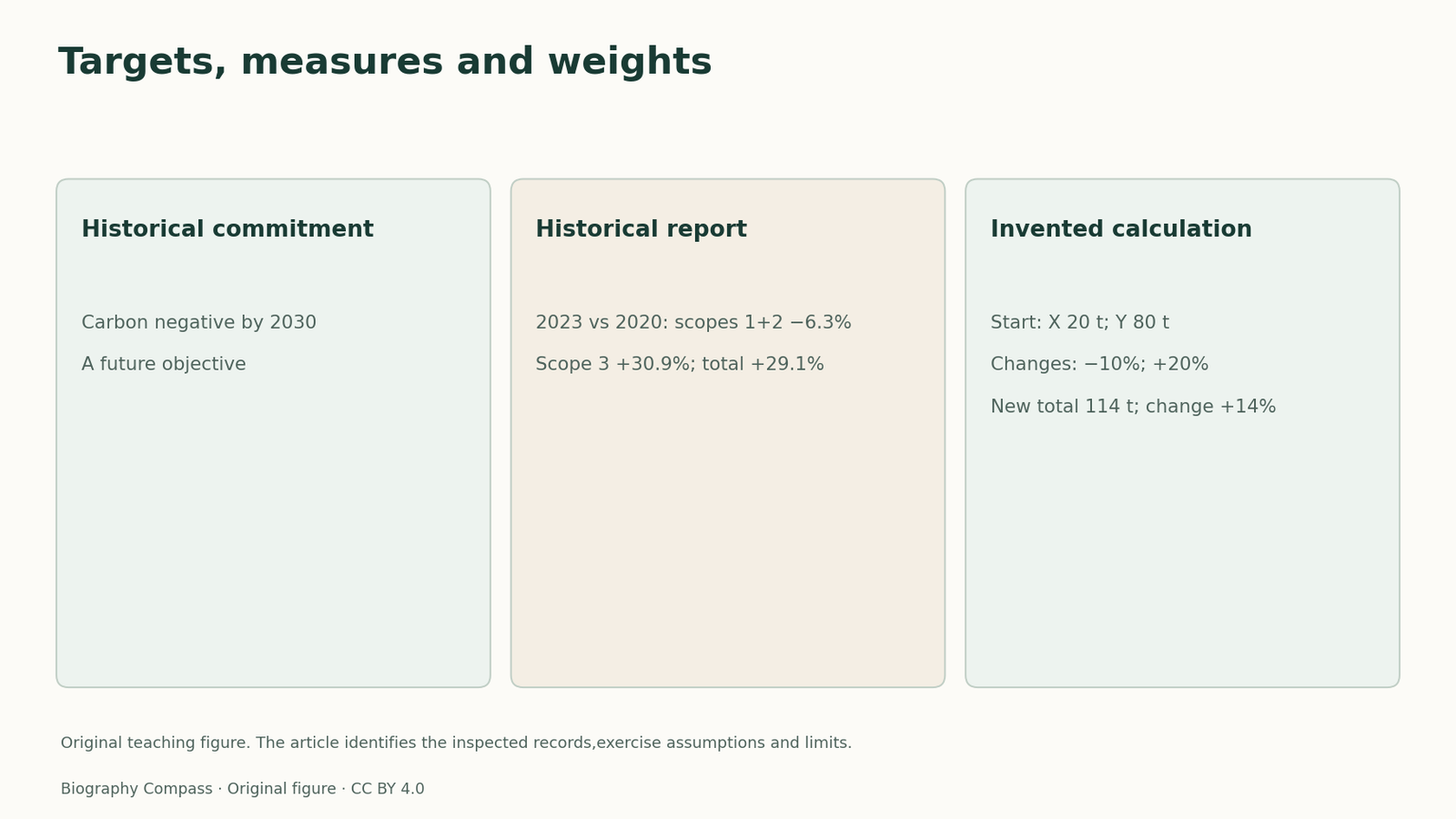
In January 2020 Microsoft committed to becoming carbon negative by 2030 across all three emissions scopes. Its explanation distinguished direct emissions, purchased-energy emissions and wider value-chain emissions.
The 2024 report’s foreword compared 2023 emissions with a 2020 baseline: scopes 1 and 2 fell 6.3%, scope 3 rose 30.9%, and the total rose 29.1%. These are the report’s historical measures, not a reading of current performance.
Why the percentages cannot simply be added
A change in a small component does not carry the same weight as an equal percentage change in a large component. To reconstruct an aggregate change, a reader needs the starting quantities for each component, expressed on a compatible basis. Adding a decline to an increase treats both components as if their starting masses were identical.
The comparison also needs a stable boundary. Ask whether the same activities, estimation methods and baseline adjustments are included. The foreword gives an aggregate result but is not enough to reproduce every underlying calculation. It would be an overreach to reverse-engineer exact audited component weights from rounded rates alone.
How to write a defensible conclusion
The later increase is evidence that the reported total was higher than its baseline. It does not convert the earlier target into a claim that the target had already been achieved. Conversely, a future deadline does not make an adverse interim result irrelevant. A useful caption states the baseline, report year, measure and direction before interpreting progress.
Keep a policy commitment and an observed result in separate sentences. That makes both open to scrutiny: readers can ask whether the target remains adequate, and whether the reported trajectory supports reaching it. Neither question is answered by repeating a corporate slogan.
An original weighted-change task
Fictional inputs: organisation A starts with 20 tonnes of emissions in component X and 80 tonnes in component Y. Over one period, X falls 10% and Y rises 20%. Assume unchanged boundaries, compatible units and no baseline restatement. Calculate the new total and percentage change. Explain why adding −10% and +20% is wrong.
Reference answer: X becomes 18 tonnes and Y becomes 96 tonnes. The total moves from 100 to 114 tonnes, an increase of 14%. The starting shares are 0.2 and 0.8, so the weighted change is 0.2 × (−10%) + 0.8 × 20% = 14%. Adding the rates gives 10%, which discards those unequal weights. These supplied masses and rates are invented and do not reconstruct Microsoft’s inventory.
Sources for this section: [2]
Continue the chronology
Related history guides
Biography context
Explore United States through connected lives
Connected biographies
The connected careers

Quick answers
Common questions
- Can the component percentage changes be added?
- No. Each change applies to its own starting amount; calculate the changed quantities before finding the combined rate.
Primary and institutional sources
How this history was checked
Compare the dated company records with the independent or regulatory context. Original task inputs are labelled separately from reported historical measures. This article was reviewed on 31 October 2026.