
The short answer
This worksheet asks you to keep the reactant and product columns of a supplied model consistent. Complete both directions, then diagnose three deliberately faulty captions.
Compare the quantities
Keep the claim within the model
These comparisons separate supplied assumptions, calculated results and missing evidence.
| Record or test | What follows | What remains separate |
|---|---|---|
| Forward model | Three glucose-1-phosphate units and a 97-unit segment | A free-glucose-only product list |
| Reverse model | Three added residues and phosphate release | An unspecified whole-cell pathway |
| Stoichiometric accounting | A consistent unit inventory | Kinetics or measured yield |
Chronology
A timeline of the turning points
Intermediates and enzymes
The careers move from physiological questions toward biochemical reactions.
Lecture record
Compare the two selected passages.
Separate inventories
Carbon residues and phosphate must both be tracked.
Read the named reactant and product
The 1947 lecture’s opening describes phosphate interacting with a terminal chain bond to produce glucose-1-phosphate. Its reverse description adds a chain unit from glucose-1-phosphate and releases phosphate. The reactant and product names therefore matter; “breaks down carbohydrate” is too broad to identify the reaction.
For comparison, a hydrolysis description names water as a reactant. Do not replace phosphate with water while keeping the product label unchanged. This guide follows the stated reaction, rather than a generic image of an enzyme cutting a chain.
A fictional chain-unit ledger
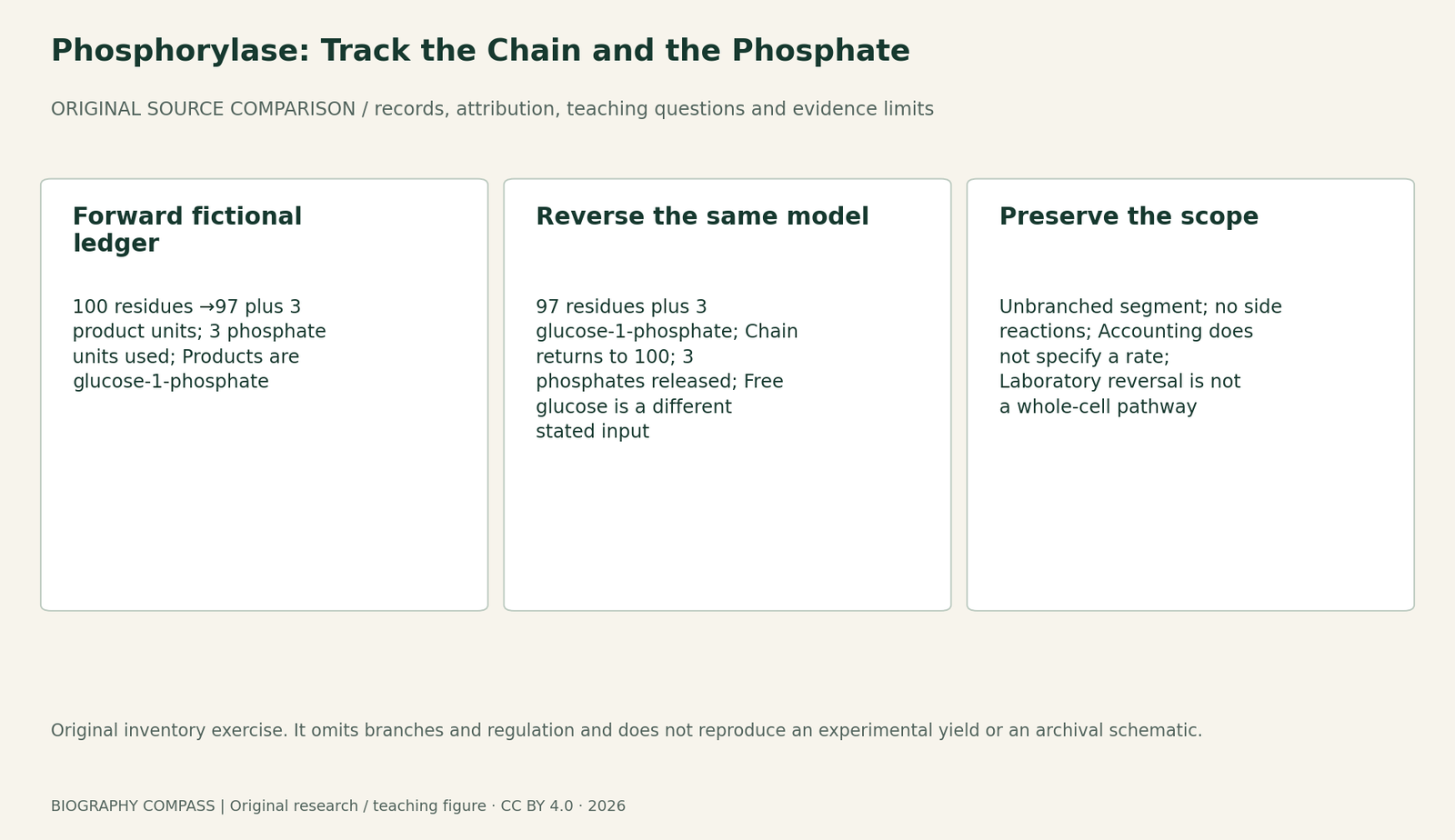
Use an idealised, unbranched segment containing 100 glucose residues. Stipulate three forward phosphorylase events and omit side reactions. The inventory becomes a 97-residue segment plus three glucose-1-phosphate units, with three inorganic phosphate units used. These are invented accounting values, not laboratory conditions or an experimental yield.
Worked answer:100−3=97, and three chain units reappear in the three products. The phosphate input must also be shown. The enzyme is a catalyst in this simplified ledger, not a substrate consumed once for every unit released. No reaction rate follows from these counts.
Sources for this section: [1]
Reverse the accounting without changing the substrate
Now reverse the three stipulated events. Three glucose-1-phosphate units add three residues to the 97-unit segment and release three phosphate units. The chain inventory returns to 100. A caption that substitutes free glucose for glucose-1-phosphate has changed the stated input and requires another explanation.
Worked answer: the reverse ledger is consistent with the specified reversible reaction. It does not establish that an isolated chain will grow at a particular speed or under unspecified conditions. The lecture’s discussion of primer effects is one reason to keep reaction accounting separate from a claim about observed activity.
A branched molecule needs more than this model
The model deliberately omits branch points. Cohn’s later memoir also distinguishes the laboratory reversal from the physiological biosynthetic pathway involving glycogen synthetase. An isolated reaction cannot be promoted into a complete description of glycogen synthesis or breakdown in a living cell.
This is a general inference problem: demonstrating one possible conversion is different from identifying the dominant route in another setting. To make the larger claim, a researcher must establish the relevant enzymes, substrates, regulation and biological conditions. A balanced equation cannot supply those observations by itself.
Sources for this section: [3]
Exercise: correct three labels
An invented answer sheet calls the forward reaction “hydrolysis,” lists free glucose as its only product, and says the reverse reaction proves the entire living pathway. Identify the missing distinctions without adding new experimental data.
Worked answer: retain phosphate in the forward reaction and glucose-1-phosphate among its products; distinguish it from the water-based description. Keep the reverse result within the specified reaction. The chain-unit calculation shows an inventory, while an explanation of the living pathway needs further biological evidence.
Continue the chronology
Related history guides
The Cori Cycle: Carbon Accounting Is Not an Energy Balance
Follow a fictional carbon ledger through the Cori cycle, compare it with the historical research record, and separate recycling, energy cost and measured flux.
Read the timeline1941 paper; invented rescue modelBeadle and Tatum’s 1941 Study: Reading Nutritional Rescue
Compare the 1941 Neurospora paper with later shorthand, then solve invented rescue patterns and distinguish a pathway inference from proof of an enzyme’s identity.
Read the timeline1943 paper; invented eight-value datasetsLuria and Delbrück’s 1943 Study: Why Fluctuations Matter
Use the 1943 resistance paper and two invented datasets to compare means and variances, distinguish models of variation, and avoid inferring a mutation rate.
Read the timelineBiography context
Explore United States through connected lives
Connected biographies
Scientists connected with this question
1896–1984
Carl Cori
Biochemist and laboratory leaderCarl Cori combined metabolic research, laboratory leadership and later studies of gene expression across a career extending well beyond the 1947 Nobel Prize.Read biography1896–1957
Gerty Cori
Biochemist and Nobel laureateGerty Cori investigated how carbohydrates are transformed, combining a long research partnership with distinctive work on glycogen structure and enzyme deficiencies.Read biographyQuick answers
Common questions
- Is the 100-unit segment real experimental data?
- No. It is an invented unbranched segment used for accounting.
- Does laboratory reversibility establish the whole physiological pathway?
- No. The biological pathway requires separate evidence.
Primary and institutional sources
How this history was checked
Read the specified original or institutional records alongside the explicitly invented teaching model; their different evidential roles are stated in the text. This article was reviewed on 29 October 2026.
- Carl F. Cori and Gerty T. Cori; Nobel Lectures,11December 1947Polysaccharide phosphorylase: selected indexed lecture passages
- Gerty T. Cori; Nobel Lectures,11December 1947Polysaccharide phosphorylase, Part II: indexed primer discussion
- Mildred Cohn; National Academy of Sciences,1992Carl Ferdinand Cori, selected memoir passages
- IUPAC Compendium of Chemical TerminologyHydrolysis,H02902: Gold Book term,2025version