
The short answer
A cycle diagram can show a route without settling every quantity along it. Start with the historical question, then test an invented carbon inventory before making a claim about energy or bodily flux.
Compare the quantities
Keep the claim within the model
These comparisons separate supplied assumptions, calculated results and missing evidence.
| Record or test | What follows | What remains separate |
|---|---|---|
| Four glucose units | 24 carbon atoms in the supplied model | A measured whole-body flux |
| Eight lactate units | The same 24-carbon inventory | A zero energy cost |
| A cycle arrow | A connection to examine | A numerical rate without measurements |
Chronology
A timeline of the turning points
Physiological research
The historical comparison concerns carbohydrate movement.
Research moves to St. Louis
The careers continue in another institutional setting.
Count a conserved quantity
The supplied numbers test carbon accounting only.
A diagram followed an experimental problem
Cohn’s memoir describes lactate’s role in the Coris’ muscle–liver studies. A later cycle diagram condenses that research; it is not itself a table of measured flows.
That distinction changes how a diagram should be read. An arrow may identify a proposed connection, while an experiment measures an amount over a specified interval. Before adding numbers to an arrow, ask which material was measured, where it was measured and whether the number describes a stock or a change.
Sources for this section: [1]
An invented carbon inventory
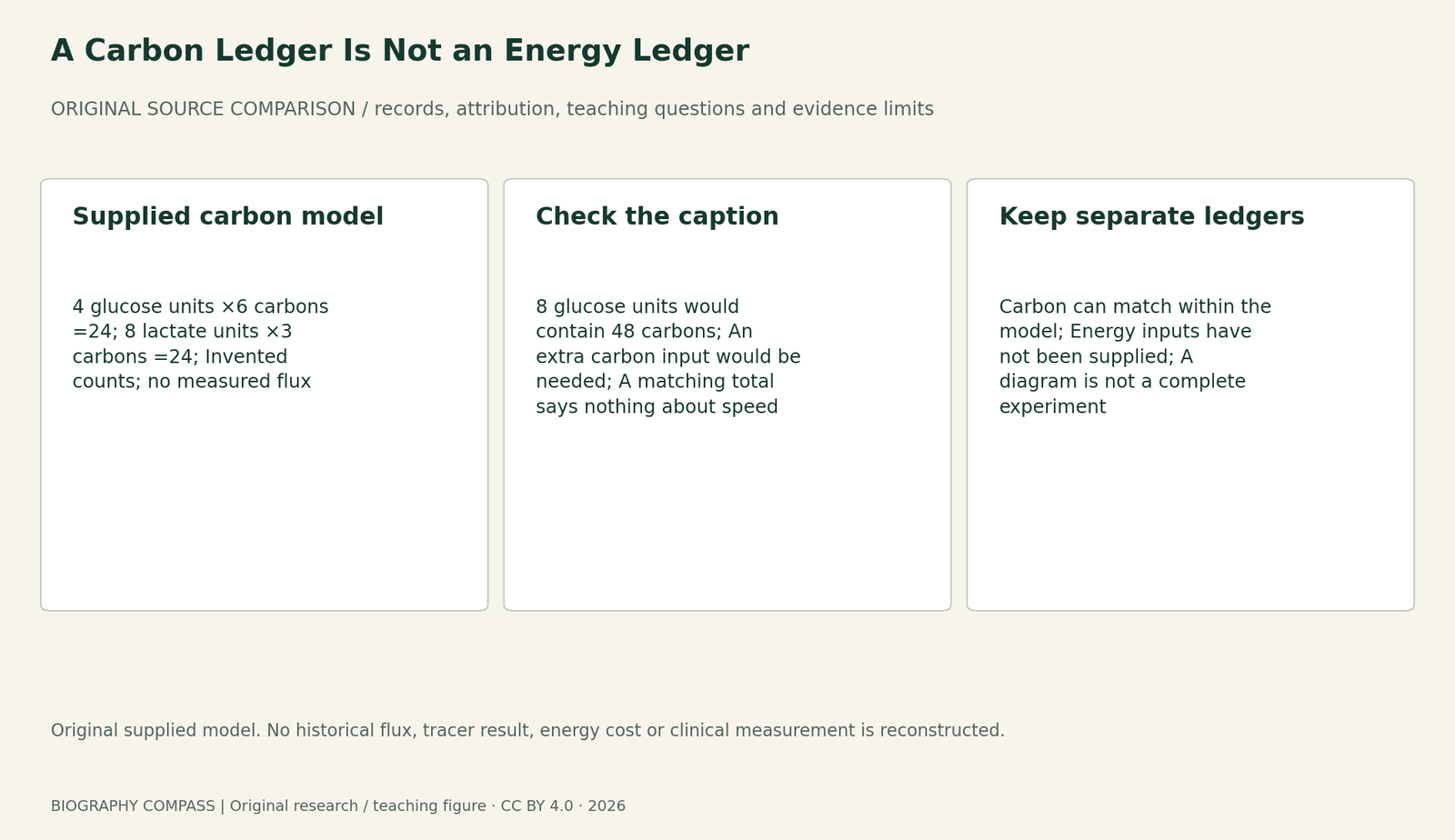
Use this supplied classroom model: each glucose unit contains six carbon atoms and each lactate unit contains three. Four glucose units therefore contain 24 carbon atoms. Eight lactate units also contain 24. Matching those inventories preserves carbon within the stated model; the numbers are not an experiment reported by the Coris.
Worked answer:4×6=24 and 8×3=24. If a fictional caption turns eight lactate units into eight glucose units, its final inventory is 48 carbons. It has doubled the inventory without an additional carbon input. The error can be diagnosed by accounting before discussing any biological rate.
Sources for this section: [1]
Recycling does not settle an energy ledger
Now consider the statement, “Because the route is a cycle, the return trip is free.” The carbon calculation does not support it. No energy inputs or outputs have been supplied. A conserved quantity in one ledger cannot silently become a zero balance in a different ledger.
Worked answer: mark energy cost as undetermined by this exercise. A separate calculation would need specified reactions, substrates and energetic assumptions. Do not import a textbook ATP total without identifying its starting point and convention. Carbon matching also does not establish how much material actually follows the route in a living subject.
Sources for this section: [1]
Repair a misleading transport caption
An invented caption says, “Muscle glycogen travels to the liver and is sent back unchanged.” Rewrite it using the distinction between a storage polymer and circulating intermediates. The historical account identifies lactate as a connection; a polymer inventory is not evidence that intact glycogen moves between the organs.
Worked answer: describe a route involving carbohydrate conversion and circulating intermediates, rather than transport of an unchanged glycogen store. A useful diagram should name each arrow’s material. Treating every box as simply “sugar” hides the very distinctions that the research sought to explain.
Sources for this section: [1]
What would make the argument stronger?
Imagine receiving only the two equal carbon totals above. They cannot reveal direction, duration, physiological conditions or competing destinations. A stronger account would attach measurements and conditions to particular stages and state which quantities remain outside its evidence. A balanced drawing is a starting check, not a complete reconstruction.
The Coris’ biographies supply the research setting and collaborators; the worksheet supplies original arithmetic. Reading them together should preserve that division. Neither the toy inventory nor the existence of a Nobel award converts an assumed route into a measured flux or a clinical conclusion.
Continue the chronology
Related history guides
Phosphorylase
Test a caption against the supplied reaction.
Read the timeline1941 paper; invented rescue modelBeadle and Tatum’s 1941 Study: Reading Nutritional Rescue
Compare the 1941 Neurospora paper with later shorthand, then solve invented rescue patterns and distinguish a pathway inference from proof of an enzyme’s identity.
Read the timeline1943 paper; invented eight-value datasetsLuria and Delbrück’s 1943 Study: Why Fluctuations Matter
Use the 1943 resistance paper and two invented datasets to compare means and variances, distinguish models of variation, and avoid inferring a mutation rate.
Read the timelineBiography context
Explore United States through connected lives
Connected biographies
Scientists connected with this question
1896–1957
Gerty Cori
Biochemist and Nobel laureateGerty Cori investigated how carbohydrates are transformed, combining a long research partnership with distinctive work on glycogen structure and enzyme deficiencies.Read biography1896–1984
Carl Cori
Biochemist and laboratory leaderCarl Cori combined metabolic research, laboratory leadership and later studies of gene expression across a career extending well beyond the 1947 Nobel Prize.Read biographyQuick answers
Common questions
- Are the four- and eight-unit values historical measurements?
- No. They are invented quantities for a carbon-accounting exercise.
- Does equal carbon prove that a cycle costs no energy?
- No. Carbon and energy require separate accounting.
Primary and institutional sources
How this history was checked
Read the specified original or institutional records alongside the explicitly invented teaching model; their different evidential roles are stated in the text. This article was reviewed on 29 October 2026.