
The short answer
An ownership percentage is incomplete until the company it measures is named. These dairy records provide a concrete case in which similar names and repeated percentages can obscure different objects.
Record comparison
Compare the evidence
Keep the objects and assumptions attached to each statement.
| Item | What it establishes | What remains separate |
|---|---|---|
| Proposal | Non-binding; approvals and contracts outstanding | Do not caption as completed. |
| Later completion | A distinct dairy-business combination | Do not merge it into the earlier event. |
| Fictional model | 100 cash units; explicit distribution rules | No inference about actual voting control. |
Chronology
A timeline of the turning points
Stake disposal
GIIL disposal with a retained interest.
Business combination
Dairy Ireland and GII combined as Glanbia Ireland.
Remaining interest
Society completed its purchase of the remaining stake.
A proposal is not a completed purchase
The 2012 half-year release described a non-binding memorandum, subject to contracts and approvals, for a dairy-ingredients joint venture: 40% for Glanbia plc and 60% for the Society.
The full-year results record the disposal of 60% of Glanbia Ingredients Ireland Limited on 25 November 2012, with 40% retained. They separately said that the Society’s holding in the plc would reduce to 41.3%.
The first percentage concerns the dairy business; the second concerns shares in its listed parent. One cannot substitute for the other. The conditional language of the earlier document also prevents treating its announcement as completion.
Later transactions changed the object again
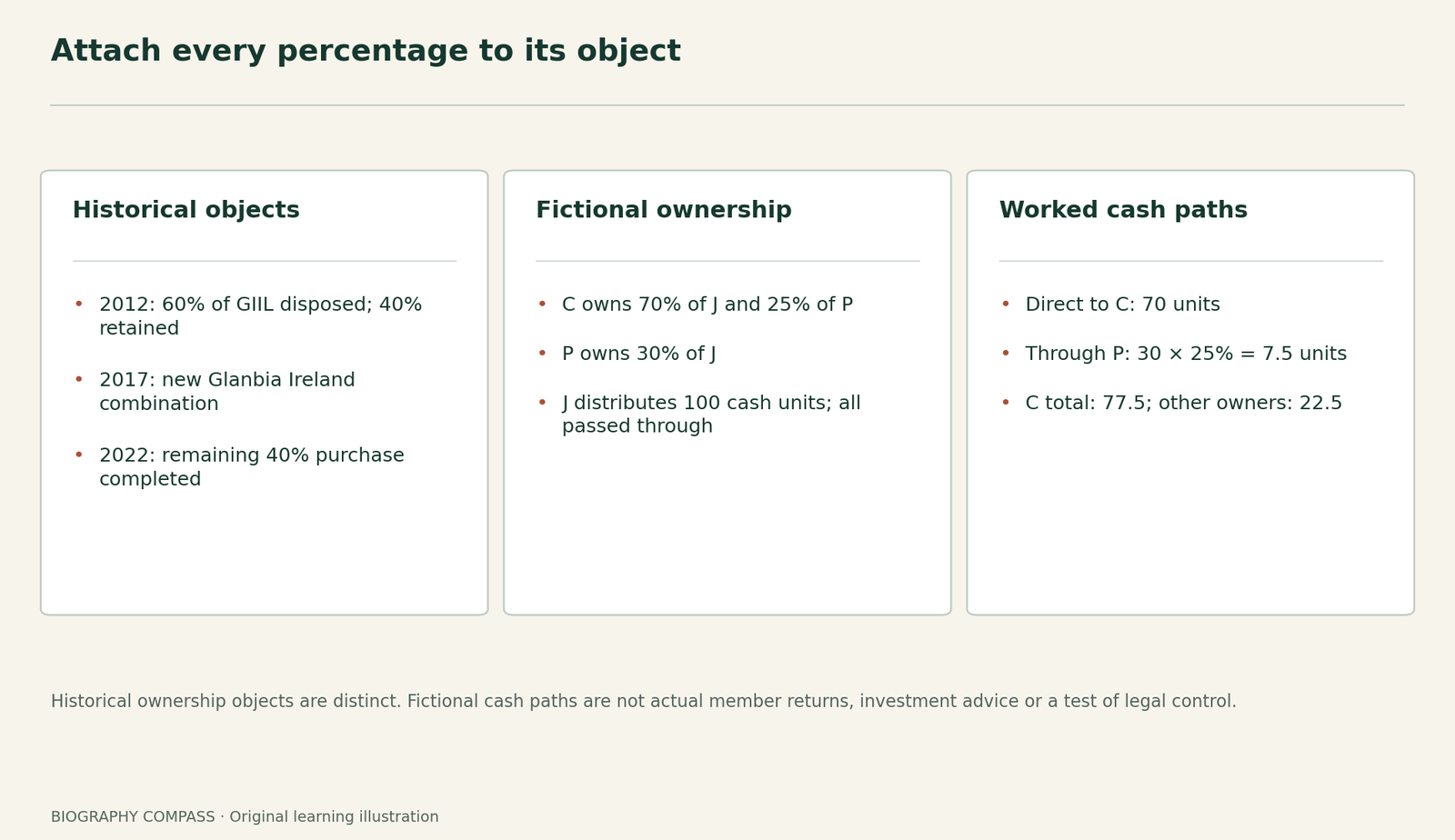
The 2017 release records a completed disposal of 60% of Dairy Ireland on 2 July. Combining that business with Glanbia Ingredients Ireland created Glanbia Ireland DAC, again owned 60% by the Society and 40% by the plc.
A September 2022 release confirms that the Society bought the remaining 40% in Glanbia Ireland on 1 April 2022. Its separate spin-out concerned plc shares.
Repeated percentages therefore do not make these the same transaction. A reliable reading keeps a three-part label beside each number: owner, asset or company, and date.
Accounting language adds another boundary
The 2012 results explain that losing control required the group first to account for a 100% disposal of GIIL and then recognise its retained 40% as an associate.
An accounting presentation of the whole former subsidiary is not a statement that the economic stake retained was zero. Conversely, an economic interest does not by itself answer which company consolidates an operation. The passage is evidence of the issuer’s treatment of this transaction, not a general ruling about every joint venture.
Original exercise: follow a supplied cash distribution
Use a fictional venture J paying 100 cash units. A cooperative C directly owns 70% of J; a listed company P owns 30%. C also owns 25% of P. Assume each entity distributes every unit it receives immediately and pro rata, with no costs, taxes, preferences, other cash or circular holdings. These are invented values, not Glanbia ownership data.
C receives 70 directly from J. P receives 30 and passes 25% of that, or 7.5, to C. C therefore receives 77.5 units in total; P’s other owners receive 75% × 30 = 22.5. The outputs sum to 100. Adding 70% and 25% would mix interests in different companies. This exercise traces cash under explicit rules; it supplies no board-voting or legal-control test.
Continue the chronology
Related history guides
Ryanair: Seat Counts and Miles
Compare a different question through its named records and original worked exercise.
Read the timeline2017 explanation and 2026 reference snapshotStripe API v1: Keys, Execution and Retry
Compare a different question through its named records and original worked exercise.
Read the timelineBiography context
Explore Ireland through connected lives
Connected biographies
People connected with these records
Career documented from 1992
Siobhán Talbot
Nutrition-business executiveTalbot led Glanbia for a decade before its leadership transition.Read biographyQuick answers
Common questions
- Is the 77.5-unit answer a historical distribution?
- No. It follows the invented 70/30 and 25% interests and the stated cash rules. It is not an estimate of a real cooperative member’s return.
Primary and institutional sources
How this history was checked
Read these records alongside their dates, stated objects and access limits. The exercise and worked answer are original learning material. This article was reviewed on 30 October 2026.
- Glanbia2012 half-year results: dairy joint-venture proposal
- Glanbia2012 full-year results: GIIL transaction accounting
- Glanbia / FinancialFilings2012 Earnings Release: GIIL accounting paragraph, republication
- Glanbia2017 full-year results: strategic initiatives, printed3
- Glanbia Co-operative Society / GlanbiaCo-operative share transfer, 13 September 2022
- CRHSiobhán Talbot: board biography