
The short answer
How did Rockefeller’s advisers distinguish an endowed institution from an annual charitable grant?
Compare the documents
Authority, evidence and limits
These records describe different responsibilities; one should not silently substitute for another.
| Record | What it establishes | What it does not establish |
|---|---|---|
| Chicago’s 1889 conditional pledge | Distinguishes a founding contribution from an unlimited operating commitment. | The condition is not a guarantee to cover every future deficit. |
| Gates’s memoir and 1905 proposal account | Connects charter, board and endowment in an institutional plan. | A retrospective account is not the original letter or a universal spending rule. |
| Original hypothetical exercise | Compares annual grant with capital generating a teaching-model amount. | The 5 percent assumption is invented, not an actual Rockefeller return. |
A founding pledge did not answer every future bill
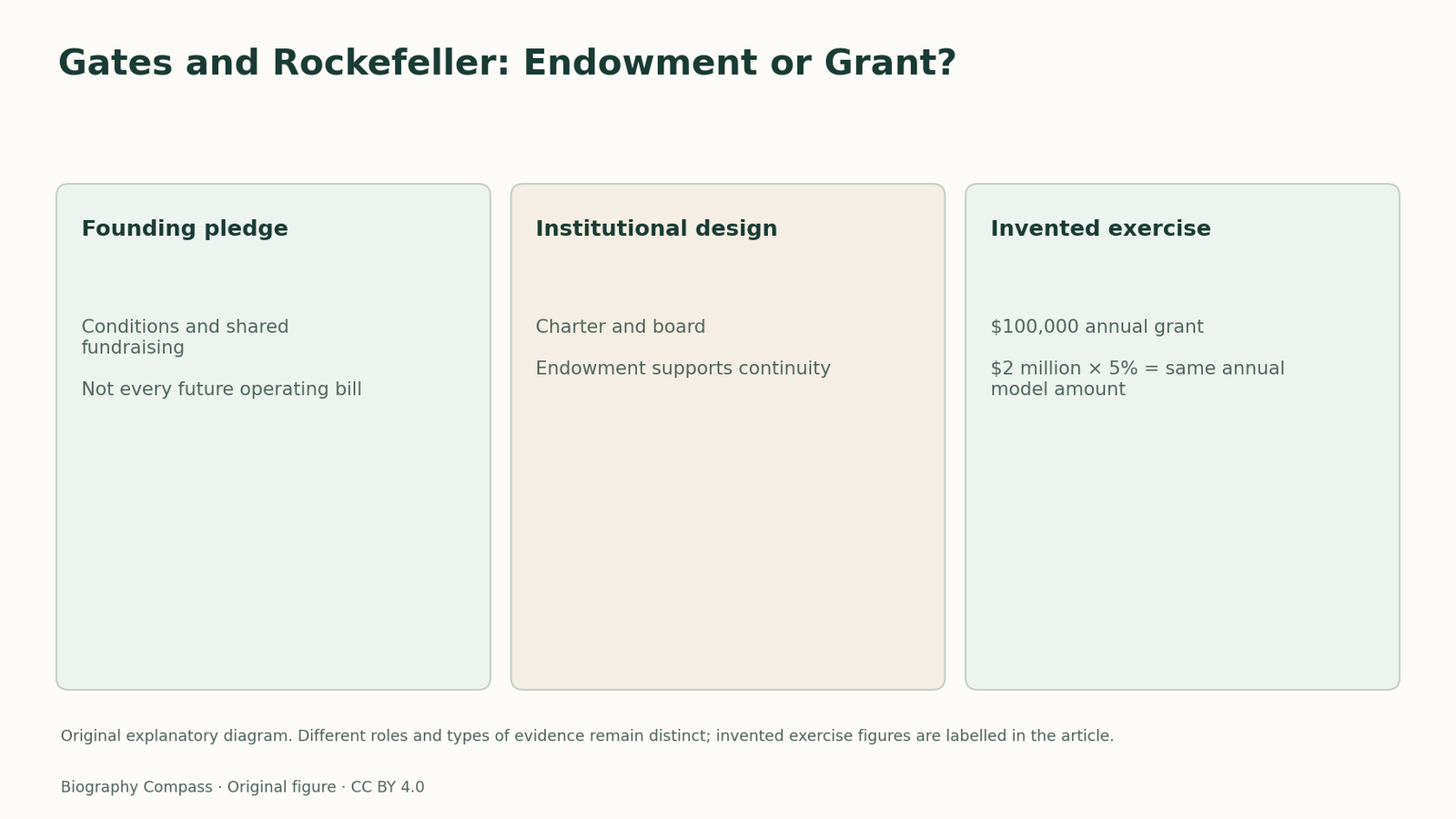
The University of Chicago’s exhibition describes Rockefeller’s 1889 pledge of $600,000, conditional on supporters raising another $400,000. A condition attached to a founding gift is different from a promise to meet every future operating deficit. The distinction became important as William Rainey Harper’s plans expanded. The exhibit also quotes Gates telling Harper in 1892 that the university’s proper officers were expected to carry management responsibility. These records connect funding with governance without making them identical: a donor can provide resources while pressing an institution’s officers to decide how they will be used and sustained.
Sources for this section: [5]
Gates’s memoir distinguishes capital and current need
In his retrospective account, Gates describes seeking additional endowment while also confronting immediate expenses and recurring shortfalls at Chicago. His 1905 proposal for specific trusts brought together independent charters, boards and endowments. That was an organisational proposal rather than simply a larger version of a one-year cheque. A memoir remains an interested source, particularly when explaining disputes in which its author participated. The inspected excerpt supports the distinction he argued for; it does not establish that all later foundations followed one uniform spending rule or that an endowed body could never need further fundraising. The original 1905 letter itself was not newly inspected.
Sources for this section: [4]
Continuing income and annual support have different risks
The library’s history records a later move toward stronger endowment support after disputes over budgets and deficits. As an analytical distinction, an annual grant can cover an identified period without guaranteeing the next one, while capital held to generate income requires decisions about investment, spending and institutional authority. Neither arrangement automatically removes uncertainty. The important historical question is which obligation a particular gift actually creates. Calling every contribution endowment obscures restrictions and purposes; calling all endowment a one-time expense misses the intended relationship between capital and future support. Those are interpretive consequences of comparing the identified records, not claims that a single arrangement is suitable for every modern charity.
Funding-model exercise and reference answer
Use invented teaching figures, not Rockefeller’s actual returns. Institution A receives $100,000 for this year’s running costs. Institution B receives $2 million of capital and is permitted, for the exercise, to spend 5 percent annually. Both begin with $100,000 available for annual operations under those assumptions, but their commitments and remaining resources differ. The reference answer identifies A’s immediate grant and B’s capital base, then notes that a future return or spending rate is not guaranteed by this arithmetic. It also asks who can change the spending terms and whether the gift restricts purpose. The exercise explains why Gates’s combination of charter, board and endowment was institutional design rather than a promise that a large initial amount would magically pay every bill forever.
Continue the chronology
Related history guides
Homestead 1892: Who Defined the Dispute?
Compare Frick’s 1892 statement with a critical wage-scale letter and workers’ recollections, distinguishing plant control, price benchmarks and wages with an exercise.
Read the timeline1968–1970EDB to DBS 1968: What Actually Moved?
Compare Singapore’s 1968 asset-transfer bill with a contemporary account of DBS, distinguishing inherited loans, new lending and equity with a worked exercise.
Read the timelineBiography context
Explore United States through connected lives
Connected biographies
People behind the collaboration
1853–1929
Frederick T. Gates
Philanthropic adviser and institution organiserFrederick T. Gates helped turn John D. Rockefeller’s giving into organised institutions, linking educational fundraising, medical research and the design of lasting endowments.Read biography
1839–1937
John D. Rockefeller
Oil entrepreneur and institutional philanthropistAn American oil businessman whose Standard Oil organization became a focus of antitrust action and whose fortune funded enduring philanthropic institutions.Read biography1849–1919
Henry Clay Frick
Coke and steel industrialist and art collectorHenry Clay Frick connected coke production with Carnegie steelmaking, confronted organised labour at Homestead and later left an art collection and endowment for a public museum.Read biographyQuick answers
Common questions
- Are the exercise’s 5 percent return and $2 million figures historical Rockefeller data?
- No. They are explicitly invented teaching assumptions used to separate annual support from a capital-based funding model.
Primary and institutional sources
How this history was checked
The bibliography distinguishes contemporary records, retrospective participant accounts and later institutional research. Access limits and uncertain attributions are identified in the article; the exercise is an original teaching example. This article was reviewed on 7 November 2026.
- American National Biography / Oxford University PressGates, Frederick Taylor
- University of Chicago LibraryGuide to the Frederick Taylor Gates Papers 1888–1906
- PBS American ExperienceFrederick Gates
- Frederick T. Gates / American HeritageThe Memoirs of Frederick T. Gates, April 1955 excerpt
- University of Chicago Library exhibitionJohn D. Rockefeller: Building for a Long Future