
The short answer
What changed when development financing moved from EDB into DBS in 1968?
Compare the documents
Authority, evidence and limits
These records describe different responsibilities; one should not silently substitute for another.
| Record | What it establishes | What it does not establish |
|---|---|---|
| Bill 45/1968, clauses 2–3 | Proposes separate transfer routes for loans and equities through the minister. | The published bill is not a separately verified final enactment. |
| IMF contemporary account | Reports inherited portfolio, new approvals and equity participation. | The three categories are not all new cash disbursements. |
| NLB biography | Connects Hon’s EDB, DBS and ministerial appointments. | A career chronology does not replace institutional financial records. |
A development agency and a bank had different jobs
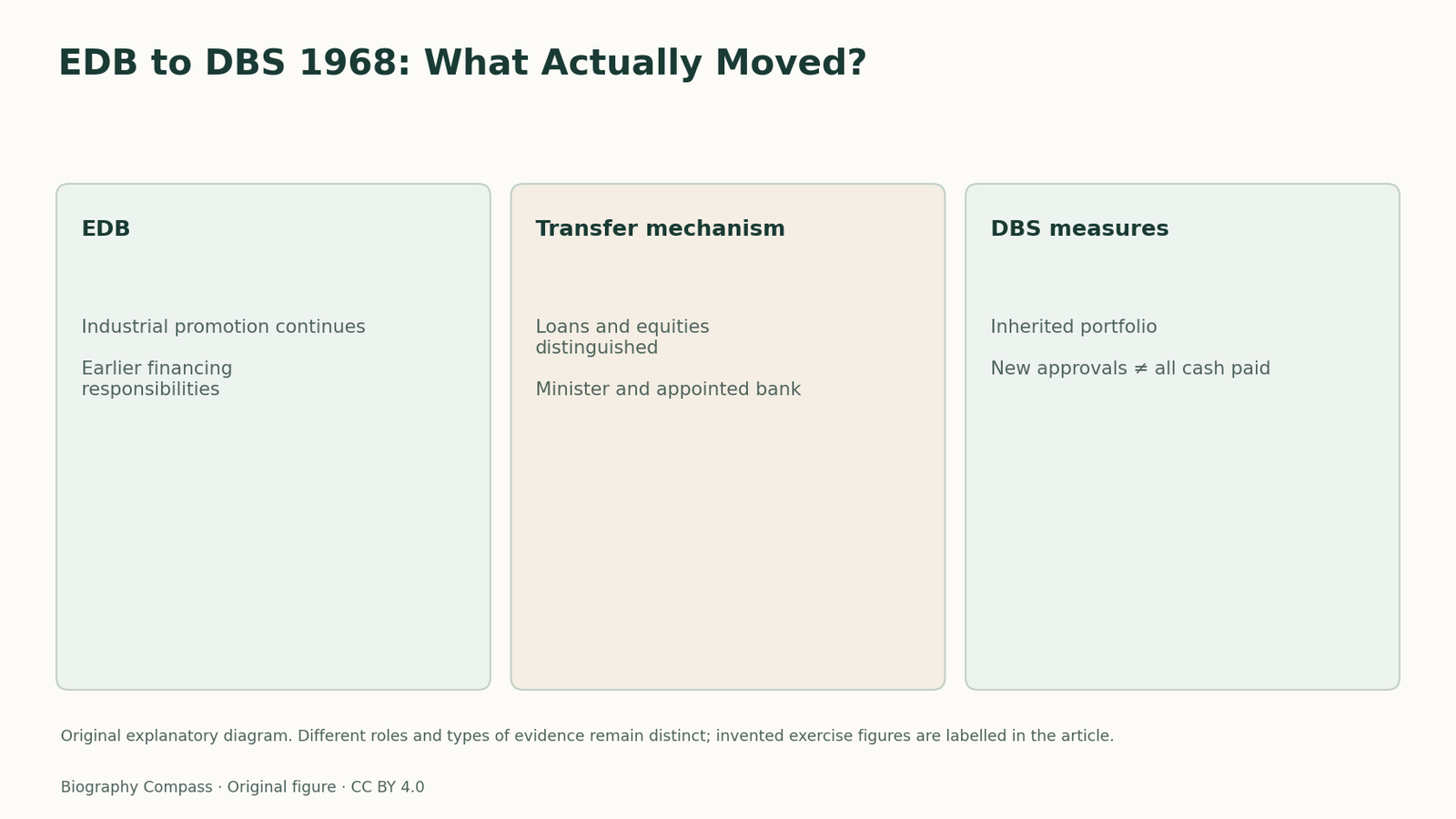
The 1970 IMF account describes EDB’s earlier financing role and DBS’s start of operations on 1 September 1968. EDB remained involved in industrial promotion while the bank handled a specialised financing function. This distinction prevents the transfer from being described either as the disappearance of EDB or as the instant creation of an entirely new industrial economy. Agencies can divide work while pursuing related objectives. Hon Sui Sen’s movement between their leadership positions helps connect the people, but the institutional change should be read through its records rather than inferred only from one man’s appointments.
The bill proposed a route through the minister
The inspected Bill 45/1968 was first read in December and proposed operation from 1 September. Clauses 2 and 3 treated loans and equities separately, with transfers through the Minister for Finance and provision for transfer onward to an appointed bank. Other clauses addressed assets, directions and guarantees. A legal mechanism for moving rights and obligations is more specific than the shorthand phrase DBS took over financing. This source is the published bill version, so its proposed machinery is compared with the contemporary operational account rather than silently presented as a separately verified final enactment. Publication date, proposed effective date and the bank’s operational date answer different questions.
Sources for this section: [4]
Inherited assets are not new approvals
The IMF account reports a loan portfolio of about S $45 million transferred from EDB, over S $100 million in 52 new loan approvals during DBS’s first year, and nearly S $24 million of equity participation in 20 projects. The categories matter more than an impressive combined total. A portfolio is an existing stock of claims; approvals describe new decisions during a period; equity participation is not simply another label for a loan. Nor does approval necessarily mean immediate full disbursement. The passage gives a contemporary view of expansion, but it is not a complete audited reconciliation of every balance or a measure of all lending in Singapore’s private financial sector.
Sources for this section: [3]
Classification exercise and checked answer
Place three invented ledger labels beside the reported categories: inherited loan book, new loan approvals and equity decisions. A hypothetical reader adds 45,100 and 24 and announces S $169 million of new cash lent in the first year. Explain two problems with that conclusion. The reference answer first notes that 45 belongs to an inherited portfolio, not wholly new lending. It then separates equity decisions from loans and observes that approvals are not automatically paid-out cash. Because the account says over 100 and nearly 24, the precise 169 total also gives a false sense of accuracy. The exercise is an original classification of the published figures, not a reconstructed bank statement. A defensible summary preserves the institutional transition and the three measures rather than merging them into one promotional statistic.
Continue the chronology
Related history guides
Biography context
Explore Singapore through connected lives
Connected biographies
People behind the collaboration
1916–1983
Hon Sui Sen
Civil servant, development banker and finance ministerHon Sui Sen helped connect Singapore’s industrial promotion, development banking and public finance through leadership of EDB, DBS and the finance ministry.Read biography
1918—2010
Goh Keng Swee
Deputy Prime Minister and economic architect of SingaporeA founding-generation minister whose institution-building shaped Singapore’s industrial economy, armed forces, monetary system and education policy.Read biography
1923—2015
Lee Kuan Yew
Founding Prime Minister of Singapore, 1959–1990The lawyer and PAP founder who became prime minister in 1959, led Singapore through independence in 1965 and remained in cabinet after handing power to Goh Chok Tong.Read biographyQuick answers
Common questions
- Can the inherited loan portfolio be counted as entirely new first-year lending?
- No. The account distinguishes transferred existing loans, new approvals and equity participation. It does not give one combined figure of new cash disbursements.
Primary and institutional sources
How this history was checked
The bibliography distinguishes contemporary records, retrospective participant accounts and later institutional research. Access limits and uncertain attributions are identified in the article; the exercise is an original teaching example. This article was reviewed on 7 November 2026.
- National Library Board SingaporeHon Sui Sen
- Lee Kuan Yew / National Archives of SingaporePrime Minister’s Tribute to the Late Mr Hon Sui Sen, 20 December 1983
- Finance & Development / International Monetary Fund, 1970The Impact of Development: Singapore
- Singapore Statutes OnlineEconomic Development Board (Transfer of Assets) Bill 45/1968
- National Archives of SingaporeGoh Chok Tong speech, 17 November 1990