
The short answer
How do traced movement, drawings and photographic reference disrupt a continuous journey?
Read the evidence
Sources, interpretation and production roles
The records answer different questions about this work. The final exercise is an original teaching model.
| Record or question | Supported reading | Boundary or contrast |
|---|---|---|
| Breer’s 1976 interview | Explains filmed reference, redrawing, invention and pauses. | A participant account is not an inventory of every frame. |
| Pompidou collection record | Registers work date, medium and acquisition. | A museum print’s format is not necessarily the reference-footage format. |
| Harvard screening programme | Documents a later presentation and critical description. | Different screening specifications should not be silently flattened. |
A journey supplies reference, not a complete finished image
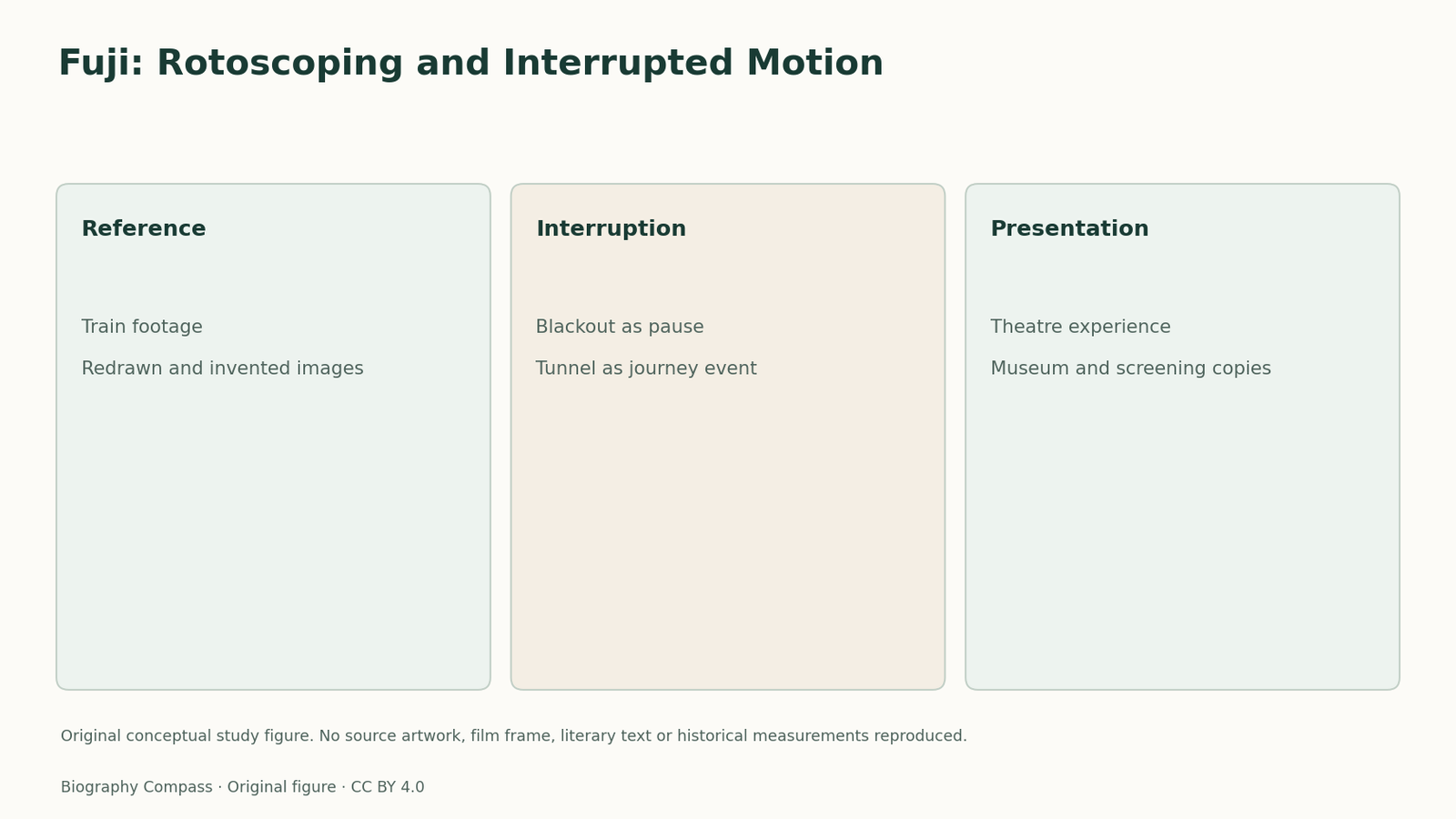
Fuji (1974) uses imagery associated with a train journey between Tokyo and Osaka. In his 1976 interview, Breer explains that he filmed reference material and then redrew it, while also inventing imagery. This makes the film a useful case for distinguishing rotoscoping from simple copying. A photographed movement can provide a starting relation between frames without determining the final line, colour or surrounding composition. The train journey is consequently both a source of observed movement and material for another kind of experience. The participant’s account supports that distinction without identifying every individual drawing’s origin.
A blackout can be an organised pause
Gardner asks why the screen or sound sometimes disappears. Breer responds in terms of theatrical viewing: a black screen darkens the room and can feel like a break in the apparatus itself. He also connects the pauses in Fuji with tunnels along the route. These are two different levels of explanation. A tunnel belongs to the represented journey; a pause belongs to the film’s rhythmic organisation and the audience’s situation. They can reinforce one another without being identical. The remarks help a viewer ask what an interruption does, rather than treating every discontinuity as a mistake that smooth animation ought to conceal.
Sources for this section: [3]
Museum records preserve versions and presentation histories
Centre Pompidou registers a 1974 colour, sound film in 16 mm and a 1975 acquisition. Harvard’s screening programme lists a different exhibition print specification and describes a blend of landscape, passengers and train interiors. The records should not be forced into one supposedly universal running time or format. A film’s reference footage, production materials and later screening copies can differ. More importantly, their presence in different institutions creates a documented history of circulation. That history supports analysis of the work while remaining separate from the primary interview’s explanation of how a particular technique or pause was conceived.
An original interrupted-journey model
Draw six invented views from a bus window. Make a first sequence that presents all six at equal intervals, a second that inserts a blank card between the third and fourth, and a third that returns briefly to the second view. A reference answer distinguishes smooth succession, a pause and a remembered or repeated image. None is automatically the most truthful version of a journey. Ask what information would be needed before identifying a blank as a tunnel rather than an abstract interval. This original exercise uses no Fuji frames or historical measurements. It separates a formal operation from its possible interpretation and makes the role of an explanatory source visible.
Continue the chronology
Related history guides
Biography context
Explore United States through connected lives
Connected biographies
People and related creative practices
1926–2011
Robert Breer
Experimental filmmaker, painter and sculptorRobert Breer entered filmmaking through abstract painting, then explored drawing, photography, rotoscoping and kinetic sculpture as different ways of organising movement.Read biography1901–1980
Len Lye
Filmmaker, kinetic sculptor and visual artistLen Lye was a New Zealand-born artist whose career crossed London and New York. His experiments joined painting, film and sculpture through a lasting interest in how movement could become an artistic medium.Read biography1920–2015
René Jodoin
Animation director, producer and studio founderRené Jodoin combined experimental direction with institution building, mentoring filmmakers and linking the NFB’s animation studio to research and new techniques.Read biographyQuick answers
Common questions
- What is rotoscoping’s role in Fuji?
- Filmed movement provided reference for drawings, while invention and editing changed the finished experience.
- Why can a blank screen matter?
- Breer described it as a rhythmic and theatrical pause, which can also connect to the journey’s tunnels.
Primary and institutional sources
How this history was checked
Sources include production records, institutional collections and the specifically identified passages discussed here. Interpretations and teaching models are distinguished from credits and publication facts. This article was reviewed on 7 November 2026.