
The short answer
A court can distinguish a permitted activity from a prohibited process and still refuse the applicant’s requested remedy. Read rule, reasoning and disposition as three separate parts of a case note.
Documentary comparison
Permission, compulsion and relief
Keep the claim, its evidence and the inference in separate columns.
| Record or test | What the record does | What must remain separate |
|---|---|---|
| Constitutional text | Sets a boundary to test | The label put on an investigative act |
| Judicial reasons | Distinguish the relevant activities | A finding of criminal guilt |
| Disposition | Identifies the result for the parties | Every general proposition in the reasons |
Chronology
A timeline of the turning points
Judgment
Read the reasons together with the operative result.
Compilation label
Record the edition; do not silently call it current.
Identify the edition before using the article
The retained NHRC compilation labels the 1999 Constitution as CAP C23, Laws of the Federation 2004. Section 308 restricts proceedings, arrest or imprisonment and compulsory personal appearance during specified offices. Its text also contains official-capacity and nominal-party exceptions.
This is an identified historical reproduction, not a current-law consolidation or an original 1999 print. An edition note belongs beside the extract because the title alone does not identify every amendment or printing decision. A rule quoted in a judgment is also a different evidential object from a later compilation, even when the relevant wording appears consistent.
Read the distinction made in the judicial reasoning
In Fawehinmi v Inspector-General of Police, the Supreme Court distinguished investigation from civil or criminal proceedings. Investigators could assemble third-party evidence without imposing the personal coercion barred by immunity.
Do not turn the distinction into a slogan that every investigative step is necessarily available. Identify the proposed act and ask whether it crosses the boundary the court discussed. The name given to an activity is not enough: calling a step “research” would not change what it actually requires of the protected person.
The remedy and operative result remain separate
The judgment also addressed police discretion, mandamus and the applicant’s legal interest. It dismissed Fawehinmi’s appeal and partly allowed the cross-appeal on standing. A discussion permitting investigation did not produce the order he sought.
This is why a case note needs a disposition field. A proposition in the reasons, an order compelling a public body and a determination of criminal guilt answer different questions. The public prominence of the applicant cannot supply any missing step. Reading only an editorial ratio or an appealing sentence risks converting useful reasoning into an inaccurate account of the litigation’s result.
Sources for this section: [2]
Exercise: classify acts before predicting remedies
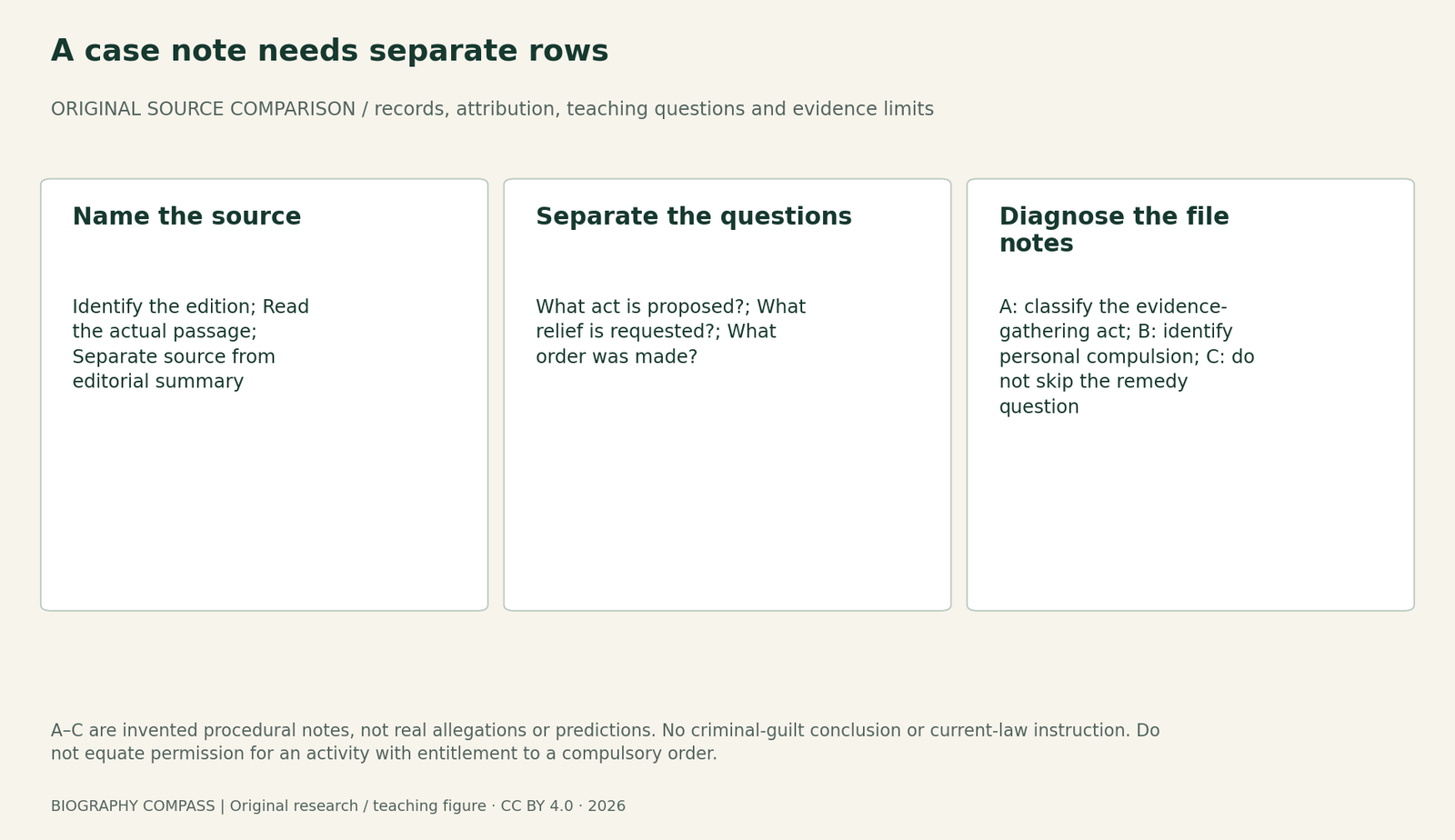
Consider three invented file notes. A proposes collecting records from an unprotected third party. B proposes compelling the officeholder’s personal court appearance. C says that a court’s recognition of a permissible activity automatically entitles every applicant to an order compelling it. Classify the act in A and B, then diagnose C as a separate claim about relief.
Worked answer: A tests the distinction between obtaining evidence and coercing the officeholder. B raises the stated restriction on compulsory personal appearance. C skips the separate conditions for the requested remedy. An accurate annotation keeps that question open until the court’s reasoning and disposition are read. This exercise does not predict the outcome of a real investigation and makes no allegation about any person.
Use a case-note structure that resists overclaiming
Create rows for text edition, issue, judicial distinction, requested relief, disposition and remaining evidence. Put the source beside the precise row it supports. This makes a disagreement visible without multiplying claims: a researcher can accept that an activity was distinguished from proceedings while also recording that this applicant failed to obtain a particular order. The comparison is confined to a dated case and inspected passages, not present legal advice.
Continue the chronology
Related history guides
Biography context
Explore Nigeria through connected lives
Connected biographies
People connected with these records
1938–2009
Gani Fawehinmi
Lawyer, publisher and political campaignerGani Fawehinmi combined legal practice and publishing with campaigns over public accountability, education and political freedom.Read biographyQuick answers
Common questions
- Can reasons and the applicant’s result point in different directions?
- Yes. Record the legal distinction and the order actually made in separate fields.
- Does this exercise determine criminal guilt?
- No. It classifies source claims and procedural acts; it does not decide an accusation.
Primary and institutional sources
How this history was checked
Read the historical records alongside the specified edition and access notes. This article was reviewed on 29 October 2026.