
The short answer
A treaty and a land judgment can concern the same place while answering different questions. This exercise separates a change in governing authority from the interests used to assess compensation.
Documentary comparison
Do not collapse the chain of inference
Keep the claim, its evidence and the inference in separate columns.
| Record or test | What the record does | What must remain separate |
|---|---|---|
| Treaty | Records terms of cession | Every interest in every plot |
| Appeal | Corrects the compensation basis | A completed money assessment |
| Archive caption | Names an issue and a capacity | A conclusion inserted by the cataloguer |
Chronology
A timeline of the turning points
Treaty text
Identify the different functions of its clauses.
Appeal
Distinguish the issue decided from the next inquiry.
Start with the words of the cession
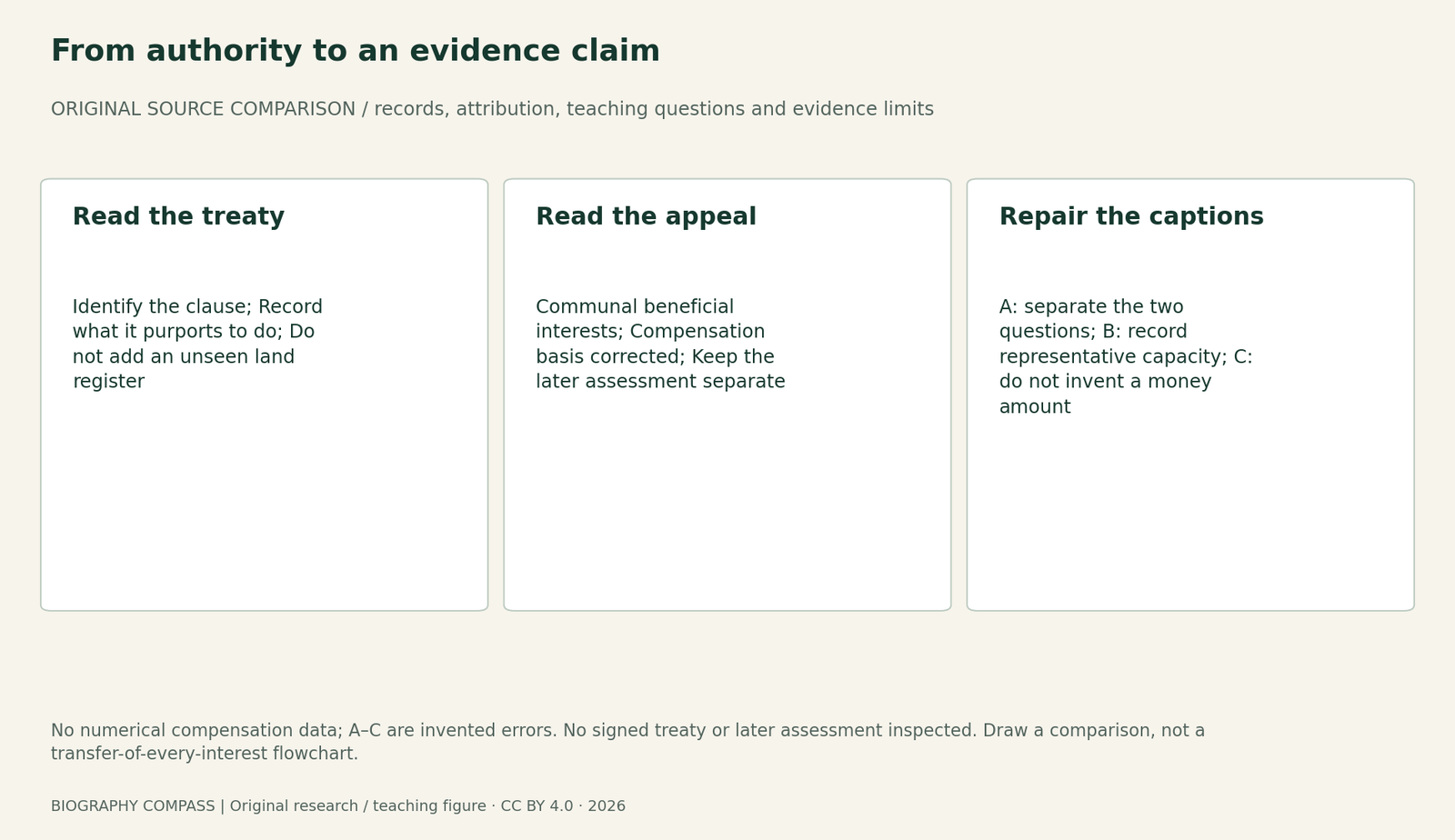
The Ardhi transcription dates the Lagos treaty to August 1861. Article I uses expansive language of cession and sovereignty. Article II retains a role for the king in disputes with consent, subject to appeal under British law. Article III concerns the significance of his stamp for competing native claims.
These are clauses in a historical transcription, not a signed facsimile. Begin by recording what each clause purports to do. A general statement about authority does not, without another interpretive step, answer every question about a particular family, community or plot. Nor does the act of transcribing an agreement establish how consent was obtained.
Sources for this section: [1]
Read the compensation appeal on its own terms
In 1921 the Privy Council rejected an approach that forced the community’s interests into English categories of ownership. Sovereignty and the Crown’s radical title did not necessarily extinguish beneficial communal interests. The compensation basis recognised full ownership, except for unoccupied land within the ordinance’s definition; further inquiry was required.
Notice the difference between identifying a basis for valuation and producing a completed valuation. An appellate declaration may correct the question for another tribunal to answer. A catalogue that records only “won the land case” loses both the legal issue and the work still required after the appeal.
Sources for this section: [2]
Separate the person named from the capacity represented
The chief represented a community; the judgment contemplated distribution through the Native Council, subject to the Governor. It did not award him every communal interest as personal property.
For an archive entry, create fields for named claimant, representative capacity, beneficiaries, disputed interest and remedy. Keep them separate even when a database offers only one name box. This is also a way to read a political biography: assistance to a claimant, legal advocacy and judicial decision-making are different contributions. A famous supporter should not silently replace the people whose interests supplied the dispute.
Sources for this section: [2]
Exercise: diagnose three invented catalogue captions
Caption A says: “A change in sovereign authority proves that no local beneficial interests survived.” Caption B says: “The named chief personally received every interest belonging to the community.” Caption C says: “The appeal itself supplies a final money amount.” Mark the inferential jump in each caption before consulting the answer.
Worked answer: A merges governing authority with the separate question of beneficial interests. B replaces a representative capacity with personal ownership. C confuses a valuation basis with a completed assessment. The appeal required further inquiry; it was not a fixed compensation award. A better entry identifies the issue decided and adds a separate box for the missing later assessment. All three captions are invented diagnostic errors, not quotations from an archive.
Use a bounded research note
A useful note can preserve uncertainty without becoming empty. List the inspected text, its reproduction or transcription status and the precise proposition it supports. Then state the next record needed for the next claim. This prevents an appealing narrative from carrying an unexamined inference from treaty to title, title to payment or payment to personal enrichment. The comparison concerns historical documents and is not advice about present land rights.
Continue the chronology
Related history guides
Biography context
Explore Nigeria and United Kingdom through connected lives
Connected biographies
People connected with these records
1864–1946
Herbert Macaulay
Surveyor, journalist and nationalist organiserHerbert Macaulay moved from technical training and colonial employment into nationalist politics, connecting local campaigns with a wider movement for self-government.Read biographyQuick answers
Common questions
- Does the named claimant have to be the sole beneficiary?
- No such inference follows from the name alone. Record capacity and beneficiaries separately.
- Is a corrected compensation basis the same as a final payment?
- No. Record the decision and look separately for an assessment or payment record.
Primary and institutional sources
How this history was checked
Read the historical records alongside the specified edition and access notes. This article was reviewed on 29 October 2026.