
The short answer
An assurance has an actor, a beneficiary, an action and conditions. Compare two selected Commons records to see why changing any one of those fields can change the apparent promise.
Documentary comparison
Three claims that require different records
Keep the claim, its evidence and the inference in separate columns.
| Record or test | What the record does | What must remain separate |
|---|---|---|
| Reported court step | A speaker’s account of another institution | The underlying judicial reasons |
| Conditional undertaking | An identified action with limits | An unconditional guarantee |
| Disputed recollection | Evidence that accounts conflict | Proof of the original conversation |
Chronology
A timeline of the turning points
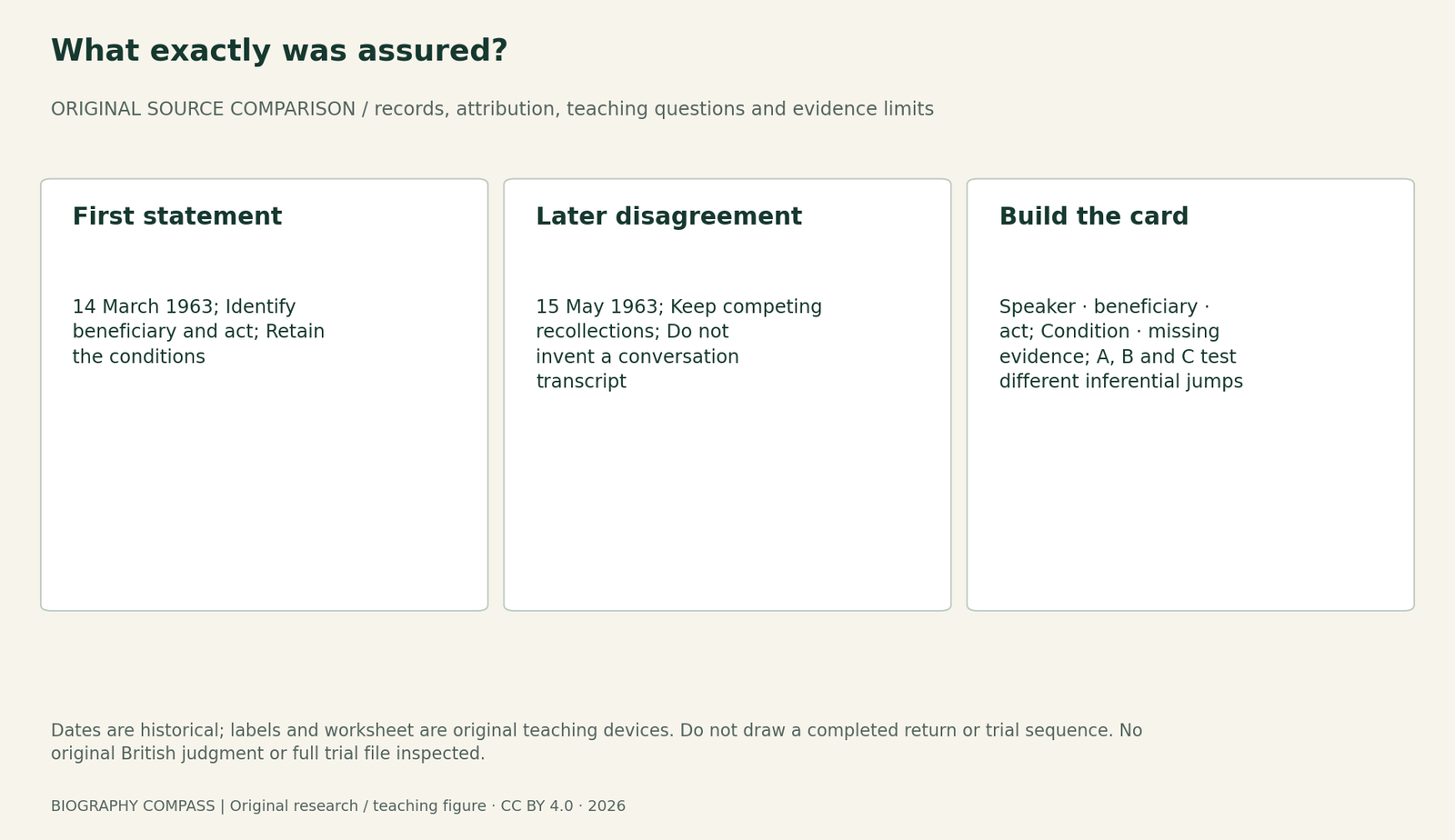
Ministerial statement
Record speaker, act and condition.
Disputed recollection
Preserve competing accounts rather than inventing a transcript.
An official statement reports several institutional stages
On 14 March 1963, Home Secretary Henry Brooke described proceedings under the Fugitive Offenders Act and his own decision on return. He reported a magistrate’s decision, failed court applications and refusal of leave to appeal. These are Brooke’s reported court outcomes, not judgments reproduced here.
The distinction matters because a speaker can report another institution’s action while taking responsibility for a different decision. A documentary chronology should retain both the reporting speaker and the institution described. Otherwise a parliamentary statement can be mislabelled as a judicial finding, and a declared intention can become an event that the selected passage never records as completed.
Sources for this section: [1]
The undertaking about defence counsel was conditional
Brooke described a Nigerian undertaking about entry for a chosen British defence barrister. Eligibility to practise depended on Nigerian law and a Chief Justice’s certificate. Entry would not be refused merely because the barrister represented Enahoro; other good reasons could remain.
An assurance about entry and a rule about professional eligibility are different gates. A researcher should not drop the conditions to create an unconditional guarantee. Equally, a condition should not be enlarged until it becomes a claim that no protection was offered at all. The task is to preserve the action and its stated limits.
Sources for this section: [1]
A later exchange exposes a disputed understanding
In selected replies on 15 May, Brooke said the earlier assurance to an intermediary concerned admission to Britain, not freedom from arrest, and referred to a Fugitive Offenders Act warning. John Stonehouse disputed that account of the understanding reached. The exchange records disagreement; it does not reproduce the original conversation.
Do not resolve that dispute simply by choosing the more confident speaker. Enter the incompatible accounts in parallel, identify who claims direct knowledge and ask what contemporaneous note or correspondence could test them. A debate may establish that a disagreement existed without establishing which recollection was accurate.
Sources for this section: [2]
Exercise: build an assurance card
For each selected passage make a card with five boxes: speaker, beneficiary, permitted action, condition and missing evidence. Then diagnose three invented labels: A, “Entry automatically confers professional eligibility”; B, “Permission to enter proves freedom from arrest”; C, “An announced return decision proves the whole transfer and trial have occurred.”
Worked answer: A crosses from immigration permission to a separate professional decision. B treats two different actions as synonyms. C substitutes an announced or reported stage for a completed sequence. Rewrite each label to name only the action actually described, retain any condition and leave a box for the next record. The labels test reading discipline; they are not historical quotations or findings about a later trial.
Keep the geographical and evidential roles visible
The parliamentary discussion took place in Britain and concerned a proposed return to Nigeria. The governing actors and sources therefore belong in a combined geographical account. The original British court decisions, the intermediary’s contemporaneous correspondence and a complete Nigerian trial file were not inspected for this comparison. Those limits prevent a selected debate from becoming a comprehensive rendition history or advice on present procedure.
Continue the chronology
Related history guides
Did Cession End Communal Land Interests?
Compare a different documentary error: merging authority with beneficial interests.
Read the timeline2002Did Immunity Stop Investigation in 2002?
Compare a different documentary error: confusing legal reasoning with the relief granted.
Read the timelineBiography context
Explore Nigeria and United Kingdom through connected lives
Connected biographies
People connected with these records
1923–2010
Anthony Enahoro
Journalist, parliamentarian and democracy campaignerAnthony Enahoro moved from newspaper editing into the Action Group, parliamentary politics and later campaigns against military rule.Read biography1906–1993
Adetokunbo Ademola
Chief justice and public-institution leaderAdetokunbo Ademola developed a judicial career from colonial service and regional courts into the federal chief justiceship, later combining legal and international public roles.Read biographyQuick answers
Common questions
- Is this an account based on the original British judgments?
- No. It compares selected parliamentary passages and identifies reported judicial steps as reported.
- Can the disagreement be settled from confidence of tone?
- No. Seek a contemporaneous record that can test the incompatible accounts.
Primary and institutional sources
How this history was checked
Read the historical records alongside the specified edition and access notes. This article was reviewed on 29 October 2026.