
The short answer
The 1831 ring experiment is often reduced to “a current made another current.” Faraday’s own report makes time central: the response at connection differed from what happened while the battery contact remained unchanged.
Evidence comparison
Read the role of each record
This original comparison follows the cited source scopes.
| Record | Evidence | What it supports | Limit |
|---|---|---|---|
| Make contact | Brief deflection | A transient secondary response | No exact peak current supplied. |
| Continue contact | Needle settles | Not a maintained deflection | Primary contact remains continued. |
| Break contact | Contrary deflection | Direction differs from first response | No equal-height waveform established. |
Chronology
A timeline of the turning points
Ring apparatus
The surviving institutional object is dated August.
Paper read
First Series read on 24 November.
Publication
The original series appeared in Philosophical Transactions.
Separate the circuits before interpreting the needle
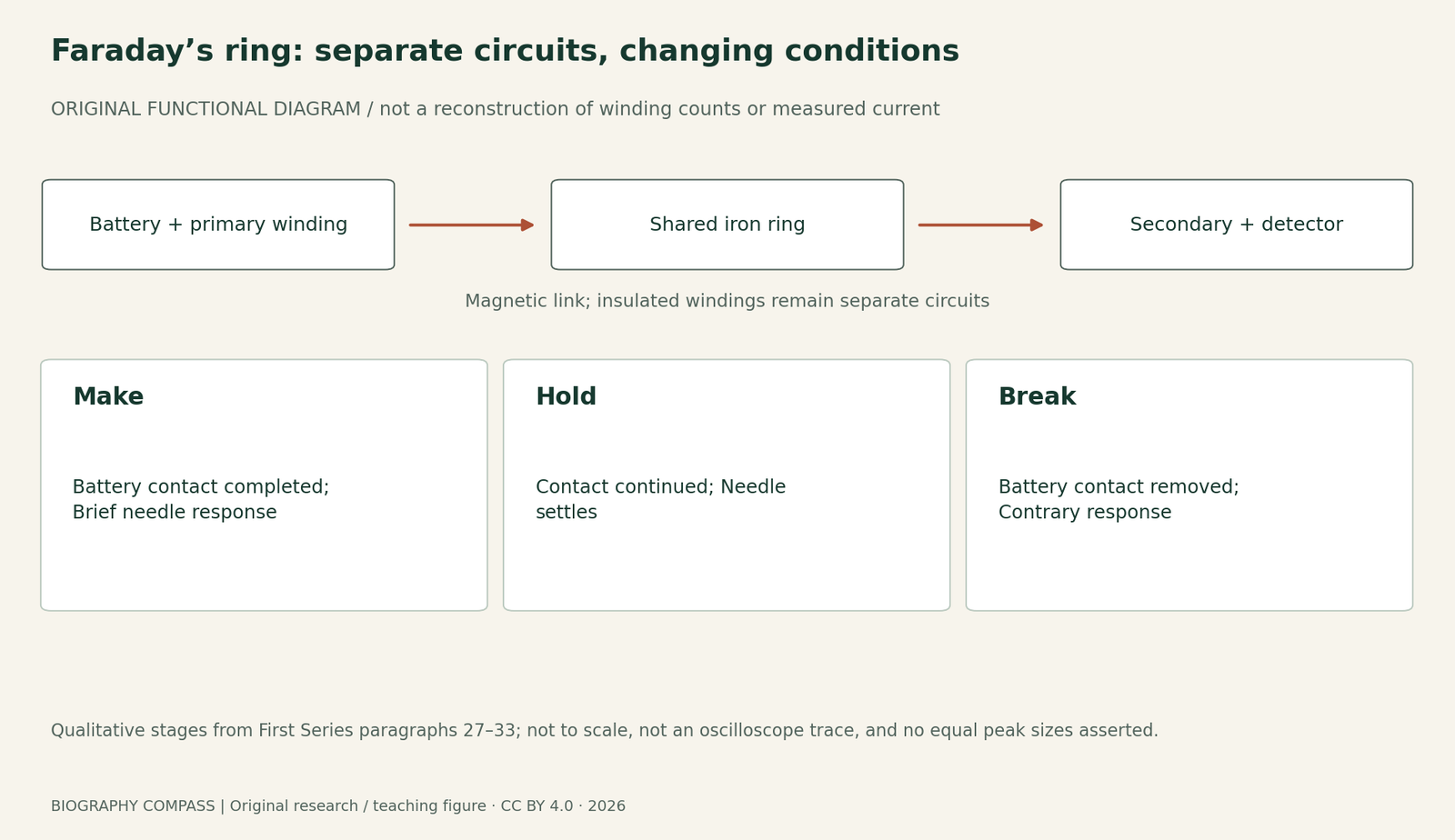
Paragraph 27 of Faraday’s First Series describes insulated windings on a soft-iron ring. Paragraph 28 connects one winding group to a battery and the other to a galvanometer. The ring links their magnetic conditions; the description does not make the windings one shared conducting wire.
Keeping that distinction visible prevents a misleading explanation in which current simply travels from the battery through the iron into the second wire. The Royal Institution’s surviving apparatus record independently identifies the wire, cotton and iron of the object made in August 1831.
Three moments, three observations
On completing battery contact, the galvanometer responded briefly. With contact continued, the needle returned to its natural position. Breaking contact produced another response in the contrary direction. Paragraph 30 restates that maintaining the battery current did not maintain the needle deflection.
The contrast supports induction associated with changing conditions in this arrangement. It should not be generalised to a statement that no electrical system can have a steady induced voltage under other configurations. Our account stays with this reported ring experiment.
Sources for this section: [1]
A moving needle is not a measured modern waveform
The report also varies the strength of the battery and arrangements of the windings. Faraday describes a stronger initial impulse in another trial and cautions through experimental detail rather than giving a modern oscilloscope trace. A detector’s motion also has its own dynamics.
Our figure therefore uses three labelled stages instead of inventing measured current-versus-time values. A modern explanation can connect this work to changing magnetic flux, but the 1831 text did not use today’s complete mathematical notation. Observation, interpretation and later formulation should remain distinguishable.
Sources for this section: [1]
Questions and answers for a source-based conclusion
Question 1: after connection, the needle settles; has the battery necessarily stopped supplying its own circuit? Answer: no. The report explicitly continues that contact while describing the secondary response as non-permanent. Question 2: what additional observation makes timing persuasive? Answer: breaking contact produces the opposite deflection.
Question 3: is a sketch with equal positive and negative peaks a historical measurement? Answer: only if evidence supplies those values. This source supports a qualitative change of direction, not a measured equality of peak height, duration or total charge. A defensible diagram labels those missing quantities instead of inventing them.
Sources for this section: [1]
Continue the chronology
Related history guides
Newton’s 1672 Prism Experiment: What Did the Second Prism Test?
Read Newton’s 1672 light letter, compare his prism tests and practise separating an observation from the inference that sunlight contains differently refracted rays.
Read the timeline1844–1859Darwin and Wallace in 1858: Authors, Documents and Communicators
Compare the 1858 Darwin–Wallace communication’s authors, document dates and editorial roles, with a source-table exercise and explained answers.
Read the timelineBiography context
Explore United Kingdom through connected lives
Michael Faraday
Michael Faraday built an experimental career at the Royal Institution, investigating electricity, magnetism and chemistry while developing public science lectures.
Explore the biographiesResearcherJames Clerk Maxwell
James Clerk Maxwell developed an electromagnetic theory of light and helped establish Cambridge’s Cavendish Laboratory, alongside research on gases, colour and mechanics.
Explore the biographiesConnected biographies
Researchers and related lives
1791–1867
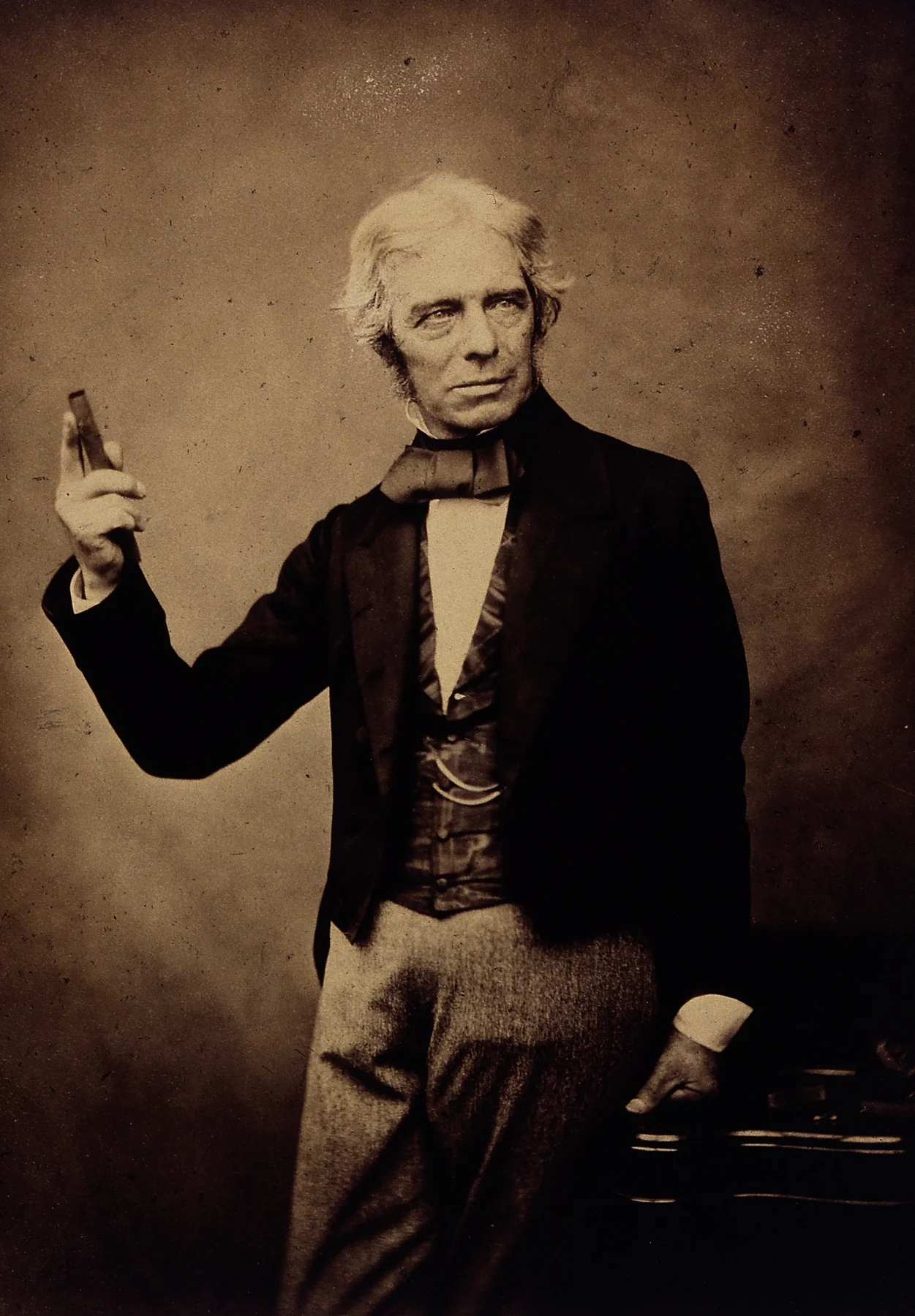
Michael Faraday
Experimental chemist and physicistMichael Faraday built an experimental career at the Royal Institution, investigating electricity, magnetism and chemistry while developing public science lectures.Read biography1831–1879
James Clerk Maxwell
Physicist and mathematical researcherJames Clerk Maxwell developed an electromagnetic theory of light and helped establish Cambridge’s Cavendish Laboratory, alongside research on gases, colour and mechanics.Read biographyQuick answers
Common questions
- Did current simply pass through the iron to the secondary coil?
- Faraday describes insulated windings and uses the return to the indifferent state as part of his argument against diversion of battery current.
- Is the diagram an experimental trace?
- No. It is an original qualitative comparison of reported stages; no new current measurements are plotted.
Primary and institutional sources
How this history was checked
Original source comparisons distinguish historical observations, interpretations and publication roles. Exercises are editorial learning materials, not newly performed experiments. This article was reviewed on 27 October 2026.