
The short answer
A first Hemingway book need not be his first publication. This guide separates a selected publication chronology from suggested reading routes, explains which titles are novels or collections, and flags books assembled from manuscripts after his death. The routes are editorial suggestions, not a ranking or an instruction left by Hemingway.
Publication chronology, with route labels
Selected Hemingway books by first publication
Rows follow original publication years, not the suggested beginner order. Same-year titles are grouped. Form labels distinguish prose fiction, mixed volumes and nonfiction; posthumous status is explicit.
| Book | First publication | Form / status | Suggested route |
|---|---|---|---|
| Three Stories & Ten Poems | 1923 | Stories and poems | Early experiments |
| in our time | 1924 | Paris vignette book | Edition comparison |
| In Our Time | 1925 | Expanded story collection | Beginner; early career |
| The Torrents of Spring; The Sun Also Rises | 1926 | Satirical fiction; novel | Experiments; early career |
| Men Without Women | 1927 | Story collection | Short fiction |
| A Farewell to Arms | 1929 | Novel | War fiction |
| Death in the Afternoon | 1932 | Nonfiction | Nonfiction |
| Winner Take Nothing | 1933 | Story collection | Short fiction |
| Green Hills of Africa | 1935 | Nonfiction | Nonfiction |
| To Have and Have Not | 1937 | Novel | Further novels |
| The Fifth Column and the First Forty-Nine Stories | 1938 | Play and stories | Collection comparison |
| For Whom the Bell Tolls | 1940 | Novel | War fiction |
| Across the River and into the Trees | 1950 | Novel | Further novels |
| The Old Man and the Sea | 1952 | Short novel / novella | Compact first encounter |
| A Moveable Feast | 1964 | Posthumous memoir | Paris; edition comparison |
| Islands in the Stream; The Garden of Eden | 1970; 1986 | Posthumous novels | Editorial history |
| The Complete Short Stories | 1987 | Posthumous compilation | Broader story reading |
Chronology
A timeline of the turning points
Three Stories & Ten Poems
Contact published the first book in Paris. Its mixed contents distinguish it from a novel or a full-length story collection.
The small Paris in our time
Three Mountains Press issued the vignette book; the descriptive bibliography transcribes its original title page and records publication on 3 April 1924.
The expanded American In Our Time
Boni & Liveright published the story collection. Its larger scope is not simply a new printing of the 1924 book.
Early novels and another story collection
The Torrents of Spring and The Sun Also Rises appeared in 1926, Men Without Women in 1927, and A Farewell to Arms in 1929.
Several forms developed in parallel
Death in the Afternoon and Green Hills of Africa are nonfiction; Winner Take Nothing is a story collection, To Have and Have Not a novel, and the 1938 Fifth Column volume combines a play with stories.
Later lifetime fiction
For Whom the Bell Tolls appeared in 1940, Across the River and into the Trees in 1950, and The Old Man and the Sea in 1952.
Posthumous books and collections
A Moveable Feast (1964), Islands in the Stream (1970), The Garden of Eden (1986) and The Complete Short Stories (1987) reached readers after Hemingway’s death in 1961.
A different presentation of the Paris memoir
Scribner issued A Moveable Feast: The Restored Edition, with an introduction and editing by Seán Hemingway and a foreword by Patrick Hemingway.
Choose a route before choosing a complete bibliography
For a compact first encounter, start with The Old Man and the Sea, then read In Our Time and The Sun Also Rises. This suggested order moves from one sustained short narrative to a collection and then a longer novel. After each, note which scenes stay with you and what the narration leaves for you to infer. You do not need to finish an omnibus before deciding whether the style rewards your attention.
For an early-career route, read the 1925 In Our Time, The Sun Also Rises, Men Without Women and A Farewell to Arms. This is a selected development sequence, not an exhaustive chronology: the first book, the 1924 vignette volume and The Torrents of Spring belong in a fuller publication history. Return to those early experiments if your interest is how the familiar style emerged, rather than obtaining a quick introduction.
Read In Our Time with its edition identified
The title conceals a substantial bibliographical difference. The 1924 Paris in our time is a small book of compressed prose vignettes. The 1925 American In Our Time expands the project with short stories. When choosing the collection as an introduction, check for the 1925 work rather than assuming that a reprint advertised with a 1924 date contains the same material. Capitalization can be a clue, but the publisher’s description and contents are better checks.
The first book, Three Stories & Ten Poems (1923), is another distinct item. The descriptive bibliography records its contents and publication separately from the 1924 volume. For a comparison exercise, read a brief vignette and then a longer story, asking how much setting, time and motivation each makes explicit. That is an editorial reading exercise; it does not imply that every vignette is a preliminary draft of a particular later story.
Keep a story collection’s arrangement visible
Readers interested in short fiction can continue from In Our Time to Men Without Women and Winner Take Nothing. Read one original collection through before switching to a large compilation. Keeping its sequence visible lets you consider how adjacent pieces change your experience, rather than treating a short story only as an isolated exercise.
The Fifth Column and the First Forty-Nine Stories (1938) is a combined play-and-stories volume, not a novel. The later Complete Short Stories is useful for breadth, but its 1987 publication is posthumous; it is not a collection Hemingway newly arranged that year. Before using any omnibus, inspect the contents and editorial note to find the original collection and identify material added later. Repeated stories across collections do not represent new works each time they are repackaged.
Follow a war-fiction route without turning fiction into testimony
For readers interested in war, pair A Farewell to Arms with For Whom the Bell Tolls. They appeared in 1929 and 1940 and concern different wars and fictional situations. The first is associated with the First World War; the second places Robert Jordan with antifascist guerrillas during the Spanish Civil War. Read each narrative before consulting its background, then distinguish what the book itself establishes from what a biography supplies about its author.
Hemingway’s Spanish reporting provides context for the later novel, but Robert Jordan is not a documentary substitute for Hemingway. Readers who want to study revision can then use the Hemingway Library Edition of For Whom the Bell Tolls, whose publisher identifies drafts, notes and supplementary war writings. Treat the main text and the added documents as separate evidence: the edition’s modern publication date does not replace the novel’s first-publication year.
Approach nonfiction and memoir with different questions
A nonfiction route can begin with Death in the Afternoon and Green Hills of Africa, followed by A Moveable Feast. The first two appeared during Hemingway’s lifetime; the Paris memoir first appeared in 1964. They are not three installments in a novel series. Ask how a writer presents an encounter, explains a practice or remembers another person, and which parts would require independent corroboration.
A Moveable Feast’s original publication and the 2009 Restored Edition present the surviving material differently. If Paris is your main interest, it can be your starting point, but keep the edition identified and remember that it is a retrospective, posthumously edited memoir. The word restored is an edition title, not proof that Hemingway personally approved that published arrangement. Compare editorial introductions after reading the narrative so that you can distinguish your response to the work from the editor’s account of it.
Use publication dates to ask what kind of book is in your hands
Hemingway died in 1961. Islands in the Stream (1970) and The Garden of Eden (1986) therefore require attention to their posthumous editorial histories. A copyright or reprint date on a modern copy cannot by itself establish when a work was written, first published or prepared for publication. These are separate questions, especially for manuscripts that were unfinished or unpublished at the author’s death.
For further study, the JFK Library’s guide separates personal papers from photographs and other collections, and identifies drafts and fragments among the manuscripts. It is a route into evidence, not a claim that every document is digitized or that this guide has consulted the complete archive. The table below is likewise selective: it maps useful books and forms, while the cited bibliographies can support a more extensive publication project.
Biography context
Explore United States through connected lives
Ernest Hemingway
Place the books alongside his reporting, international life, prizes and surviving manuscripts.
Explore the biographiesComparative readingJames Baldwin
Consider another American writer’s Paris experience and movement between fiction and nonfiction, without assuming a shared outlook.
Explore the biographiesConnected biographies
The writer behind the books
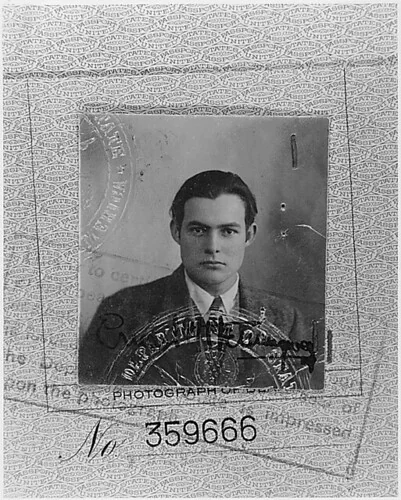
1899–1961
Ernest Hemingway
Novelist, short-story writer and journalistErnest Hemingway was an American writer whose novels, short stories and journalism made understatement, sharply observed action and the consequences of war central to twentieth-century prose.Read biographyQuick answers
Common questions
- Which Hemingway book should I read first?
- For a compact introduction, this guide suggests The Old Man and the Sea, then the 1925 In Our Time and The Sun Also Rises. For war fiction, start with A Farewell to Arms. These are editorial routes, not a universal ranking.
- Should I read Hemingway in publication order?
- Only if your purpose is to follow his development. A selected early-career route is In Our Time, The Sun Also Rises, Men Without Women and A Farewell to Arms. An exhaustive chronology also includes the 1923 and 1924 books and other publications omitted from that route.
- Why do editions give both 1924 and 1925 for In Our Time?
- They refer to distinct publications: the small Paris vignette book in 1924 and the substantially expanded American story collection in 1925. Check the contents and edition description before buying or borrowing.
- Are all Hemingway books novels?
- No. His books include stories, poems, a play, nonfiction and memoir as well as novels. The Fifth Column and the First Forty-Nine Stories combines a play and short stories; Death in the Afternoon and Green Hills of Africa are nonfiction.
- Which books need a posthumous-edition warning?
- Among the selections here are A Moveable Feast (1964), Islands in the Stream (1970), The Garden of Eden (1986) and The Complete Short Stories (1987). They appeared after his death in 1961. Read their editorial notes; publication does not imply Hemingway personally approved each final arrangement.
Primary and institutional sources
How this history was checked
The Foundation bibliography supplies a selected publication framework; the descriptive bibliography identifies early first editions. Nobel and publisher records clarify forms, context and later editions, while the JFK Library guide identifies archival categories. Reading routes and exercises are editorial suggestions. Full manuscripts and every edition were not consulted. This article was reviewed on 21 October 2026.
- Ernest Hemingway Foundation of Oak ParkErnest Hemingway bibliography
- Oak Knoll PressErnest Hemingway: A Descriptive Bibliography, early-edition excerpt
- Princeton University, Shakespeare and Company ProjectIn Our Time: unidentified 1924 or 1925 library copy
- Nobel PrizeErnest Hemingway: Biographical
- Nobel PrizeErnest Hemingway: Facts
- Scribner / Simon & SchusterFor Whom the Bell Tolls: The Hemingway Library Edition
- Scribner / Simon & SchusterA Moveable Feast: The Restored Edition, 2009
- John F. Kennedy Presidential Library and MuseumErnest Hemingway: Archival Holdings
- National Archives Foundation, DocsTeachErnest Hemingway Passport, NAID 192693: public-domain item
- U.S. National ArchivesErnest Hemingway 1923 Passport Photograph: official unrestricted-use posting