
The short answer
A narrator can feel an obligation to tell a story while doubting the means of telling it. Close reading works best when it preserves that tension instead of treating every hesitation as a puzzle already solved.
Record comparison
Compare the evidence
Keep the record, its authority and the claim being tested together.
| Record | What it establishes | What remains separate |
|---|---|---|
| Opening narrator | Questions event and telling | Not a complete explanation of the novel |
| Prize citation | Describes shifts of form | Not a sentence-by-sentence answer key |
| Original exercise | Keeps distinct uncertainties legible | Does not resolve the fictional past |
Chronology
A timeline of the turning points
Publication and reception
The Gathering receives the Booker Prize.
A later critical account
Yale citation discusses narrative shifts.
An obligation without certainty
The opening narrator wants to record a childhood event while questioning whether it happened. The desire to witness and the doubt appear together. Later in the extract she distinguishes not knowing the truth from not knowing how to tell it.
Those are different difficulties: uncertainty about an event and uncertainty about language. Collapsing them into a single diagnosis of unreliability can erase the passage’s work on how a story becomes tellable.
Sources for this section: [1]
An image made, then withdrawn
The speaker offers Liam an image of her daughters on a beach, then erases it. Physical remains, family observation and the act of composing an image move through the same opening.
The withdrawal makes composition visible. An image can be emotionally necessary without functioning as a verified recollection. Annotation should mark the transition from remembered material to a scene the narrator consciously makes and revises.
Sources for this section: [1]
A critical description is not a solution key
Yale’s citation emphasizes Enright’s changes of narrative style, viewpoint and time.
The Gathering won the 2007 Booker Prize.
The recognition helps locate the book’s reception; it cannot settle a particular sentence’s meaning. The citation suggests useful questions about form, while the extract supplies the words against which any answer must be tested. A reading confined to this opening should not announce the outcome of the whole novel.
Exercise: preserve two different doubts
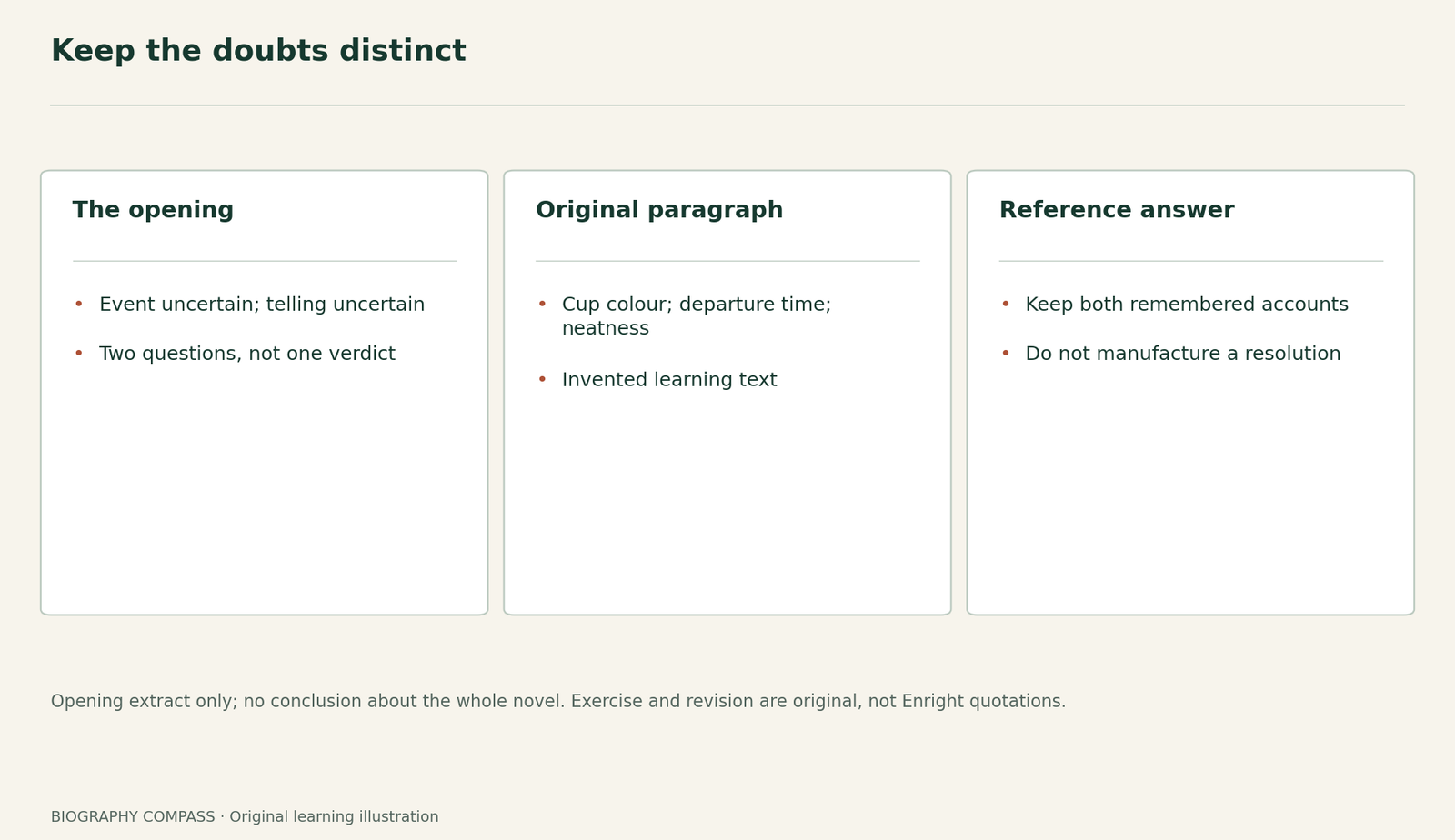
Invented paragraph: “I remember a blue cup by the door. Perhaps it was green. My cousin says we left before dawn, but I remember the kitchen bright. I could tell it neatly if I removed one of us.” Identify one uncertainty about an object, one conflict between accounts and one comment on making a narrative. Revise it into two sentences without choosing a winner.
Reference answer: “I remember a blue—or perhaps green—cup beside the door, while my cousin remembers our leaving before dawn and I remember a bright kitchen. A neat version would require me to discard someone’s account.”
The answer preserves the colour doubt and the conflicting memories. It does not infer a false witness from brightness alone: artificial light, chronology or mistaken recollection remain possible. The final sentence describes the cost of narrative neatness rather than supplying a missing historical fact.
Continue the chronology
Related history guides
Biography context
Explore Ireland through connected lives
Connected biographies
People connected with these records
born 11 October 1962
Anne Enright
Novelist and essayistEnright explores family life through shifts of voice and time.Read biographyQuick answers
Common questions
- Does hesitation prove dishonesty?
- No. The supplied exercise distinguishes uncertain recall, conflicting accounts and choices of presentation; those alone do not prove deliberate deception.
Primary and institutional sources
How this history was checked
Compare each record’s date, author and stated purpose. The supplied tasks and reference answers are original learning material. This article was reviewed on 30 October 2026.