
The short answer
Theatre makes words public through several kinds of work. A strange sentence may be intentional, a translator may need to protect that strangeness, and a director must still decide how bodies and pauses will make it perceptible.
Record comparison
Compare the evidence
Keep the record, its authority and the claim being tested together.
| Record | What it establishes | What remains separate |
|---|---|---|
| Dramatic speech | Reverses expected family roles | Not a grammatical accident to erase |
| Translator’s account | Explains the added footnote | Not proof of uniform reception |
| Production credits | Identify distinct collaborators | Not a recording of their choices |
Chronology
A timeline of the turning points
Opening
Abbey production opens.
Translation discussion
Carr and Fernandes discuss the speech in Brazil.
A wedding speech undoes its own praise
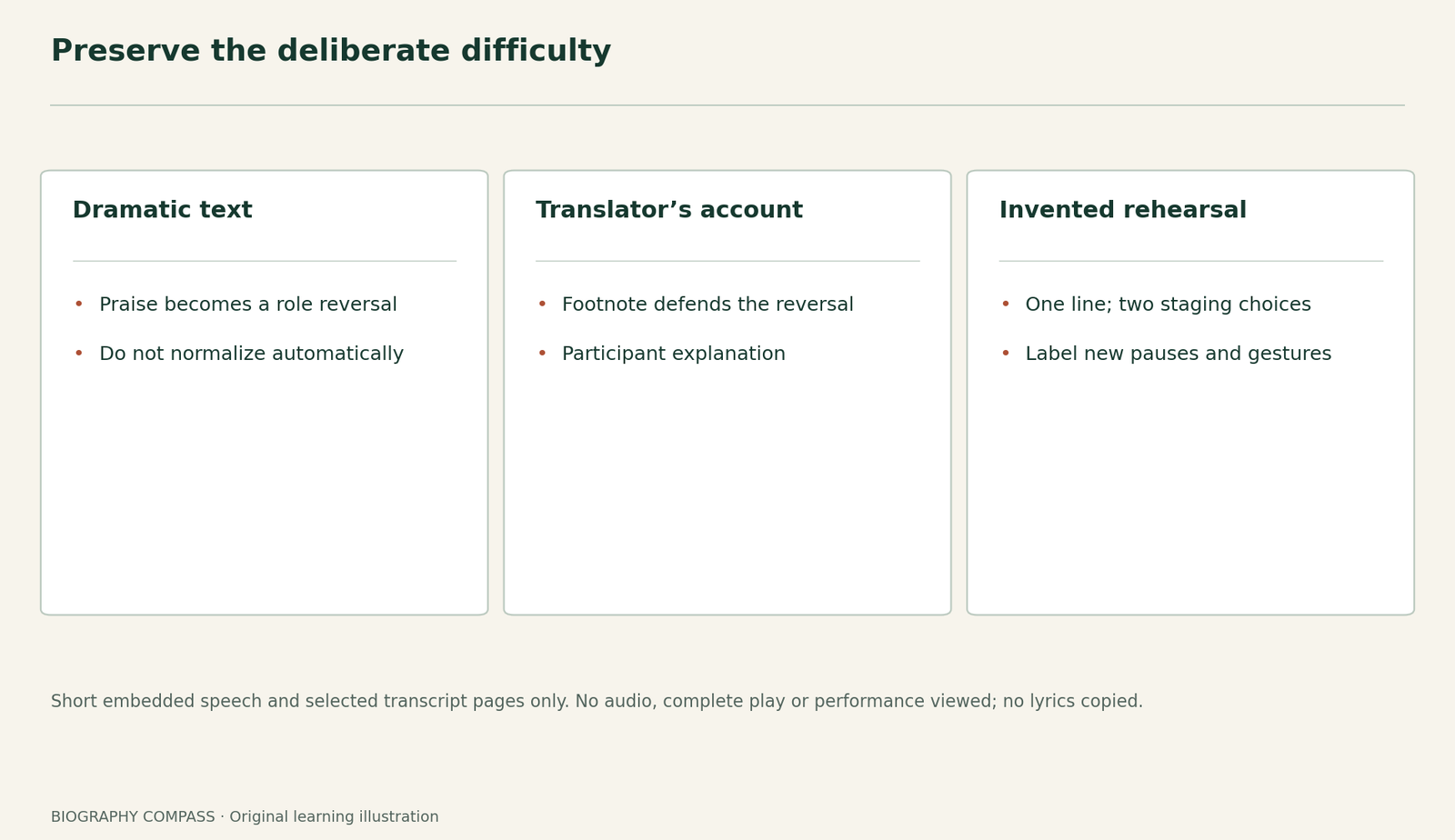
In the wedding speech read by Carr, Mrs Kilbride praises her son, then reverses the expected mother/son and husband/wife roles. The social form of congratulation becomes a disclosure of possessiveness.
The effect depends on the relation between a conventional occasion and a sentence that no longer fits it. Correcting the role words into ordinary logic would remove the dramatic disturbance rather than merely improve grammar.
Sources for this section: [1]
What the translator had to defend
Fernandes explains that she added a footnote because readers might treat that reversal as a translation mistake.
This is a concrete example of fidelity requiring explanation rather than silent normalization. The note records a translator’s decision; it does not guarantee that every audience will respond in the same way. A translation can preserve a productive difficulty without reproducing every feature of the original idiom.
A script still needs a production
The programme-derived record names Patrick Mason as director, Monica Frawley as designer, Conor Linehan under song and Ruth Hickey under additional music.
The Abbey record gives 7 October 1998 as the opening date.
Those credits locate responsibility. They cannot tell us the exact pause or audience reaction in the scene. A proposed performance must therefore label timing, emphasis and movement as new decisions. The source record and the rehearsal proposal answer different questions.
Exercise: retain an intentional reversal
Invented line for a retirement dinner: “He has been a loyal apprentice to the apprentice he trained, and a demanding master to the master who trained him.” Write a translator’s note explaining why you retain both role reversals. Then propose two staging choices, one exposing the speaker’s pride and one exposing the audience’s discomfort, without adding a joke or claiming that either was used in Carr’s production.
Reference answer: “The reversed relationships are intentional: praise blurs who teaches and who depends on whom. I retain them rather than repair the logic.” The speaker could warmly gesture to the apprentice, treating the words as an honour; the audience could remain still through a short pause after “trained him”.
The note protects the verbal design. The gestures offer contrasting interpretations rather than translating a stage direction that was never supplied. Another defensible answer might use timing instead of movement, provided it says which part of the text remains unchanged.
Continue the chronology
Related history guides
Biography context
Explore Ireland and Brazil through connected lives
Connected biographies
People connected with these records
born 1964
Marina Carr
PlaywrightCarr writes drama that resists a single label of myth or motherhood.Read biographyQuick answers
Common questions
- Was the performance watched?
- No. The inspected material is a written interview transcript with a short speech, plus production records. The staging proposals are original.
Primary and institutional sources
How this history was checked
Compare each record’s date, author and stated purpose. The supplied tasks and reference answers are original learning material. This article was reviewed on 30 October 2026.
- Núcleo de Estudos Irlandeses, UFSCMarina Carr interviewed by Alinne Fernandes, 7 November 2017
- Irish Theatre Institute / PlayographyIrelandBy the Bog of Cats: original programme transcription
- Abbey TheatreBy the Bog of Cats: 1998 production record
- Noel Ward / The Irish TimesWhen a teacher was engulfed by The Dark, and his union failed
- RTÉ ArchivesJohn McGahern: archive profile