
The short answer
How did repeat, colour and the demands of transport upholstery interact in Marx’s designs?
Read the evidence
Sources, interpretation and production roles
The records answer different questions about this work. The final exercise is an original teaching model.
| Record or question | Supported reading | Boundary or contrast |
|---|---|---|
| Commission history | Designers were commissioned for a public system. | The fabric is one element of an interior. |
| 1938 interior record | Identifies Shield and a manufacturing number. | An installed example does not prove universal route-wide use. |
| Original seam model | Separates motif, repeat and fitting. | It is not a reproduction or a historical performance test. |
A textile intended for a moving public interior
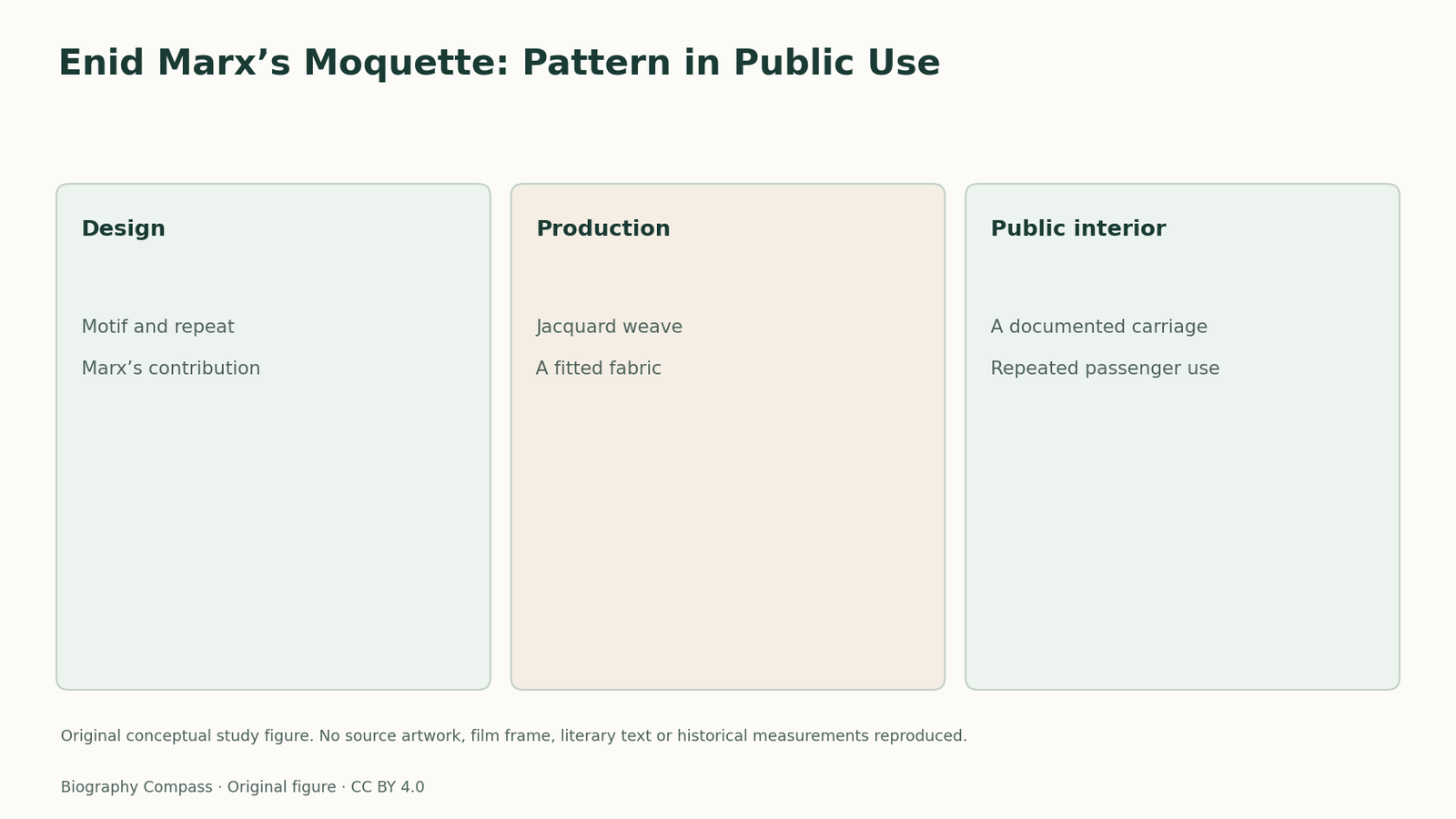
Enid Marx’s London Transport work belongs to the development of specially commissioned upholstery rather than a single self-contained picture. The Design Museum explains that the transport organisation moved away from buying stock patterns from manufacturers. Christian Barman and Frank Pick commissioned artists and designers, including Marx, to create fabrics for the system. A seat covering therefore sat within a larger public design programme, alongside other decisions about vehicles and interiors.
Print and weave are different working conditions
Marx had considerable experience with hand-blocked textiles and small printed repeats. Moquette was woven using a jacquard process, with a pile surface made for upholstery. A drawn pattern had to become a repeat that could operate through this material and production process. This distinction prevents a common simplification: an industrial fabric is not just a paper design transferred unchanged onto a seat. The relationship among motif, repeat, texture and installed surface is part of the design problem.
What a carriage record adds
The London Transport Museum’s record of a 1938 tube-stock interior identifies Marx’s Shield pattern and a manufacturer’s design number. It also describes its use on re-upholstered vehicles. These details add production and use history to an artist’s name. A photograph can show a fabric in an interior without proving that every later seat on a named route used the same material. Likewise, the record does not turn Marx into the designer of the whole carriage. Her pattern gained its public setting through several linked acts: design, weaving, fitting, maintenance and repeated passenger use.
Sources for this section: [4]
Original exercise: a repeat crosses a seam
Draw an invented repeat using one short dash and one empty square, avoiding Marx’s historical motifs. Place six repeats across a paper strip representing a seat cushion. Now divide the strip with a seam and describe what changes if the second piece begins halfway through the repeat. A reference answer distinguishes the unchanged motif from a changed continuity at the join. Next imagine the same pattern viewed across a whole carriage rather than close to one cushion. Explain why the scale of repetition and the surrounding interior may alter its effect. The model does not test durability or claim to reconstruct an undocumented technical brief. It makes one production relationship visible: a pattern can be coherent as a drawing yet require further choices when made and fitted. Return to the official record by identifying which information belongs to Marx’s design and which belongs to the particular fabric and vehicle. This is a practical way to connect artistic authorship with public use without collapsing them into one stage. The seam also supplies a useful scale check. A motif legible on one small cushion may produce a different overall rhythm when the same unit is repeated across several seats and their surrounding gaps.
Continue the chronology
Related history guides
Biography context
Explore United Kingdom through connected lives
Connected biographies
People and related creative practices
1902–1998
Enid Marx
British textile designer, printmaker and illustratorEnid Marx moved between hand printing and industrial commissions, while her collecting with Margaret Lambert broadened the materials through which design could be studied.Read biography
1834–1896
William Morris
Designer, manufacturer, writer and socialistWilliam Morris built a furnishing business around pattern, skilled craftsmanship and revived techniques. A poet, printer and socialist as well as an employer, he questioned industrial capitalism while selling labour-intensive products that often depended on wealthy customers.Read biography1903–1942
Eric Ravilious
British watercolour painter, wood engraver and designerEric Ravilious worked across watercolour, wood engraving, books and design before his career ended on an official wartime mission in 1942.Read biographyQuick answers
Common questions
- Is moquette a printed paper pattern?
- No. It is a woven upholstery textile; the design must work through a different material process.
- Did Marx design the entire carriage?
- The cited record establishes her fabric design, not sole authorship of the whole vehicle interior.
Primary and institutional sources
How this history was checked
Sources include production records, institutional collections and the specifically identified passages discussed here. Interpretations and teaching models are distinguished from credits and publication facts. This article was reviewed on 8 November 2026.