
The short answer
How does a railway carriage organise the contrast between near interior and passing countryside?
Read the evidence
Sources, interpretation and production roles
The records answer different questions about this work. The final exercise is an original teaching model.
| Record or question | Supported reading | Boundary or contrast |
|---|---|---|
| Museum journey account | Connects the work with railway travel and a chalk-figure project. | It does not establish a single simultaneous glance. |
| Material record | Lists watercolour, pencil and collage. | A photograph-like effect does not identify a photographic source. |
| Original carriage model | Compares stable interior details and a passing exterior. | The route and landmark in the exercise are invented. |
A railway journey becomes a painted arrangement
Train Landscape dates from 1940 and belongs to Aberdeen’s collection. The museum connects it with Ravilious’s plan to make a book about the chalk figures of southern England. He travelled on the Eastbourne–Lewes line, studying the carriage interior and landscape views. That account gives the painting a specific working context. It does not mean that every element was recorded simultaneously during a single glance from a moving train.
Sources for this section: [2]
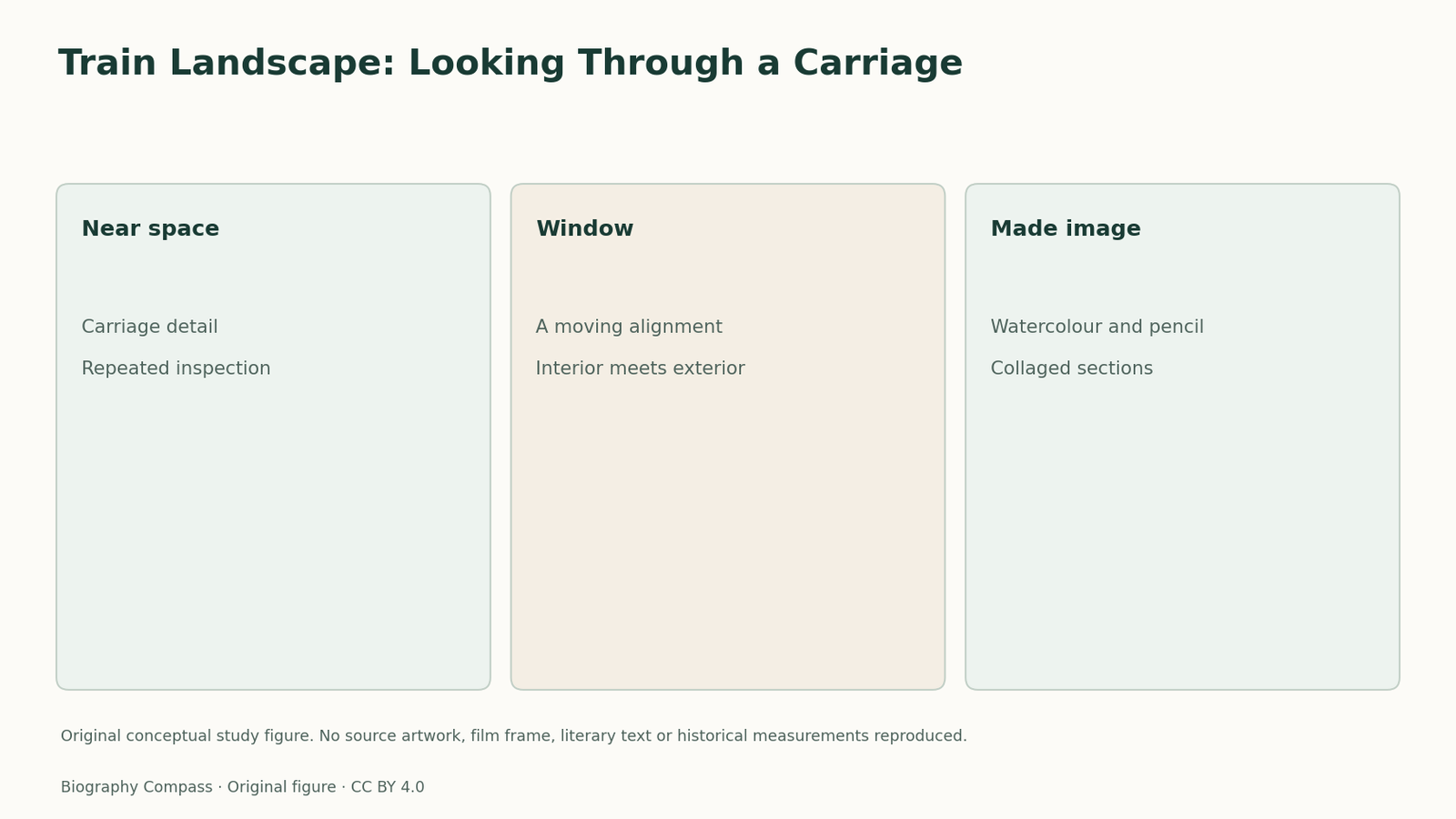
The carriage is an active frame
The Dulwich collection guide draws attention to upholstery, a window strap and striped draught strips. These details make the near space more than a neutral border around a landscape. They establish a compartment occupied by a traveller, even when the principal visual attraction lies outside. A window divides the image and joins its spaces: the interior remains comparatively stable while the countryside is encountered in passing. This reading makes travel itself part of the subject. It is different from imagining that a landscape painting has simply been placed behind a decorative frame.
A photograph-like effect made with other means
The guide compares the slightly crooked view with someone trying to catch a landmark as it moves past. That is a curatorial analogy, not evidence that the painting was copied from a particular photograph. The listed medium includes watercolour, pencil and collaged sections. Those materials belong to a process of making and revision. A sense of a fleeting instant can therefore be produced through several stages of work. This is especially useful beside Ravilious’s engraving and book design: immediacy in the final image does not exclude planning, graphic selection or the joining of separate elements.
Original exercise: a fixed seat and a passing landmark
Make a written plan for an imaginary carriage with a bench, two windows and an invented hill outside. Do not reproduce Ravilious’s interior or the historical chalk figure. List what a seated observer can inspect repeatedly and what may be visible only briefly. A reference answer places upholstery and a strap in the first category and a particular alignment of hill and window in the second. Now describe how a painter could preserve both kinds of information in one image: the answer might combine repeated interior studies with remembered or separately studied exterior forms. This is a possible working model, not a claim about undocumented steps in Ravilious’s process. Finally, tilt one window edge slightly in the plan. Explain why this might strengthen a feeling of a caught view while also remaining a deliberate compositional choice. The comparison separates the duration of looking from the time implied by a finished picture and gives the carriage a clear role in constructing the encounter. The fixed interior is crucial to this comparison: it supplies a stable scale against which a brief outside alignment can feel especially transient. Both durations can coexist in one carefully made sheet.
Continue the chronology
Related history guides
Biography context
Explore United Kingdom through connected lives
Connected biographies
People and related creative practices
1903–1942
Eric Ravilious
British watercolour painter, wood engraver and designerEric Ravilious worked across watercolour, wood engraving, books and design before his career ended on an official wartime mission in 1942.Read biography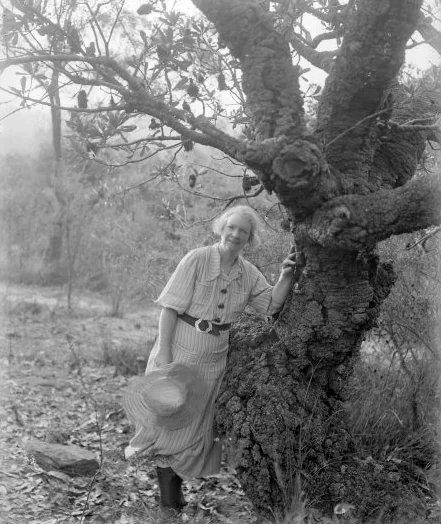
1875–1963
Margaret Preston
Australian painter and printmakerMargaret Preston combined European training, Japanese print interests and Australian plant subjects while pursuing a contested vision of national art.Read biography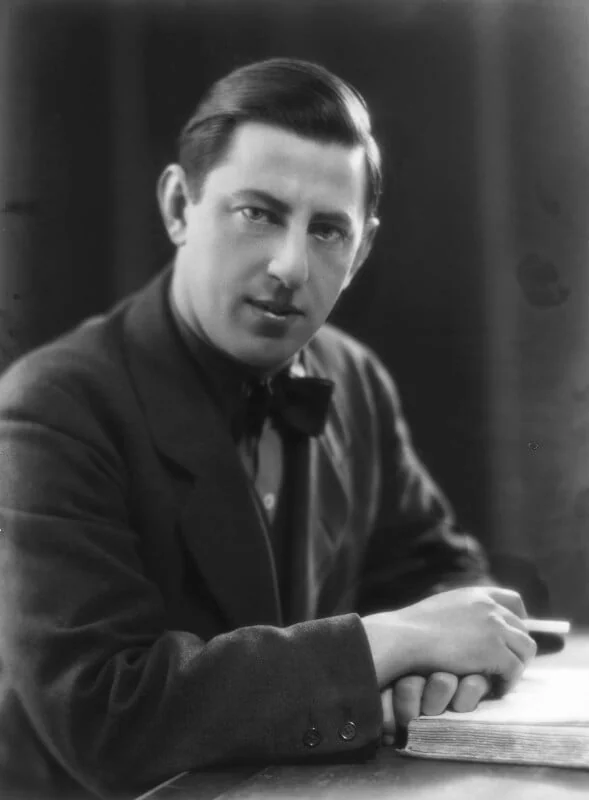
1889–1946
Paul Nash
British landscape painter, photographer, designer and official war artistPaul Nash carried landscape through war painting, design, photography and Surrealism, repeatedly transforming observed places into constructed images.Read biographyQuick answers
Common questions
- When was Train Landscape made?
- Aberdeen dates it to 1940.
- Is the carriage only a frame?
- The guide reads its detailed interior as an active part of the experience of travel and looking.
Primary and institutional sources
How this history was checked
Sources include production records, institutional collections and the specifically identified passages discussed here. Interpretations and teaching models are distinguished from credits and publication facts. This article was reviewed on 8 November 2026.