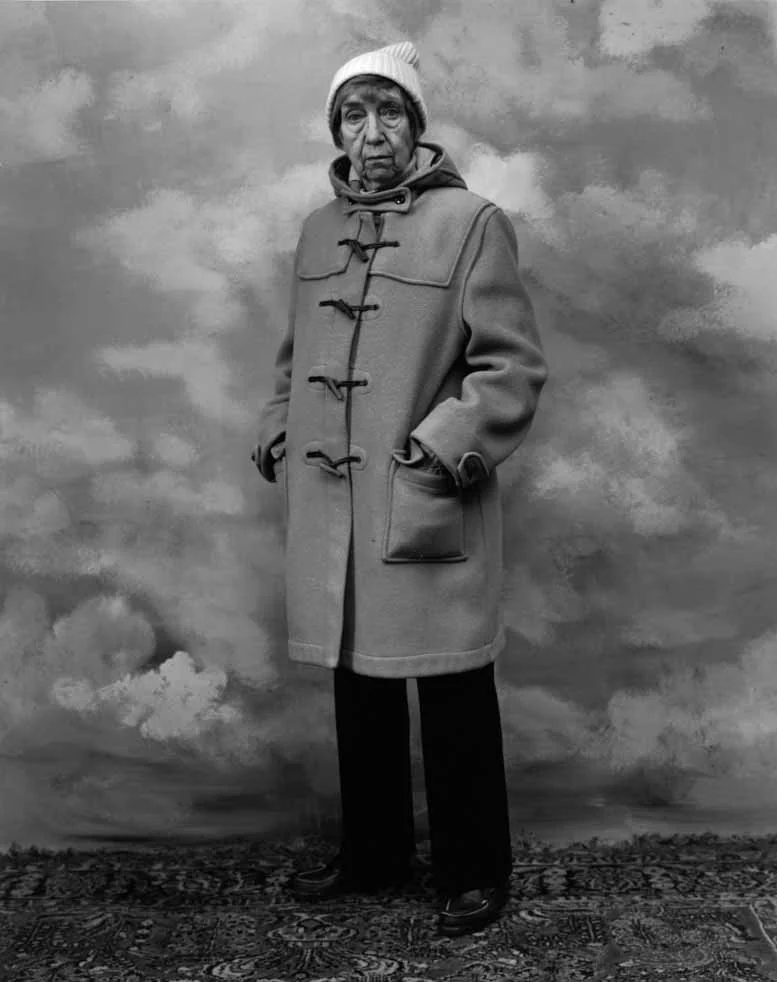
In this biography
Quick facts
- Born
- 1883
- Died
- 1976
- Birthplace
- Portland, Oregon, United States
- Country
- United States
- Nationality
- Not independently established
- Known for
- Portraits and botanical studies
Why this life matters
Her work moves across portraits, plants, the body and everyday surroundings without making one subject stand for the entire career.
Timeline
Key moments
Seattle studio
Opened an independent practice.
Group f/64
Joined a community advocating photographic clarity.
After Ninety
The book appeared after her death.
Chemistry, work and a studio
Imogen Cunningham earned a chemistry degree at the University of Washington in 1907 while working in its botany department. Employment at Edward Curtis’s studio developed practical photographic and business skills. A fellowship enabled study of photochemistry with Robert Luther in Dresden.
She returned to Seattle and opened a studio in 1910. Marriage to printmaker Roi Partridge and the move to California changed the setting of her work. During the 1920s she developed studies of plant forms alongside other subjects.
The laboratory and the studio were connected routes into making images. Technical competence did not settle the artistic question of what a picture should emphasise, but it gave her ways to pursue it.
A modern photographic community
Cunningham joined the photographers who formed Group f/64 in 1932. She also worked for Vanity Fair and other magazines, making portraits of performers and artists including Martha Graham and Alfred Stieglitz.
The Getty checklist distinguishes a 1925 negative of Magnolia Blossom from a 1930 print.
That distinction helps keep both the image’s making and a particular object’s later production in view. A subject associated with one phase need not mark a complete departure from everything that came before.
Continuing to work and planning a legacy
In 1947 she established a studio in her San Francisco home and continued exhibiting until her death in 1976.
In her nineties she planned a trust to keep her prints and negatives available for future study and exhibition.
The checklist records the late self-portraits and the book After Ninety, published in 1977. Her work remained concerned with human presence as well as formal detail.
A long career can be understood through recurring questions rather than a single signature photograph. Her archive preserves changes of medium, use and audience that an isolated celebrated image cannot represent.
Quick answers
Frequently asked questions about Imogen Cunningham
- Who was Imogen Cunningham?
- Imogen Cunningham was a photographer. Her work moves across portraits, plants, the body and everyday surroundings without making one subject stand for the entire career.
- What is Imogen Cunningham best known for?
- Imogen Cunningham is best known for portraits and botanical studies.
- When and where was Imogen Cunningham born?
- Imogen Cunningham was born in 1883 in Portland, Oregon, United States.
- When did Imogen Cunningham die?
- Imogen Cunningham died in 1976.
Keep exploring
Lives connected to this story
- Walker Evans
Compare another photographer’s working choices and collaborations.
- Dorothea Lange
Read a separate documentary career and the named people within its pictures.
Sources and further reading
Explore the evidence
These references support the biography and offer further reading. Official records, first-person accounts and independent reporting provide different perspectives; image records document attribution and licensing.