
The short answer
What did the recurring Philadelphia chromosome marker establish before its mechanism was understood?
Read the evidence
Philadelphia Marker to Clonal Evolution
Compare an observed recurring feature with a proposed account of population change.
| Record or comparison | What the record supports | What remains separate |
|---|---|---|
| 1960 chromosome observations | A detectable abnormality recurred in the examined chronic-leukaemia material | A marker is not a complete molecular or evolutionary history |
| 1976 evolutionary model | Variation and selection provide a framework for tumour progression | A model requires evidence to reconstruct a particular tumour’s branches |
A recurring feature was an important beginning
The early Philadelphia chromosome studies associated an unusually small chromosome with a particular form of leukaemia. The 1960 long paper compared normal and leukaemic leukocytes and reported a detectable abnormality in its chronic cases, while its acute cases did not show the same result. This is a pattern of association within the examined material. It does not identify every molecular event producing the disease, nor demonstrate that every cancer must possess that same visible feature. Its value lies partly in the specificity of the comparison.
Sources for this section: [3]
A model asked about change over time
Nowell’s 1976 abstract proposes a single-cell origin followed by genetic variation and selection of sublines during tumour progression. That is a different claim from finding a recurring marker. The marker is an observation in examined cells; the evolutionary model concerns relationships and change within a population. His participant recollection connects chromosome research with these later questions, while acknowledging how much interpretation depended on subsequent technical advances. A reader should not treat a repeated marker by itself as a complete map of all branches within a tumour.
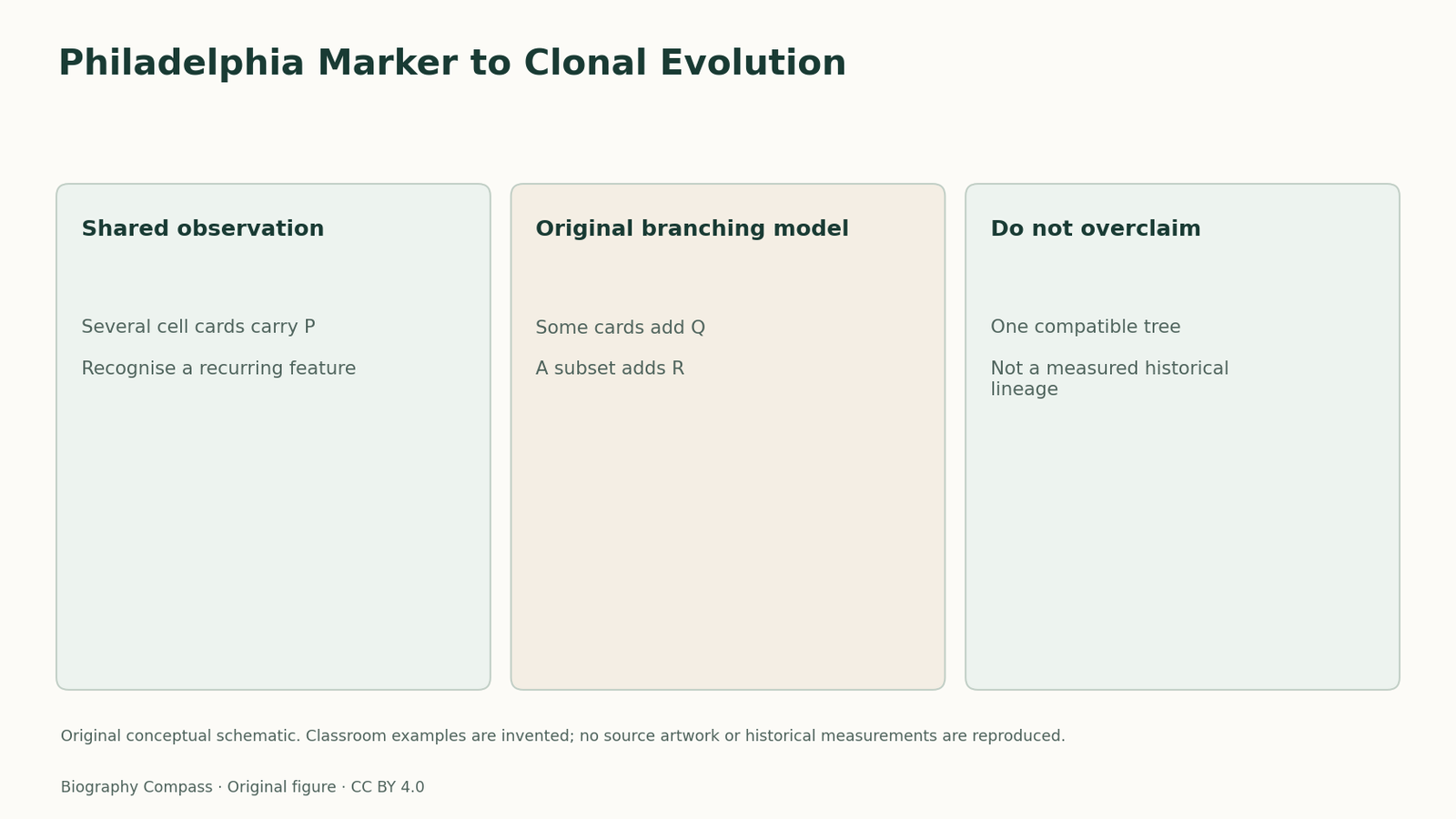
An original marker-and-lineage exercise
Imagine six invented cell cards. All six carry symbol P. Two also carry Q, and one of those carries R. Ask students to draw a possible branching diagram consistent with those symbols. One possible model places P before the Q branch and R within part of that branch. Then ask whether the cards prove that exact history. They do not: the example omits information about observation time, marker loss and whether similar changes could arise independently. Finally, ask whether the presence of P alone distinguishes the Q and R subgroups. It cannot. This is an original reasoning exercise about the difference between a shared feature and a complete lineage. It is not a reconstruction of Nowell’s patients, a measured tumour tree or proof of a particular mechanism.
What the two records establish together
The combination is useful because it separates a research clue from a framework that generates further questions. A recurring feature can direct attention to a shared biological change; an evolutionary model asks how diversity and selection develop after a population originates. Nowell’s 1984 recollection is a participant’s historical perspective, not an additional experiment proving every part of that model. The guide therefore preserves both achievements without claiming that the original chromosome observation independently settled the complete evolutionary history or clinical behaviour of every cancer.
Continue the chronology
Related history guides
How should an early abnormal-chromosome observation be compared with later identification of a translocation?
Compare the initial observation with later identification of the rearrangement.
Read the timeline1960–1976How did the evidence change between the 1996 selective-inhibition experiments and the 2001 early clinical trial?
Follow a later programme that tested a molecularly directed compound.
Read the timelineBiography context
Explore United States through connected lives
Connected biographies
Researchers and related questions
1928–2016
Peter Nowell
Pathologist and cancer researcherPeter Nowell combined pathology and chromosome research, collaborating on a recurring cancer-associated abnormality and later developing an evolutionary model of tumours.Read biography1927–1993
David Hungerford
Cytogeneticist and cancer researcherDavid Hungerford supplied chromosome-analysis expertise to a collaboration that identified a recurring abnormality in a particular form of leukaemia.Read biography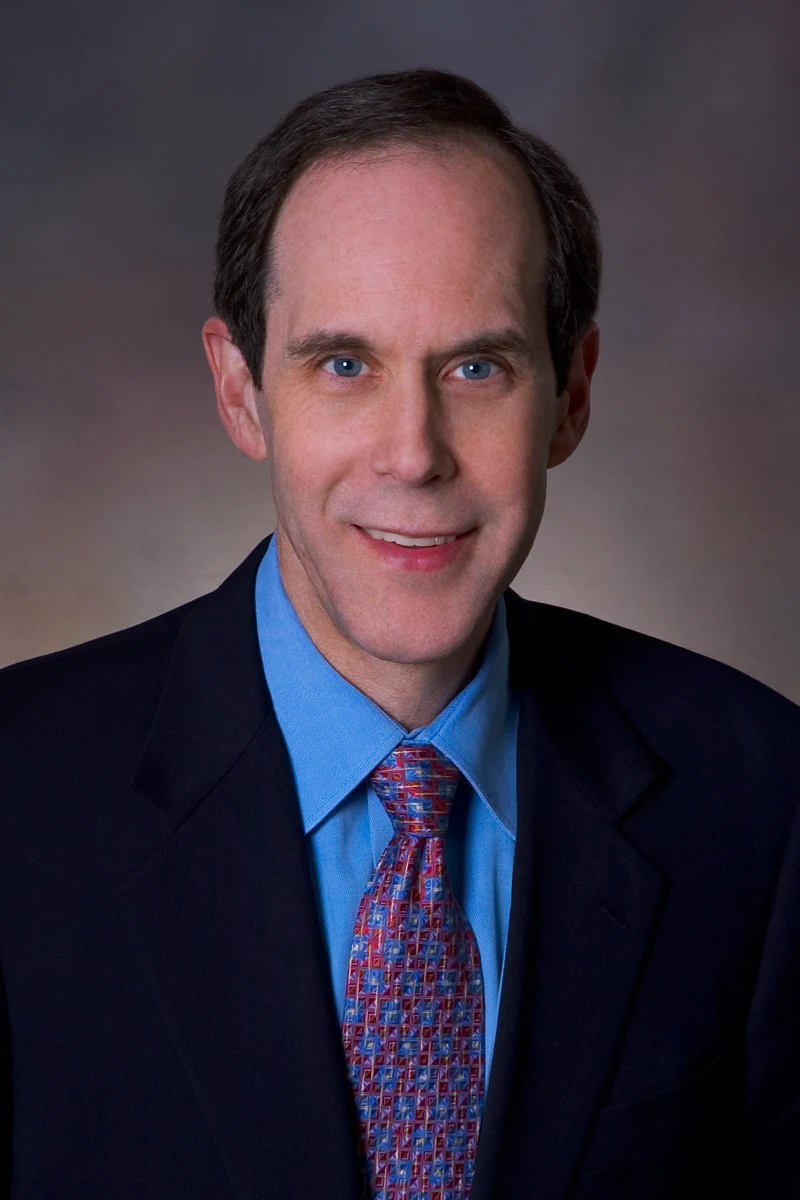
1955–
Brian Druker
Physician-scientist and leukaemia researcherBrian Druker connected clinical questions with a collaborative programme testing whether a molecular abnormality could guide the development of a cancer medicine.Read biography1925–2013
Janet Rowley
Physician and cancer geneticistJanet Rowley used chromosome-banding techniques to identify recurring exchanges of chromosome material in leukemia. Her findings helped establish a genetic basis for particular cancers and changed the questions that researchers could ask about their origins.Read biographyQuick answers
Common questions
- Is a shared marker a complete tumour family tree?
- No. It may indicate a common feature without resolving every subsequent branch or evolutionary event.
- Was Nowell’s 1976 article another Philadelphia chromosome experiment?
- Its abstract presents a broader evolutionary model of tumour populations, a different kind of contribution from the early chromosome observations.
Primary and institutional sources
How this history was checked
The 1960 summary and early analysis context are compared with a 1976 primary abstract and Nowell’s dated participant recollection. No patient lineage was reconstructed. This article was reviewed on 7 November 2026.