
The short answer
How did Smith’s government mission at Red River interact with his Hudson’s Bay Company position?
Read the records together
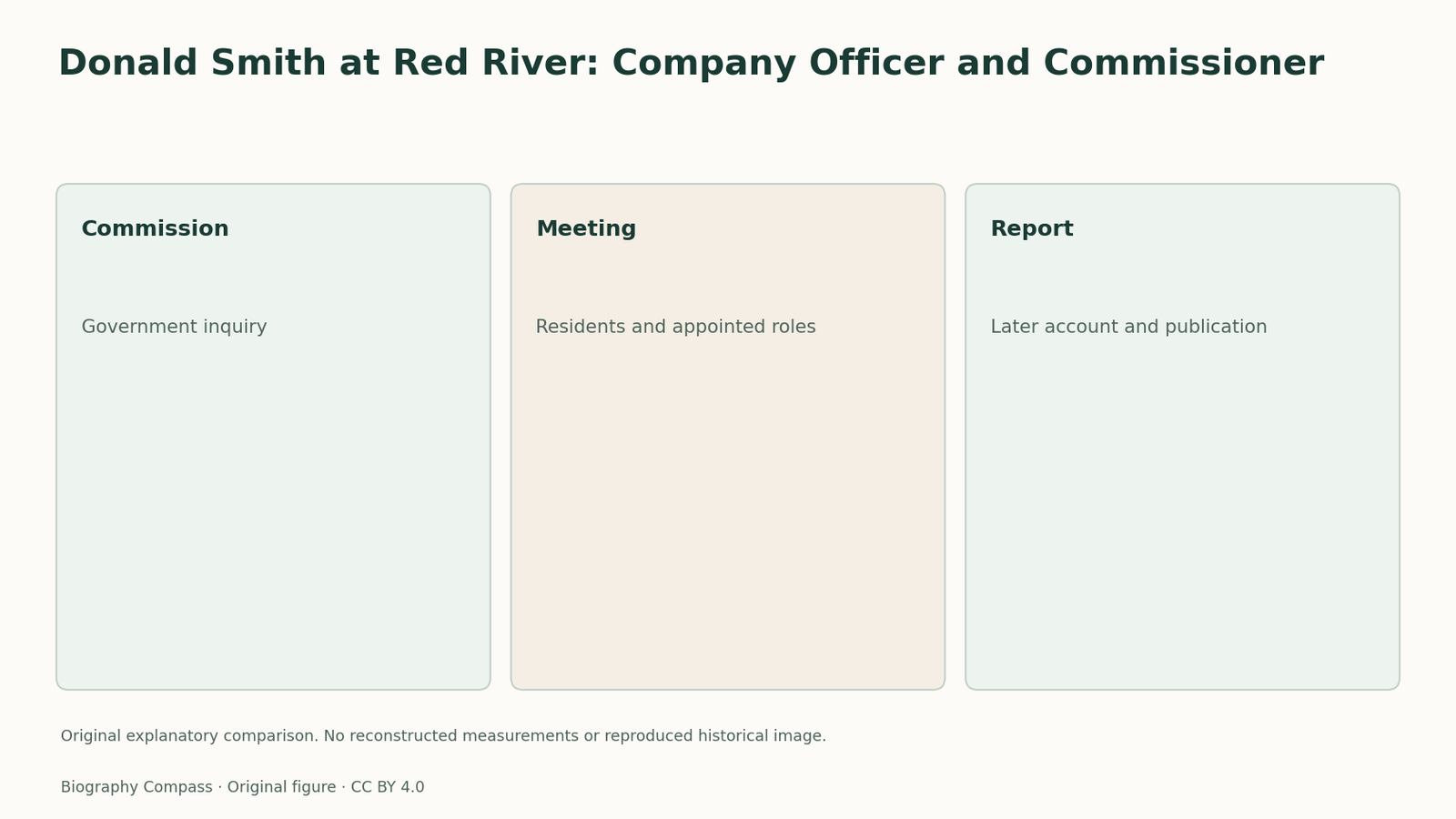
Evidence, functions and interpretation
Compare the particular records and mechanisms discussed in this study.
| Record or mechanism | What it establishes | The distinct question |
|---|---|---|
| Appointment letter | Defines the Canadian government’s inquiry. | A commission is not proof of residents’ consent. |
| Meeting report | Names a chair, interpreter and secretary. | The settlement had an organised political response. |
| Edited report edition | Distinguishes publication from manuscript passages. | Editorial explanation is not a newly inspected original order. |
The commission had a government-defined remit
The appointment letter read at the January 1870 public meeting identified Smith as a special commissioner. It directed him to inquire into and report on the obstruction facing the Canadian government’s intended entry into Red River. The phrasing belongs to the appointing government’s perspective. It establishes a remit, not an agreement that all residents accepted the transfer on those terms. Reading the letter as a document of authority explains what Smith was sent to do while leaving the settlement’s political response as a separate question.
Sources for this section: [3]
His HBC position supplied another institutional connection
The Manitoba archival service table places Smith in senior HBC administration before the mission and records his 10 December 1869 government appointment. These were connected roles, but they were not identical. The company had interests in the territory and its transfer; the Canadian government sought to establish its own authority. Smith’s experience and contacts could assist the mission without making company employment itself a public mandate. The distinction is useful whenever a commercial intermediary also acts for government.
The public meeting had its own organisation
The contemporary newspaper account names Thomas Bunn as chair, Riel as interpreter and Judge Black as secretary. Smith read the government material within that organised gathering. Those details reveal an encounter between institutions and participants, rather than a commissioner simply delivering instructions to an unstructured crowd. The biography’s account traces the subsequent proposal for a convention of representatives. The residents’ deliberation and their demands must therefore remain visible alongside the Canadian message that Smith carried.
A later report also had a publication history
The Manitoba Historical Society edition explains that Smith’s published report omitted passages visible in the manuscript and prints those passages distinctly. Its introduction offers an interpretation of why the cuts were made. That editorial account should not be confused with a newly inspected original instruction from an editor. The reprinted report’s opening does establish Smith’s own account of his journey and arrival at Fort Garry on 27 December. Reading the mission letter, meeting report and retrospective report together distinguishes authority, public encounter and subsequent self-reporting.
Sources for this section: [4]
An original authority-and-perspective task
Place three hypothetical statements beside three records: what a commissioner was instructed to investigate, how a meeting was chaired, and how the commissioner later described his arrival. The appointment letter, meeting report and later report support those questions respectively. Does the first document establish residents’ consent? The checked answer is no. Does the last document necessarily reproduce every passage of an earlier published version? Again no: the edition’s textual history must be checked. This original exercise clarifies the actual record types without inventing a negotiation transcript or reducing Métis political action to a response controlled by Smith.
Continue the chronology
Related history guides
The Canadian Pacific: Last Spike and Regular Service
Compare the 1885 last spike and first through train with the 1886 regular passenger arrival at Port Moody, distinguishing physical connection from scheduled service.
Read the timeline1884The 1884 Meridian Conference: Longitude, Day and Local Time
Read the 1884 conference resolutions to distinguish Greenwich longitude, a universal day and local standard time, with an original example of reference and display.
Read the timelineBiography context
Explore Canada through connected lives
Donald Smith
Donald Smith was a hudson’s bay company officer, financier and public representative, known for combining company administration, railway investment and public missions, including the disputed transfer of the Red River settlement.
Explore the biographiesWider contextJohn A. Macdonald
Read John A. Macdonald’s lawyer, confederation negotiator and canada’s first prime minister career as a separate contextual comparison.
Explore the biographiesConnected biographies
People and wider context
1820–1914
Donald Smith
Hudson’s Bay Company officer, financier and public representativeDonald Smith was a hudson’s bay company officer, financier and public representative, known for combining company administration, railway investment and public missions, including the disputed transfer of the Red River settlement.Read biography
1815–1891
John A. Macdonald
Lawyer, Confederation negotiator and Canada’s first prime ministerJohn A. Macdonald helped negotiate the federation created in 1867 and served as Canada’s first prime minister in two periods. He built political alliances, promoted protective tariffs and backed a transcontinental railway. His government also imposed racial exclusion and coercive policies against Indigenous peoples, including the expansion of residential schools.Read biography1818–1880
George Brown
Journalist and reform politicianBrown used the Globe and parliamentary alliances to advance reform, then defended a federal compromise balancing population and regional representation.Read biographyQuick answers
Common questions
- Was Smith only an HBC representative at Red River?
- No. He also held a Canadian government commission, whose remit must be distinguished from his company position.
- Did driving the last spike mean he constructed the railway himself?
- No. His important financial role was different from executive management, engineering and construction labour.
Primary and institutional sources
How this history was checked
Primary records, institutional catalogues and historical interpretation answer different questions. The comparison and worked example are original editorial analysis. This article was reviewed on 8 November 2026.
- Dictionary of Canadian BiographySmith, Donald Alexander,1st Baron Strathcona
- Archives of ManitobaDonald Alexander Smith: HBCA Biographical Sheet
- Original 1870 newspaper / PrimaryDocuments.ca facsimileThe New Nation,21 January 1870: public meeting and commission
- Manitoba Historical Society editionManitoba: The Birth of a Province, Smith report section