
The short answer
How did the last-spike milestone differ from the start of scheduled transcontinental passenger service?
Read the records together
Evidence, functions and interpretation
Compare the particular records and mechanisms discussed in this study.
| Record or mechanism | What it establishes | The distinct question |
|---|---|---|
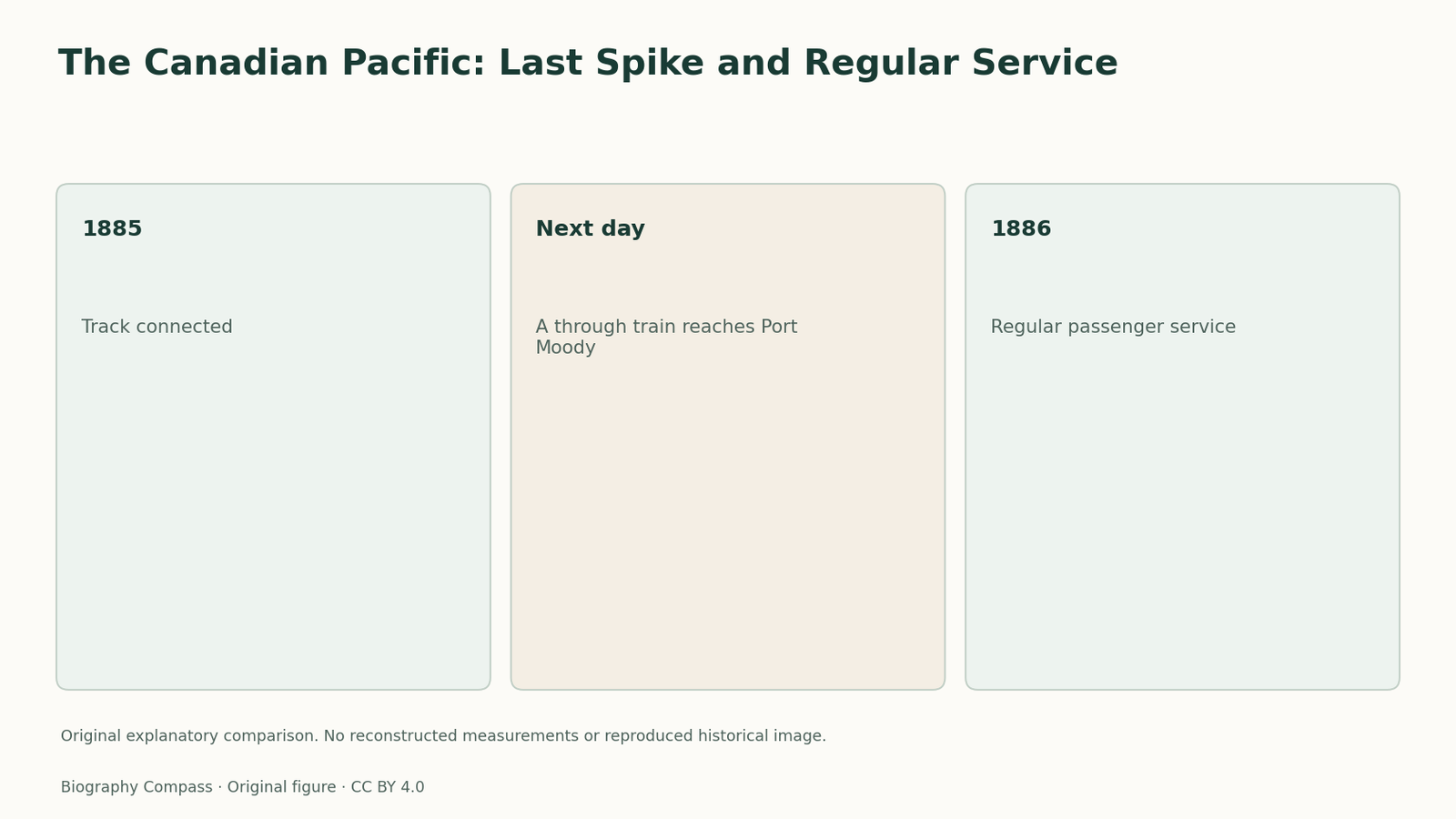
| November 1885 completion | Marks the physical connection and ceremonial last spike. | It is not automatically the regular-service start. |
| Through-train record | Establishes a journey over the line. | One journey and a recurring timetable differ. |
| July 1886 arrival | Names Port Moody as the scheduled train’s destination. | The later Vancouver terminus belongs to another stage. |
The last spike marked a connected line
On 7 November 1885 the ceremonial last spike was driven at Craigellachie, British Columbia. Parks Canada’s commemorative record identifies the event as the completion milestone for the Canadian Pacific line. A connected track was a necessary achievement, but it did not by itself establish every feature of a regular passenger business. The distinction is between infrastructure becoming continuous and an organisation offering repeated, scheduled journeys over it. Both mattered, but they were not the same milestone.
Sources for this section: [3]
A through train followed before regular service
The same plaque records a transcontinental train reaching Port Moody on the following day. This detail prevents the 1886 passenger-service date from being mistaken for the first possible movement over the completed line. A through journey can demonstrate a physical connection without constituting the start of a recurring public timetable. The language in a source therefore matters: first train, first regular passenger train and first scheduled service identify different claims. A careful chronology preserves the qualifier instead of replacing all three with one universal first.
Sources for this section: [3]
The 1886 arrival belonged to a scheduled service
The first regular passenger train from Montreal arrived at Port Moody on 4 July 1886. Parks Canada and British Columbia’s Legislative Assembly both identify that destination and date. Another Parks Canada account places the start of scheduled service in June, consistent with a journey beginning before its July arrival. Departure and arrival are distinct events even within one service. The date of reaching the western terminus should consequently not be described as the departure date from Montreal.
Port Moody and Vancouver were not interchangeable
The 1886 western terminus was Port Moody. The later extension to Vancouver belongs to the subsequent development of the railway and the coast’s transport geography. British Columbia’s page title uses Vancouver as a broad reference, but its historical body identifies Port Moody for the 1886 arrival. Reading the body rather than relying only on the heading avoids moving the event to a different destination. It also shows how a railway’s commercial endpoint could change after the major construction milestone.
Sources for this section: [4]
An original service-definition exercise
Imagine a railway with a continuous track, a successful one-off through journey and a public service scheduled every week. Which record would establish each claim? The checked answer requires construction evidence for the connection, an operating record for the particular journey and a timetable or service record for recurrence. A photograph of a last-spike ceremony cannot establish all three on its own. Now distinguish a train’s departure date from its arrival date. This original exercise explains the 1885–1886 sequence without inventing traffic figures, a historic timetable or the reasons for every intervening delay.
Continue the chronology
Related history guides
Donald Smith at Red River: Company Officer and Commissioner
Examine Smith’s 1869–1870 commission alongside his HBC position and the January meeting record, distinguishing an emissary’s remit from residents’ political response.
Read the timeline1884The 1884 Meridian Conference: Longitude, Day and Local Time
Read the 1884 conference resolutions to distinguish Greenwich longitude, a universal day and local standard time, with an original example of reference and display.
Read the timelineBiography context
Explore Canada through connected lives
William Cornelius Van Horne
William Cornelius Van Horne was a railway manager and industrial organiser, known for directing Canadian Pacific construction and operations, then expanding an integrated transport and development business.
Explore the biographiesWider contextJohn A. Macdonald
Read John A. Macdonald’s lawyer, confederation negotiator and canada’s first prime minister career as a separate contextual comparison.
Explore the biographiesConnected biographies
People and wider context
1843–1915
William Cornelius Van Horne
Railway manager and industrial organiserWilliam Cornelius Van Horne was a railway manager and industrial organiser, known for directing Canadian Pacific construction and operations, then expanding an integrated transport and development business.Read biography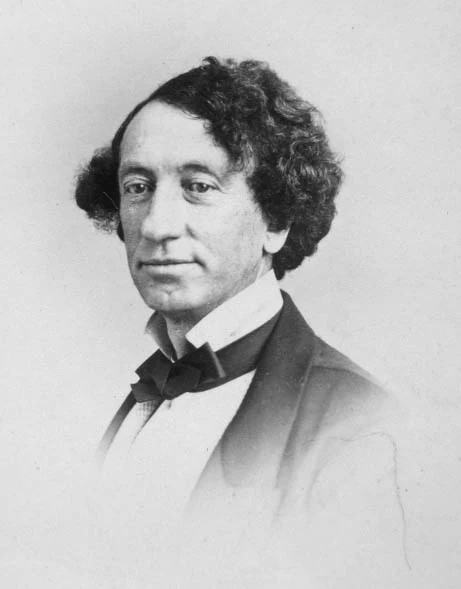
1815–1891
John A. Macdonald
Lawyer, Confederation negotiator and Canada’s first prime ministerJohn A. Macdonald helped negotiate the federation created in 1867 and served as Canada’s first prime minister in two periods. He built political alliances, promoted protective tariffs and backed a transcontinental railway. His government also imposed racial exclusion and coercive policies against Indigenous peoples, including the expansion of residential schools.Read biographyQuick answers
Common questions
- Did the first regular passenger train arrive in 1885?
- The last spike and an initial through train belong to 1885; the first regular passenger arrival at Port Moody was 4 July 1886.
- Was Vancouver the destination of that 1886 arrival?
- The inspected historical accounts identify Port Moody. Vancouver became the terminus later.
Primary and institutional sources
How this history was checked
Primary records, institutional catalogues and historical interpretation answer different questions. The comparison and worked example are original editorial analysis. This article was reviewed on 8 November 2026.
- Québec Ministry of Culture and CommunicationsVan Horne, William Cornelius
- McGill University ArchivesWilliam Cornelius van Horne Fonds, MG 2013
- Parks CanadaCompletion of the Canadian Pacific Railway National Historic Event
- Legislative Assembly of British Columbia1886: The First Transcontinental Train Arrives
- Parks Canada, Glacier National ParkThe Snow War