
The short answer
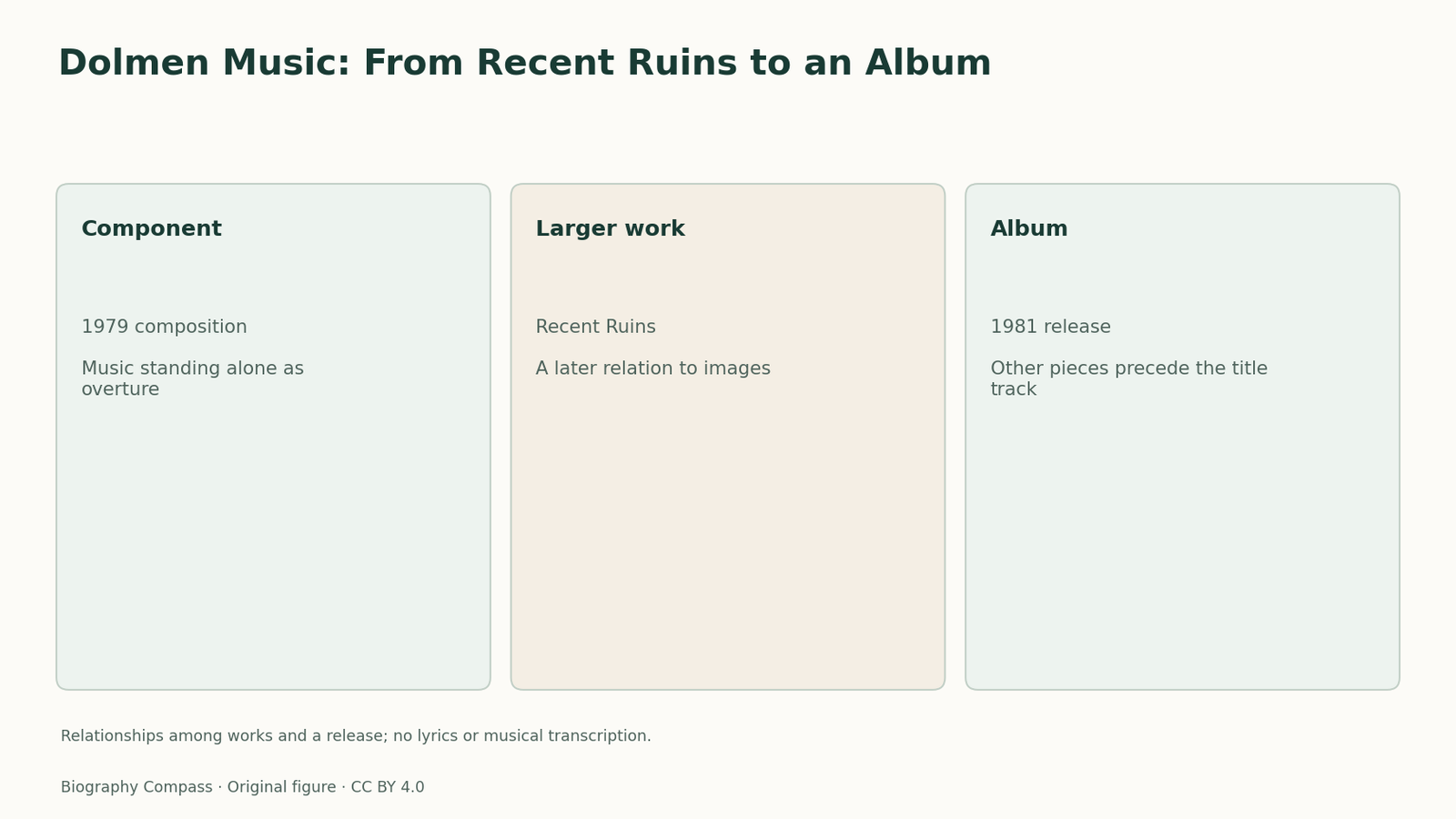
Combining art forms does not always mean retaining every element. Meredith Monk’s account of Dolmen Music describes a decision to let music stand alone within a larger theatre work. A later album gives that title another frame.
A working comparison
What changes between these records?
Use each record for the question it can answer. The distinctions below are our synthesis of the cited materials.
| Record or element | What it establishes | What remains separate |
|---|---|---|
| Composition | A named piece can function within another work. | Its title does not denote the whole album. |
| Theatre | A decision removes images at one point. | It does not forbid combining media elsewhere. |
| Album | A release has several pieces and collective credits. | Album-wide credits are not track-by-track assignments. |
The composer describes a subtraction
In conversation with Deborah Jowitt, Monk explained that images initially paired with Dolmen Music did not work. She returned to music alone as the overture to Recent Ruins. Later in the larger work, a tape of its last section returned with images, forming a different relationship between sound and scene.
This is an account of selection, not a general rule against images. Music can stand independently at one point and be combined with other material at another. The same sound gains a different function because of where and how the work places it.
Sources for this section: [1]
An album is a new sequence
The title composition’s relationship to Recent Ruins explains a stage function. Its position after other pieces on an album explains a listening sequence. Both can matter, but one is not a substitute for the other. A listener should identify the edition before treating track order as an original theatre running order.
The important research question is what is preserved by each carrier: a chronology gives categories and dates; an artist’s recollection gives a working decision; an album record gives credits and a release sequence. None, by itself, transmits all the bodily and spatial knowledge of a performance.
A useful reference answer
If asked whether the whole album was the overture to Recent Ruins, the supported answer is no: the composer discusses the title composition, while ECM lists an album containing additional pieces. If asked which vocal gesture belonged to a particular performer on a particular night, these written records are insufficient. This article has not listened to the recordings or reconstructed Monk’s vocal material.
Continue the chronology
Related history guides
Biography context
Explore United States through connected lives
Connected biographies
Explore the creators
b. 1942
Meredith Monk
Composer and interdisciplinary artistA composer and performer connecting voice, movement and music theatre.Read biographyQuick answers
Common questions
- Does the album title prove all its tracks were part of Recent Ruins?
- No. The consulted chronology and track list do not make that claim.
Primary and institutional sources
How this history was checked
Selected written records, with the scope of the comparison stated in the article. No complete performance or work is claimed to have been consumed. This article was reviewed on 4 November 2026.