
The short answer
How can a material supply charge carriers while reducing their scattering from the atoms that provided them?
Read the evidence
Separate supply from motion
Two samples can have the same carrier density and different mobilities.
| Quantity | Meaning | Effect in the illustrative comparison |
|---|---|---|
| Donor distribution | Location of charged impurity atoms | Changes the scattering encountered by carriers |
| Carrier density | Number of mobile carriers per area | Affects current even at fixed mobility |
| Mobility | Response of carriers to an electric field | Can increase without an increase in density |
The donor and the mobile carrier do different jobs
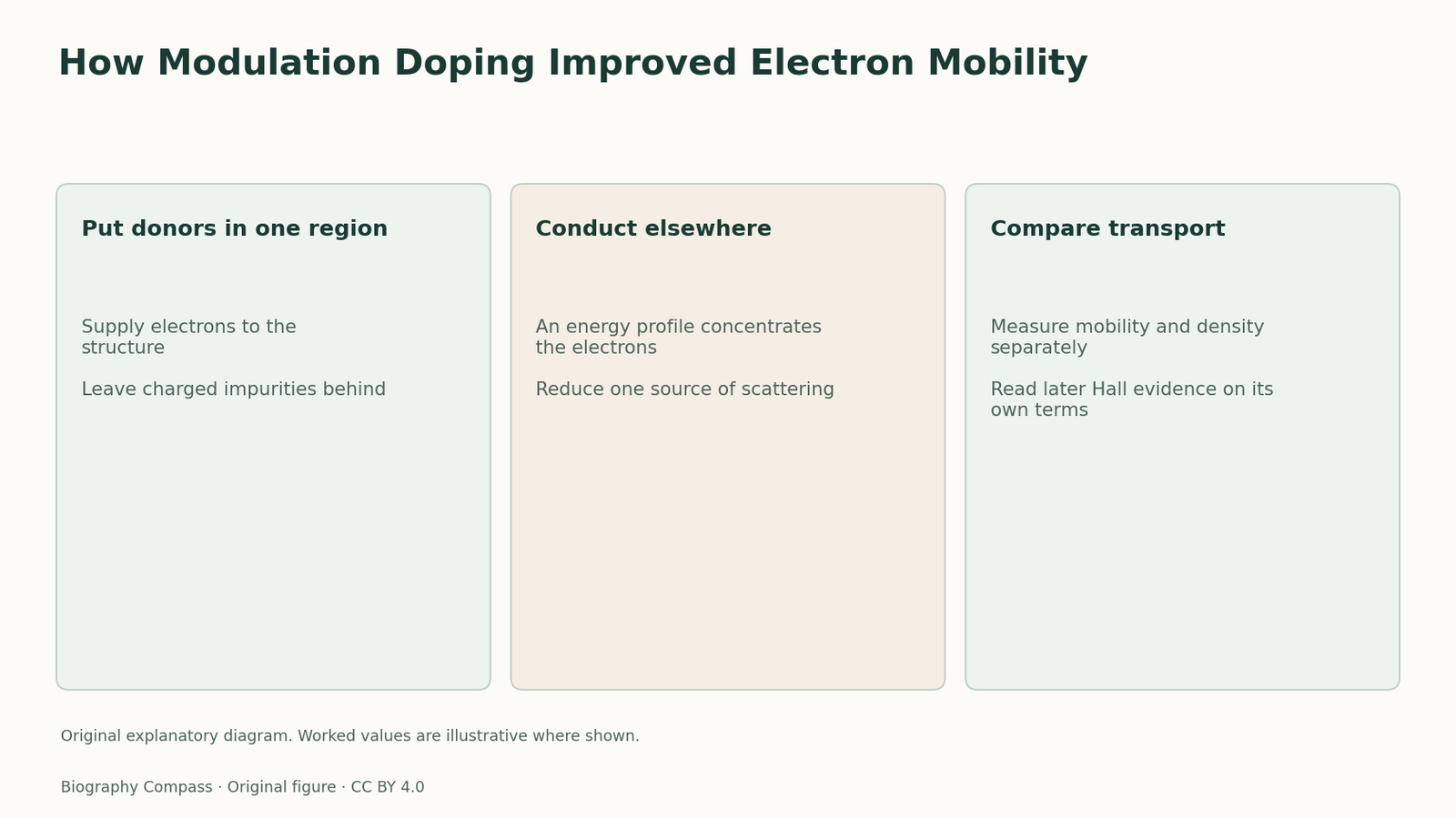
Adding donor atoms can supply electrons to a semiconductor. Once an electron is available to move, the donor it left behind can remain charged and influence the electron’s motion. A structure that mixes both in the same region may therefore gain carriers while also adding scattering. Modulation doping uses distinct layers to separate where many donors sit from where electrons spend much of their time. The electronic energy profile can still favour transferring electrons into the conducting region. The materials have to perform both tasks, which is why the location of the dopants matters alongside their number.
What the 1978 result compared
Dingle, Störmer, Gossard and Wiegmann reported high mobility in gallium arsenide and aluminium gallium arsenide heterojunction superlattices. Their abstract compares those results with otherwise equivalent gallium arsenide material and theoretical impurity-scattering expectations. The proposed reason was spatial separation of electrons from the donor impurity atoms. That explanation makes a testable distinction. Changing where the donors are placed can change the mobility even if the material still contains mobile carriers. It is more precise than saying that fewer impurities were simply used throughout the whole sample.
An invented density and mobility comparison
Consider two fictional samples with the same number of mobile carriers per unit area. Give one a mobility of three arbitrary units and the other a mobility of six. In a simple one-carrier comparison with the same charge, the second can conduct twice as strongly in response to the same field. Now suppose a third sample has only half as many carriers but double the first mobility. In that same model, its conductance can match the first. The invented numbers show why mobility and carrier density are separate measurements even when both affect the measured current.
Sources for this section: [2]
Scattering can be reduced in more than one way
Moving charged donors farther from the conducting electrons can reduce one source of scattering. Other mechanisms can still limit mobility, including roughness at interfaces, defects or scattering that changes with temperature. A high measured value does not establish which contribution has been eliminated unless the comparison addresses those alternatives. The 1978 experiment is valuable because it links a deliberate structural change with a measured response and a proposed mechanism. A full reading should preserve which structures were compared and which physical process the separation was intended to suppress.
A platform for another result
Cleaner two-dimensional electron systems made additional experiments possible, including work on the fractional quantum Hall effect. The reason mobility matters there is practical: scattering can obscure features of the collective state. A fractional plateau nevertheless requires a separate measurement and interpretation, and a high mobility by itself predicts no particular fraction. This distinction keeps the materials result visible instead of treating it as a footnote to the later Nobel discovery. The paper answers how a useful electronic environment was made. The plateau study answers what the electrons did when they were measured under additional conditions.
Continue the chronology
Related history guides
The Fractional Hall Effect 1982: A New Plateau
Read the Tsui–Störmer–Gossard transport result in its original scope, separating plateau measurements from the later quantum-fluid explanation.
Read the timeline1969–1977Why Hopping Conduction Has a Quarter-Power Law
Read Mott’s low-temperature hopping argument and use an original example to see why electrons may favour a farther state with a smaller energy cost.
Read the timeline1950s–1963Why a Double Heterostructure Confines Carriers
Use an original band-edge example to understand how two semiconductor interfaces can confine carriers and why optical guidance is a separate question.
Read the timelineBiography context
Explore United States through connected lives
Connected biographies
Researchers and collaborators
1949–
Horst Störmer
Experimental condensed matter physicistFollow Horst Störmer from Frankfurt and Stuttgart to Bell Labs and Columbia, including modulation doping and his later work with Tsui and Gossard.Read biography1939–
Daniel Tsui
Experimental condensed-matter physicistDaniel Tsui studied two-dimensional electron transport and co-discovered the fractional quantum Hall effect using exceptionally clean semiconductor samples.Read biography1950–
Robert Laughlin
Theoretical condensed-matter physicistRobert Laughlin proposed a correlated quantum-fluid description of the fractional quantum Hall effect, linking a many-electron state with fractional-charge excitations.Read biography1928–2024
Herbert Kroemer
Semiconductor physicist and engineerRead Herbert Kroemer’s path from Göttingen to RCA, Varian and UC Santa Barbara, including his proposal for a double-heterostructure semiconductor laser.Read biographyQuick answers
Common questions
- Why separate donors from mobile carriers?
- It can reduce scattering from the charged impurities while retaining a supply of electrons.
- Does high mobility prove a fractional Hall state?
- The collective state needs its own transport measurement and theoretical interpretation.
Primary and institutional sources
How this history was checked
Dates, legal milestones and historical claims are checked against the official and institutional records below. This article was reviewed on 13 November 2026.