
The short answer
A precise-looking plant study can make us curious about the settings behind it. Begin by separating what a catalogue records from a new photographic decision we can test ourselves.
Compare practice and evidence
Keep the decisions distinct
The comparison separates documented premises from the original task.
| Question | Catalogue evidence | Original making task |
|---|---|---|
| Setting | Not supplied by the object entry. | Choose and record a new setting. |
| Clarity | A photographic aim. | Define the feature that must be readable. |
| Exposure | Do not infer it from a group name. | Use the stated model and test its limits. |
Chronology
A timeline of the turning points
Two production dates
Negative and print dates in the selected catalogue.
Group f/64
A later institutional association.
A conditional exposure
Hold the stated inputs fixed.
A dated object is not a settings log
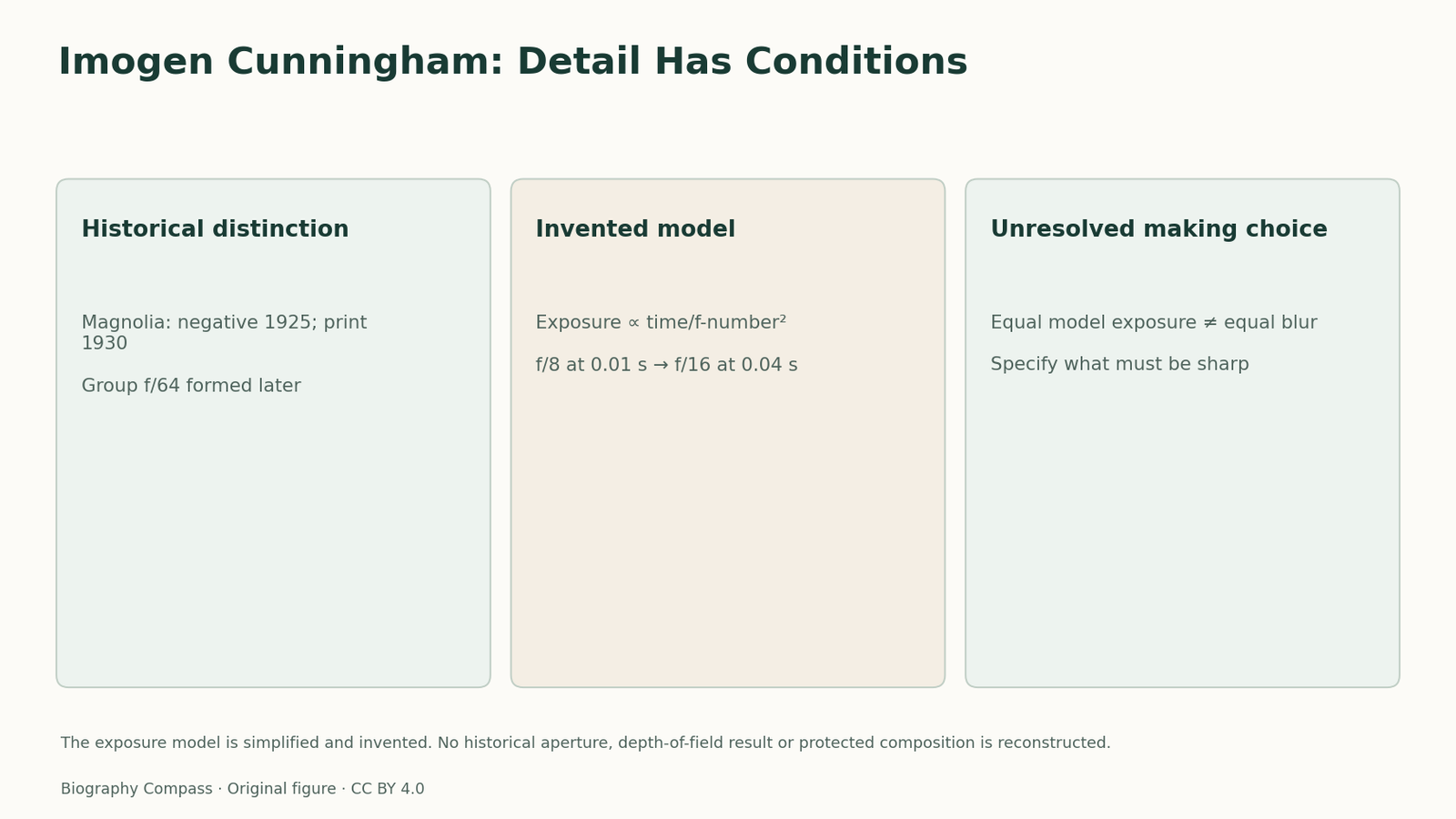
The Getty checklist identifies a Magnolia Blossom negative from 1925 and a print from 1930. It does not list the exposure setting for that object.
Cunningham joined Group f/64 in 1932, after her botanical studies were already under way.
The group’s name should not be retroactively turned into the aperture of every member’s picture. Date, medium and institutional association are different kinds of information from a camera log. This lets us discuss a photographic aim while keeping an unknown setting unknown.
Connect aperture with exposure
Nikon’s manual explains that aperture and shutter time work together: each full aperture step halves or doubles the light admitted, with time adjusted in the opposite direction to maintain exposure.
For an invented idealised setup, hold the scene, lens transmission and sensitivity fixed, and use the supplied relation exposure proportional to time divided by the square of the f-number. The first plan uses f/8 for 0.01 seconds. What time at f/16 would preserve that model exposure? What would happen if time stayed at 0.01 seconds?
Sources for this section: [3]
Reference answer and a moving leaf
The f-number doubles, so its square increases by 4. Time must become 0.04 seconds. Keeping 0.01 seconds would give one-quarter of the first plan’s model exposure. These values are classroom inputs, not Cunningham’s settings or a recommended exposure for every plant.
Now suppose a leaf moves during the longer interval. Equal total model exposure does not guarantee equal motion blur. Nor does the arithmetic calculate depth of field: focal length, focus distance, camera movements and the standard for acceptable sharpness have not been supplied. Choose which feature must be legible, then identify the additional observations needed to test it.
An original picture plan
Plan three photographs of an ordinary plant you can observe without moving it: an overall arrangement, a particular edge and a surface texture. Draw only schematic boxes and lines, not a copy of Magnolia Blossom. For each, write what must be sharp and what may remain indistinct. A useful reference response changes the position or framing before assuming that the smallest opening is the solution to every kind of detail.
Continue the chronology
Related history guides
Biography context
Explore United States through connected lives
Connected biographies
The photographer’s working life
1883–1976
Imogen Cunningham
PhotographerA photographer whose long practice joined technical knowledge with sustained curiosity about people and natural forms.Read biographyQuick answers
Common questions
- Does Group f/64 prove the flower was photographed at f/64?
- No. An institutional association is not an exposure record for that object.
Primary and institutional sources
How this history was checked
Selected records support the historical comparison; the exercise and reference response are original. This article was reviewed on 31 October 2026.