
The short answer
An unposed photograph and its eventual public use are different events. A long interval can change a picture’s context without turning it into an encounter in which permission was recorded.
Compare practice and evidence
Keep the decisions distinct
The comparison separates documented premises from the original task.
| Question | What is recorded | What needs judgment |
|---|---|---|
| Capture | A method and a moment. | Do not assert a stranger’s thoughts. |
| Delay | Time has elapsed. | Time is not a missing agreement. |
| Publication | A proposed public context. | Explain the institution’s reason and limits. |
Chronology
A timeline of the turning points
Subway work
The consulted object description dates the capture period.
Museum release
MoMA published an attributed explanation for delayed release.
New uses
Separate the stated agreement from the proposed context.
Capture and a later public explanation
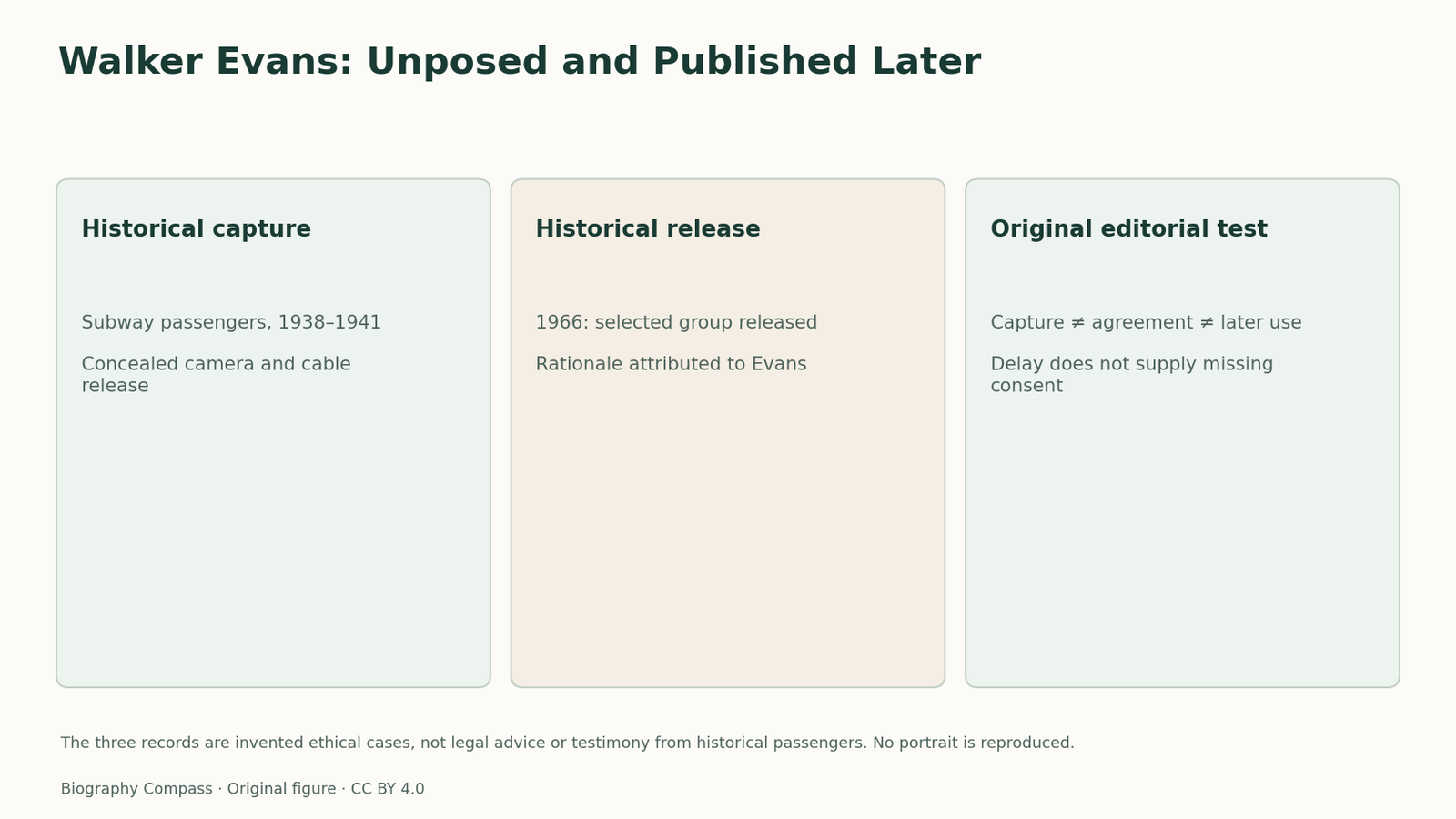
Evans photographed New York subway passengers between 1938 and 1941 with a camera concealed beneath his coat and a cable release.
The 1966 MoMA release describes a selected group as deliberately withheld for more than two decades. It attributes release to Evans’s belief that elapsed time partly mitigated the intrusion.
This is the photographer’s rationale as reported by the museum, not a statement from every passenger. It also concerns the selected group; it should not be expanded into a claim that no subway image ever circulated earlier.
A method does not reveal an inner life
An unposed expression can be valuable evidence of an appearance at a moment. It does not by itself tell us what the person was thinking, whether they recognised the camera, or whether they approved a later caption. Avoid replacing a staged performance with a different certainty about a stranger’s private experience.
For an original editorial exercise, invent three records: A is a posed portrait with an agreement for a local newsletter; B is an unposed portrait whose sitter cannot be identified; C is a portrait whose sitter approved one exhibition but was not asked about a new advertisement. No actual person or photograph is represented.
Reference response: identify the unanswered question
For A, check whether the proposed use is the agreed newsletter use or a different one. For B, lack of an identifiable sitter is an evidence gap, not affirmative permission. For C, approval for one context does not establish approval for the advertisement. A delay of 20 years would not supply the missing agreement in any of these records.
These are ethical editorial judgments in a stipulated exercise, not statements of the law in every jurisdiction. A responsible proposal can identify a historical purpose and still ask whether the new context exposes a person to an avoidable harm. The source records do not supply one universal answer for all later uses.
Write without inventing testimony
Draft a two-sentence display note for B. A reference version identifies the known place and date, states that the sitter’s identity and publication agreement are not recorded, and avoids assigning a mood as fact. Then write a separate curatorial reason for considering display. Keeping those sentences separate makes the institution’s judgment visible rather than placing it in the absent sitter’s voice.
Continue the chronology
Related history guides
Biography context
Explore United States through connected lives
Connected biographies
The photographer’s working life
1903–1975
Walker Evans
Photographer, editor and teacherA photographer and editor who found lasting visual complexity in ordinary places, objects and public encounters.Read biographyQuick answers
Common questions
- Does this study establish the legal status of every street portrait?
- No. Its invented cases separate evidence and ethical judgment; applicable legal rules require their own context.
Primary and institutional sources
How this history was checked
Selected records support the historical comparison; the exercise and reference response are original. This article was reviewed on 31 October 2026.