
The short answer
What survives from a demo, and who makes the decisions that turn it into a released recording? The documentary trail for All Over Now gives a specific way to study collaboration after a singer’s death.
Original evidence comparison
What moved from work in progress to release?
People, recorded parts and later decisions belong in the same production history.
| Country | Object or decision | Useful evidence | Further research |
|---|---|---|---|
| Separate writing | Hogan describes material sent to O’Riordan and her musical response. | A collaborative process worked across time and location. | Do not infer every co-writing detail for all songs. |
| Recorded vocal | Additional files supplied an existing O’Riordan performance. | Her captured work preceded later production. | No claim about unrecorded approval of every final decision. |
| Studio work | Band interviews identify Street and the surviving instrumentalists. | Later performances and choices helped finish the track. | Keyboard retention remains inconsistent within the transcript. |
| Release object | Single report and 26 April 2019 licensed album record. | Public release is separately dated. | Release metadata is not a session log. |
Chronology
A timeline of the turning points
A separate-writing partnership
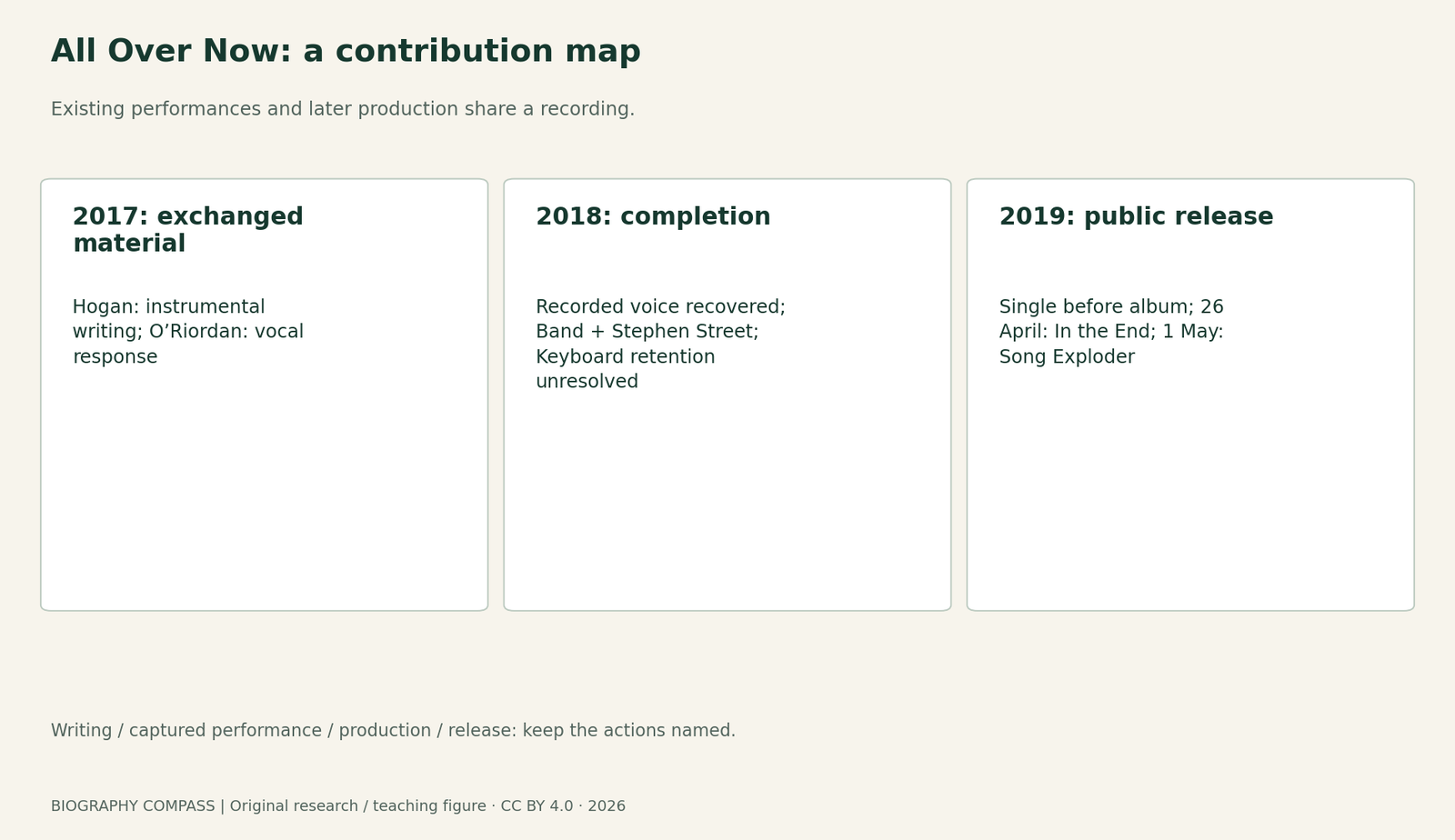
Hogan and O’Riordan exchange developing songs and recordings.
Material and production
The surviving musicians review recordings and work with Stephen Street.
Single, album and testimony
All Over Now precedes In the End; Song Exploder publishes the episode on 1 May.
Identify the recording question before judging the finished album
A posthumous album can easily be discussed only as a memorial. Begin instead with a practical question: what material already existed, and what work remained? Song Exploder’s May 2019 episode provides Noel Hogan’s account of All Over Now, while a January band interview describes the larger In the End project. Release metadata supplies another kind of fact. Together these sources let a reader distinguish composition, captured performance, later recording and distribution. This guide reads their text; it has not listened to the episode or album. Descriptions of sound remain the named participants’ observations rather than new listening analysis.
Recovering a performance is different from inventing it
The transcript describes Hogan obtaining additional material from a hard drive after O’Riordan’s death, enabling him to assemble a more complete vocal. The band’s January interview likewise recalls reviewing demos and recognising usable work. These accounts place her existing performance at the centre of the later production. They also identify decisions by surviving collaborators about selection, assembly and accompaniment. It is useful to preserve both parts of that history: a recorded vocal came from a particular singer, and turning available recordings into a finished track required further work. A production chronology can show those contributions without pretending the singer attended the later sessions.
Family consultation helped define the decision to proceed
In the NME interview Fergal Lawler says the band approached O’Riordan’s family before announcing its plan and describes their support. The official band biography also records consultation. This is evidence of the process the surviving musicians say they followed. It should be attributed accordingly, particularly when their discussion turns to what she would have thought of the result. A researcher can report family consultation and the band’s declared purpose without claiming direct access to a deceased artist’s unexpressed final preferences. That distinction protects the specificity of the decision the sources actually describe.
Production involved continuity and choices about what to keep
The band recalled calling Stephen Street after deciding the available songs were strong enough. His long working relationship with them supplied familiarity with the voice and the group’s methods. Song Exploder discusses drums, keyboards, acoustic guidance and layered guitars; it also describes retaining an early guitar performance alongside a later studio version. These accounts explain why demo need not mean disposable. A draft recording may contain a performance a later attempt does not replace to the participants’ satisfaction. For study purposes, distinguish the reason for keeping a part from the technical method used to combine it; one belongs to artistic judgement, the other to production procedure.
Preserve a small conflict inside the testimony
The transcript first says a keyboard part played by Olé Koretsky on the demo was kept, but later summarises the surviving demo music as the main guitar line and O’Riordan’s vocal. These statements do not fit neatly together. Keep the discrepancy attached to the question of retained material, rather than silently producing a definitive inventory. It may reflect a compressed answer or an unclear use of demo; the transcript alone cannot settle that. A useful next source would be detailed track credits or a direct clarification from production documentation. The unresolved point does not require discarding the whole account of how the project developed.
Sources for this section: [2]
Release records date the public objects
Official Charts reported All Over Now as the lead single ahead of the final album. Apple Music’s licensed release record dates In the End to 26 April 2019 and lists eleven tracks, while its rights line identifies the companies and BMG licensing relationship. Those fields describe a commercially released object. They should not be used to determine exactly when a particular vocal was sung. The band’s January interview says recording had finished the previous May, supplying a different point in the chronology. Writing, capture, assembly, completion and release are therefore separate events, even when a retrospective story moves between them quickly.
Exercise: make a contribution map with no lyrics
Create five boxes labelled initial idea, vocal writing and performance, recovered material, studio production and release. Add named people only where the consulted source identifies them. Use arrows for the movement of material, not for ownership of another person’s contribution. Under the keyboard claim, place a small question marker and list the conflicting transcript passages. Then write a hundred-word account of the process for a reader who knows neither the band nor the song. Require each sentence to name an action and its source. Remove any adjective that would require having listened to the recording to justify it.
Reference approach: tell a history of making rather than a premonition
A careful account can describe exchanged writing, existing vocals, the return of surviving musicians to the studio, Street’s production role and the dated release. It should not present a title or a lyric as proof that O’Riordan anticipated her death. The documented project began during her life and acquired a different significance afterward. That distinction makes the creative history more, rather than less, moving: collaborators completed work in changed circumstances using what a colleague had already made. Comparing the sources also leaves a concrete further question about particular retained parts, giving future research a useful task instead of forcing an artificially complete story.
Continue the chronology
Related history guides
Biography context
Explore Ireland through connected lives
Connected biographies
People in the evidence

1971–2018
Dolores O’Riordan
Singer, songwriter and musicianDolores O’Riordan brought church and school singing into an international rock career with the Cranberries. Songwriting with Noel Hogan, solo projects and renewed collaboration shaped her work.Read biographyQuick answers
Common questions
- Was the podcast or full album listened to for this guide?
- No. The full nine-page published transcript, episode page, band interview and release records were read. No lyric quotation or new listening judgement is included.
- Can the guide list every demo part retained on the final track?
- No. The transcript is inconsistent about a keyboard part. A definitive inventory would need further production evidence.
Primary and institutional sources
How this history was checked
All nine transcript pages, the original episode page, the complete January 2019 band interview, official artist records and licensed release metadata were read. No audio, full album, studio multitracks or complete liner notes were inspected. All descriptions of musical decisions remain attributed to participant testimony. No song lyrics are reproduced. This article was reviewed on 27 October 2026.
- Song ExploderEpisode 158: The Cranberries, 1 May 2019
- Song Exploder / Thao Nguyen, Noel Hogan and Christian KoonsEpisode 158: The Cranberries — All Over Now, transcript
- NMEThe Cranberries on their final album, Elizabeth Aubrey, 22 January 2019
- The Cranberries / Apple MusicIn the End: album release record
- The Cranberries official siteThe Cranberries: biography, Stuart Clark
- Official ChartsThe Cranberries release All Over Now, 15 January 2019