
The short answer
How did a prompt positron-related signal and delayed neutron capture help distinguish a neutrino candidate from background?
Read the evidence
Different records within the same investigation
The following comparison distinguishes the specific questions answered by the inspected records.
| Record or test | What it establishes | What remains different |
|---|---|---|
| Delayed-pair signature | Connects prompt positron-related and later neutron-capture signals. | Timing alone does not exclude every background. |
| Source dependence | Tests whether event rates track reactor operation. | A reactor-associated background must still be considered. |
| Target and component controls | Test specific ingredients of the proposed interaction. | Need detector-efficiency interpretation as conditions change. |
Timing was part of a larger identification test
Reines’s lecture describes the Savannah River water targets, cadmium and surrounding scintillation detectors. The prompt and delayed signals had to be interpreted through their expected physical origins. A pair of pulses separated in time could also arise accidentally or through a background process. The inference therefore required checking more than the existence of a delay. The instrument’s energy response, target properties and background behaviour helped determine whether the recorded events matched the proposed interaction.
Sources for this section: [2]
The primary report tested components of the explanation
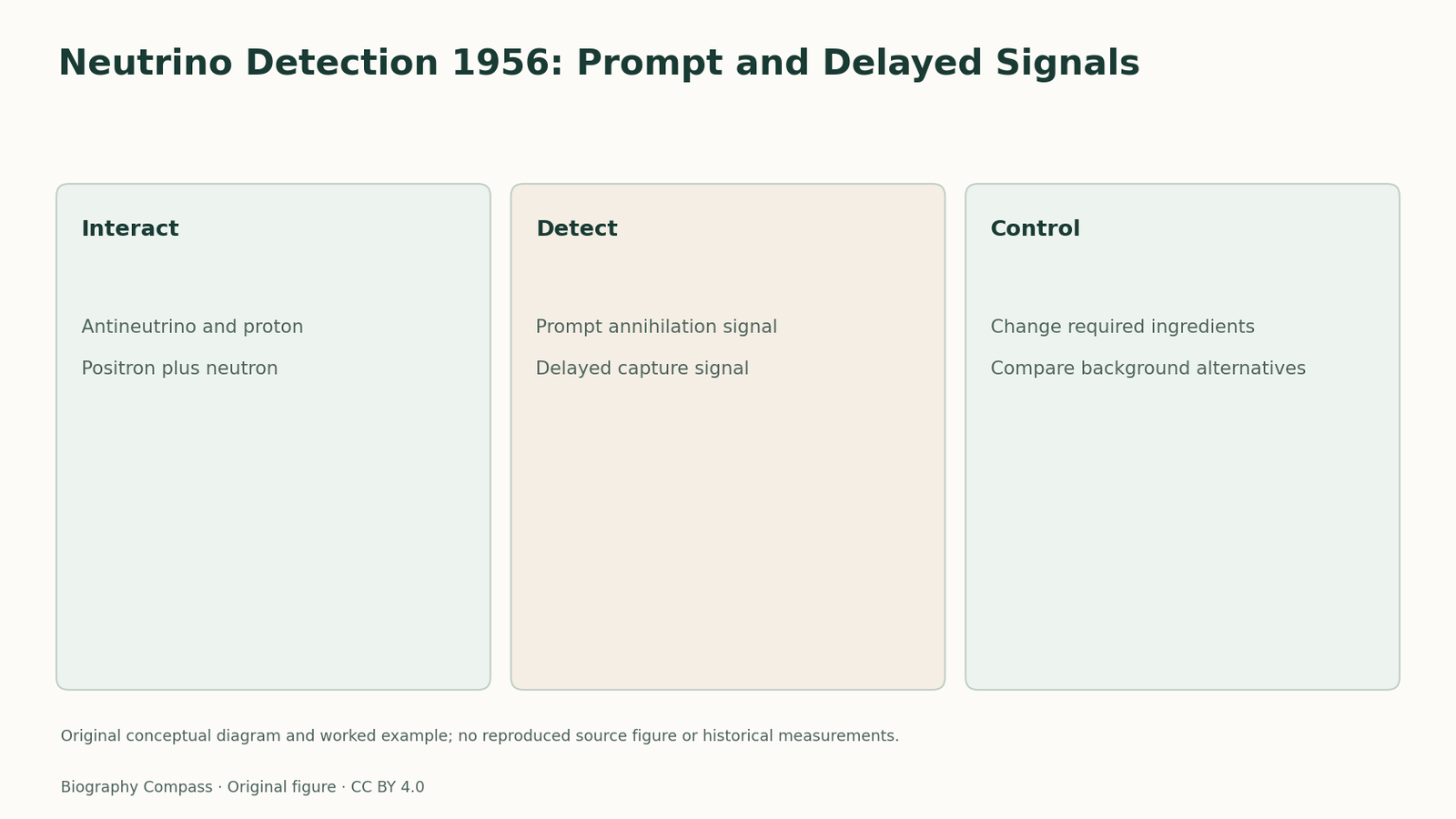
The 1956 paper describes changing target-proton density, examining the prompt signal, varying cadmium and testing possible reactor-neutron or gamma backgrounds. Each change addressed a different part of the hypothesis. These were not interchangeable repetitions of a single count. Taken together, they linked the signal with the reaction’s expected ingredients. Reading the contemporary report alongside the later lecture also preserves the progression from the less decisive Hanford result to the more discriminating Savannah River design.
An original control-test exercise
Imagine a fictional detector with prompt–delayed pairs that become more frequent when a source operates. A student calls that dependence complete identification. What further question should be asked? Source operation might also change an unwanted background. A stronger test changes a component specifically required by the proposed interaction while checking how detector efficiency changes. If the expected signal responds accordingly and a background alternative does not, the explanation becomes more discriminating. This exercise gives no invented historical rate or timing window. Its supported answer is to map each control to a particular part of the causal account. A timing match, a source-dependent excess and a target-composition test contribute different information. Agreement across them can be more persuasive than treating any one as an automatic proof.
Continue the chronology
Related history guides
Biography context
Explore United States through connected lives
Connected biographies
Researchers and related approaches
1918–1998
Frederick Reines
Experimental physicist and neutrino researcherFrederick Reines and Clyde Cowan developed delayed-coincidence detection, using reactor experiments and multiple controls to establish the antineutrino signal.Read biography
1918–1988
Richard Feynman
Theoretical physicist and physics educatorRichard Feynman combined quantum research with physics teaching, moving from MIT and Princeton through wartime Los Alamos, Cornell and a long Caltech career.Read biographyQuick answers
Common questions
- Was an incoming antineutrino photographed?
- No. Detection relied on the products of a controlled interaction signature.
- Why use several controls?
- Different controls test different parts of the proposed process and its background alternatives.
Primary and institutional sources
How this history was checked
The references below distinguish the original study from later explanations. The worked exercise and comparison are newly written for this article. This article was reviewed on 8 November 2026.