
The short answer
How does a sequence of visits and stories build a community rather than a single plot?
Read the evidence
Sources, interpretation and production roles
The records answer different questions about this work. The final exercise is an original teaching model.
| Record or question | Supported reading | Boundary or contrast |
|---|---|---|
| Contents and visits | People and places organise the reading sequence. | A community need not be represented through one central conflict. |
| Littlepage encounter | The narrator witnesses a conversation and hears an account. | Immediate observation and embedded testimony are different levels. |
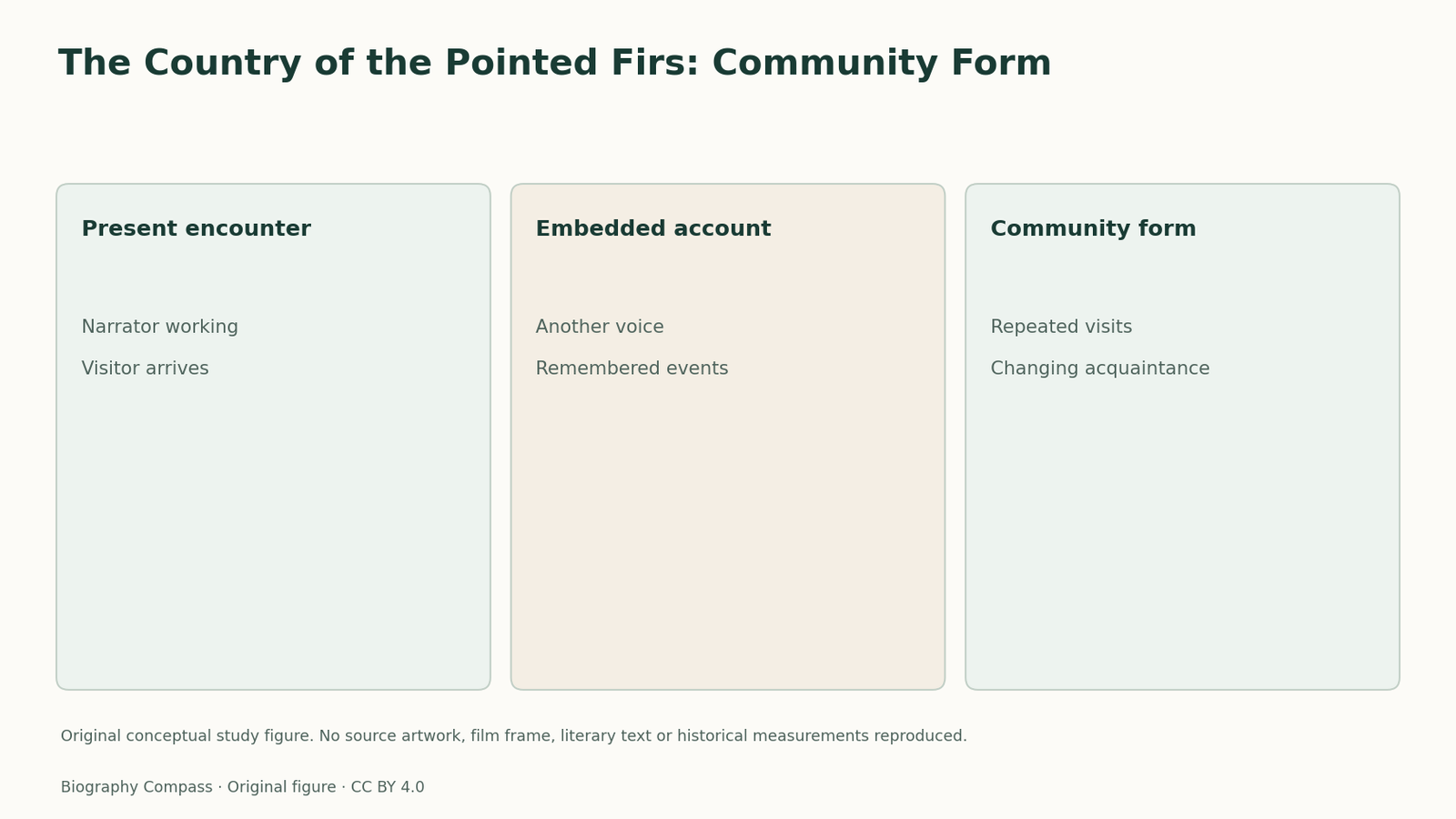
| Original diagram | Separate a visitor’s arrival from the story brought into the room. | Listening itself has a location and practical conditions. |
A book organised through encounter
The Country of the Pointed Firs appeared in 1896. Its contents move through named people, visits and places rather than announcing one central contest. The opening describes Dunnet Landing through the attachment of someone who has come to know it. A visiting narrator then becomes involved in households and stories. This form makes community a process of acquaintance: the reader learns by following where attention is directed and whose voice is given time.
Sources for this section: [4]
Writing time and a visitor’s claim
In the schoolhouse sequence, the narrator tries to preserve time for her own work. Captain Littlepage arrives, bringing another demand on that attention. The meeting is staged through positions in the room, politeness and the narrator’s private responses. Such details make listening an action with practical conditions. The visitor is not simply an information source who appears outside the life of the person hearing him.
Sources for this section: [4]
A story heard is not a scene witnessed
Littlepage’s conversation includes his account of the world and his desire for certainty about what lies beyond ordinary knowledge. The narrator can describe his manner and the circumstances of his visit directly within the scene. The experiences he recounts reach her as testimony. Keeping these levels separate makes the book’s form easier to see. A community narrative can preserve a person’s way of understanding without requiring the narrator to endorse every proposition as independently verified fact.
Sources for this section: [4]
An original encounter diagram
Draw a small centre labelled narrator’s workroom. Add an incoming arrow for a visitor and a second arrow for the story the visitor tells. Which parts belong to the immediate encounter, and which to the embedded account? A supported answer puts arrival, seating and conversation in the first group; remembered or transmitted events inside the visitor’s story belong to the second. The diagram does not rank one form of experience as worthless. It identifies how the book connects the present act of listening with another person’s memory.
Sources for this section: [4]
Why this is more than local colour
A reader can repeat the exercise with another visit and ask what changes when the listener’s relationship with the speaker deepens. The setting may remain local while the narrative builds different kinds of access to people. Jewett’s household and literary relationships provide historical context for an interest in community, but the guide does not treat Dunnet Landing as an exact map of South Berwick. The independent question is formal: how can a book make a sequence of encounters carry the weight that a single continuous plot carries elsewhere?
Continue the chronology
Related history guides
Biography context
Explore United States through connected lives
Connected biographies
People and related creative practices
1849–1909
Sarah Orne Jewett
Novelist and short-story writerSarah Orne Jewett built fiction around Maine households, visits and remembered lives while maintaining a literary partnership and a wider Boston network.Read biography
1819–1892
Walt Whitman
Poet, journalist and essayistWalt Whitman transformed American poetry through the expansive lines and changing editions of Leaves of Grass, while working as a journalist, hospital volunteer and federal clerk.Read biography1873–1947
Willa Cather
Novelist, journalist and editorWilla Cather moved from journalism and magazine editing to fiction that reshaped remembered landscapes and immigrant lives through narrative form.Read biographyQuick answers
Common questions
- Is every account narrated firsthand?
- No. The visiting narrator hears stories as well as describing encounters she experiences.
- What gives the book continuity?
- Repeated people, places, visits and developing acquaintance connect its episodes.
Primary and institutional sources
How this history was checked
Sources include production records, institutional collections and the specifically identified passages discussed here. Interpretations and teaching models are distinguished from credits and publication facts. This article was reviewed on 7 November 2026.