In this biography
Quick facts
- Born
- 20 November 1923
- Died
- 13 July 2014
- Birthplace
- Springs, Transvaal, now Gauteng, South Africa
- Country
- South Africa
- Nationality
- Not independently established
- Known for
- The Conservationist, Burger’s Daughter, July’s People and the 1991 Nobel Prize in Literature
- First story collection
- Face to Face, 1949
- First novel
- The Lying Days, 1953
- Booker Prize
- Joint winner, 1974, The Conservationist
- Nobel Prize
- Literature, 1991
- Literary forms
- Novels, short stories and essays
Why this life matters
Her fiction connects intimate choices with unequal power. Its political importance does not make the books simple documentary records or predictions: imagined relationships remain central to the work.
Timeline
Key moments
Springs and early writing
A childhood in a segregated mining town precedes publication and a move to Johannesburg.
Stories, then a first novel
Face to Face and The Lying Days establish different parts of her early bibliography.
Fiction meets censorship
Several novels encounter apartheid-era publication bans.
A shared Booker award
The Conservationist wins jointly with Stanley Middleton’s Holiday.
An imagined future and international recognition
July’s People appears a decade before the Nobel Prize.
Writing beyond apartheid
New fiction and public criticism continue after democratic government begins.
A segregated mining town shaped her early perspective
Nadine Gordimer was born in Springs on 20 November 1923 to Jewish immigrant parents: a Latvian father and an English mother. Growing up within a white household offered security while placing racial inequality in everyday view. Her writing later returned to the distance between a protected domestic world and the lives that sustained it.
She began writing as a child and published while still in her teens. Her 2005 interview links racial awareness with domestic life and reading. She attended the University of the Witwatersrand briefly without graduating. Personal contact, reading and literary friendships mattered more to her development than a completed university qualification.
Short fiction and novels developed together
Face to Face, published in 1949, was a collection of stories, not her first novel. The Lying Days followed in 1953 as the novel debut. Gordimer had moved to Johannesburg in 1948, and the city became an important base for a career built across longer narratives and compressed encounters.
The distinction between forms is useful when navigating her bibliography. The Soft Voice of the Serpent is another early story collection; it should not be inserted into a list of novels. Nor does a political setting make every character a spokesperson for the author. Her fiction repeatedly places uncertain motives and personal attachments inside systems that constrain available choices.
Apartheid censorship was a material constraint
A World of Strangers, The Late Bourgeois World and Burger’s Daughter encountered bans under apartheid. These restrictions concerned circulation of published work, not simply unfavourable reviews. Gordimer also supported organised opposition to censorship and the development of a broader South African literary community.
Her political commitments included support for the ANC, but commitment should not be confused with an uncomplicated relationship to any government. The later July’s People school-curriculum dispute involved a provincial education process, rather than a repeat of the earlier national publication bans. Keeping those episodes separate makes the history of censorship more precise.
Two major prizes recognised different books and periods
The Conservationist shared the 1974 Booker Prize with Stanley Middleton’s Holiday. Describing Gordimer as the sole winner erases the unusual result. The novel’s recognition also preceded the 1981 publication of July’s People, with which readers sometimes merge her best-known achievements.
In 1991 she received the Nobel Prize in Literature. That award honoured a body of work rather than selecting July’s People as a winning book. International recognition widened attention to her fiction, but neither prize substitutes for distinguishing individual works, their dates and the questions each explores.
Democratic change did not end her public criticism
After 1994 Gordimer continued writing about a changed South Africa. She did not present a democratic election as an automatic solution to poverty, unequal relationships or the responsibilities of public power. Her 2005 interview criticises HIV/AIDS policy and discusses the fundraising anthology Telling Tales.
These interventions belong to the history of an author’s civic commitments, not to medical guidance. They also complicate a simple liberation-era portrait: support for a movement could coexist with criticism of its record in office. Fiction and public advocacy remained related but distinct kinds of work.
Her legacy includes expression as well as literary honours
Gordimer served as a vice-president of PEN International and delivered the 2007 PEN/Arthur Miller Freedom to Write Lecture. PEN’s tribute after her death emphasised this sustained defence of expression alongside the fiction. It is a different contribution from merely accumulating prestigious awards.
She died in Johannesburg on 13 July 2014, aged 90. A useful introduction to her work therefore follows several paths: stories and novels, the institutions that restricted circulation, and the changing political contexts in which readers encountered them. None requires turning a complex writer into a flawless representative of an entire country.
Quick answers
Frequently asked questions about Nadine Gordimer
- Which book won Gordimer the Booker Prize?
- The Conservationist shared the 1974 award with Stanley Middleton’s Holiday.
- Was The Lying Days her first published book?
- It was her first novel, in 1953. The story collection Face to Face had appeared in 1949.
- Was the 1991 Nobel Prize awarded to July’s People?
- No. The Literature award recognised Gordimer’s work as an author rather than naming that novel as a prize-winning entry.
- Did Gordimer stop writing after apartheid ended?
- No. Her later fiction and public interventions continued to examine life under democratic government.
Keep exploring
Lives connected to this story
- Miriam Makeba
Another South African cultural career shaped by apartheid, international audiences and public advocacy.
- Nelson Mandela
The political transition behind, but not interchangeable with, Gordimer’s literary settings.
- Ngũgĩ wa Thiong’o
Compare another writer’s relationship with political power, language and exile, in a distinct East African history.
Sources and further reading
Explore the evidence
These references support the biography and offer further reading. Official records, first-person accounts and independent reporting provide different perspectives; image records document attribution and licensing.
- 1. Nobel PrizeNadine Gordimer — life dates and the 1991 Literature award
- 2. South African History OnlineNadine Gordimer — selected literary and political chronology
Selected biography and bibliography; no adoption of an exclusive speech-writing credit at Rivonia or a claim to have read the full novels.
- 3. The Booker Prizes1974 prize — joint winners The Conservationist and Holiday
- 4. Nobel Prize / Simon Stanford26 April 2005 — written Gordimer interview
Written transcript, not a claim to have watched the interview. The author’s account distinguishes the brief provincial curriculum row from national censorship.
- 5. PEN America14 July 2014 — Gordimer’s literary and freedom-of-expression work
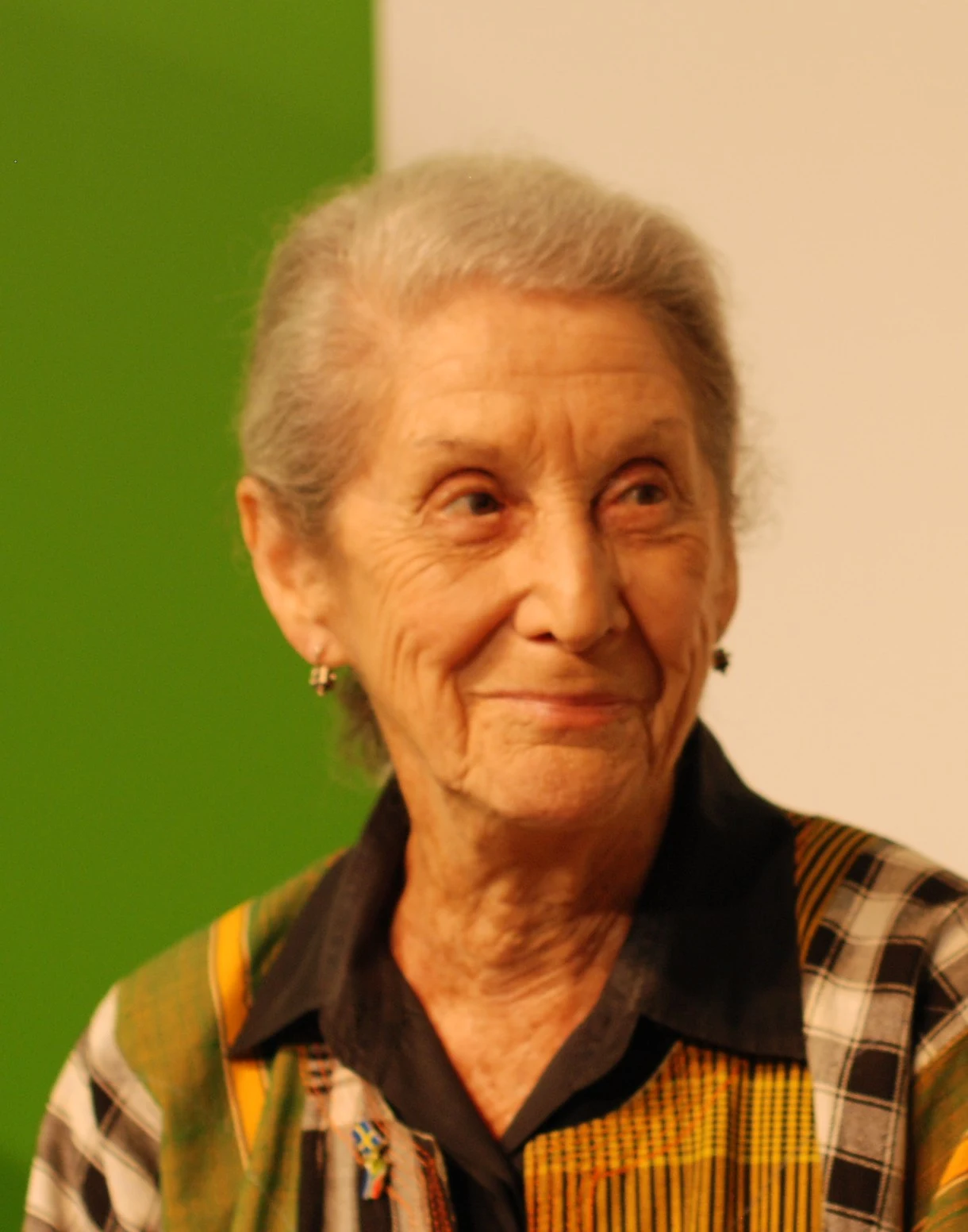
- 6. Wikimedia Commons / Bengt ObergerNadine Gordimer 01.JPG — earliest complete photographer upload
The earliest author upload is used, not the later levels-adjusted or cropped versions.