
The short answer
How did an unexpected tissue response lead to epidermal growth factor?
Evidence comparison
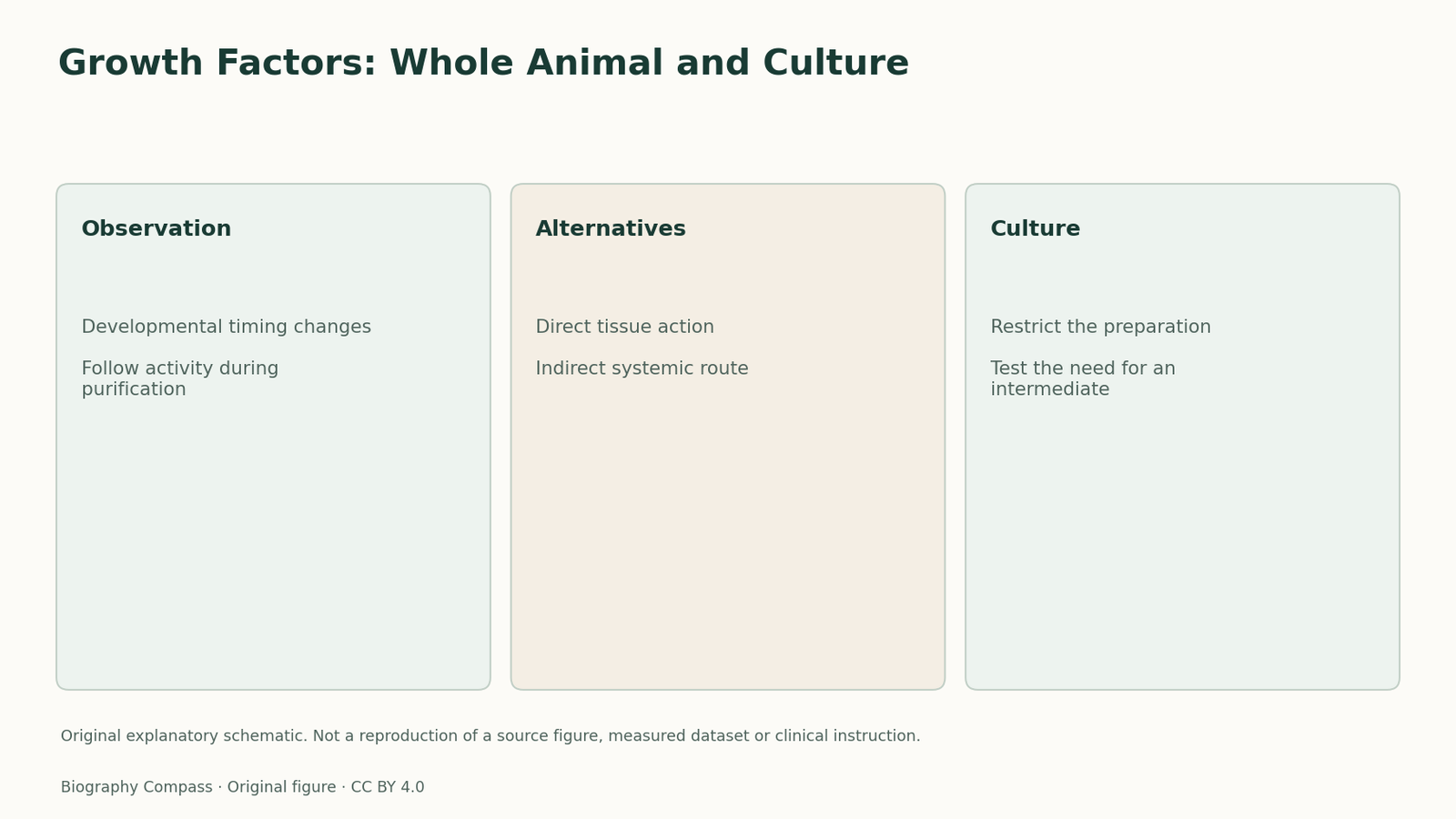
Growth Factors: Whole Animal and Culture
Compare the observations with the narrower conclusions they support.
| Record or observation | What it supports | What remains separate |
|---|---|---|
| Whole-animal developmental response | Provides an observable assay for activity | Leaves direct and indirect pathways possible |
| Responsive tissue in organ culture | Narrows the need for a systemic intermediate | Does not establish every receptor-level or in-vivo detail |
A visible developmental response is an assay
Cohen's lecture describes unexpected effects of gland preparations on newborn animals. Changes in developmental timing supplied a way to follow an active factor during purification. This made the response useful experimentally, but a whole-animal endpoint left open several mechanisms. The applied material might act on the observed tissue directly, or it might first alter another organ or hormone that then produced the visible change.
Use culture to narrow the alternative
Cohen describes organ-culture experiments, including work with Levi-Montalcini and Domenica Attardi, in which EGF stimulated proliferation of epidermal cells in chick-embryo skin. Removing much of the whole animal's systemic context made an indirect hormonal explanation less necessary for that particular response. It did not make the culture an exact miniature of normal development. The point was a more restricted experimental question, not the replacement of every whole-organism observation.
Sources for this section: [3]
Draw the competing pathways first
Make two original diagrams. In the first, factor A acts on skin. In the second, A acts on organ B, which releases another influence on skin. Ask which route becomes harder to maintain if isolated skin responds without organ B. The answer is the requirement for that particular intermediate organ. The result does not yet identify a receptor, prove that every cell responds, or show the concentration normally present in an animal. Those remain different questions requiring additional measurements.
Sources for this section: [3]
Keep the endpoint and mechanism connected
Compare purification guided by an observable response with a later test of where the response can occur. The first helps locate an active substance; the second narrows its mode of action. This distinction explains why a dramatic side effect can begin a discovery without serving as its complete mechanistic explanation.
Sources for this section: [3]
Continue the chronology
Related history guides
Biography context
Explore United States through connected lives
Connected biographies
Researchers and related questions
1922–2020
Stanley Cohen
Biochemist and growth-factor researcherPreparations studied in connection with nerve growth produced other effects in newborn animals, including changes in eyelid opening and tooth eruption.Read biography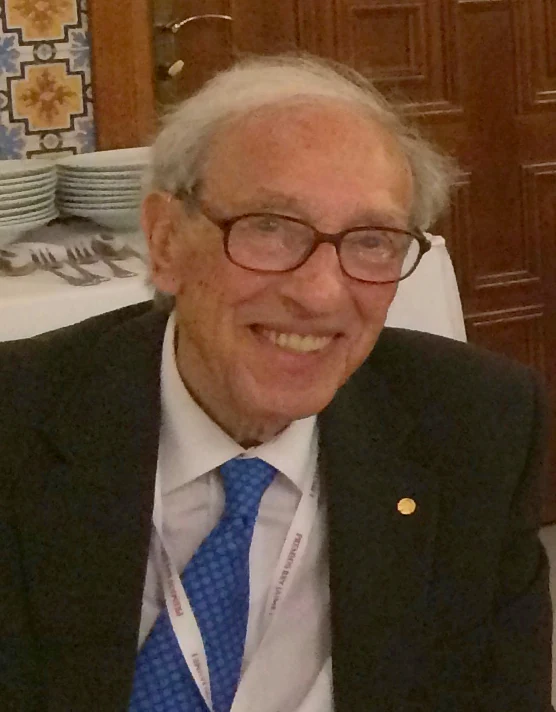
1920–2021
Edmond H. Fischer
Biochemist and protein-phosphorylation researcherFischer and Krebs investigated glycogen phosphorylase and established reversible phosphorylation as a way to regulate protein activity.Read biography1925–1998
Martin Rodbell
Biochemist and cellular-signalling researcherRodbell's work separated reception of a chemical signal from the machinery that carries the influence onward and generates a cellular response.Read biographyQuick answers
Common questions
- How did an unexpected tissue response lead to epidermal growth factor?
- Provides an observable assay for activity. Leaves direct and indirect pathways possible.
- Are the classroom examples historical measurements?
- No. Invented examples are labelled as classroom models; the source-based discussion identifies the historical evidence separately.
Primary and institutional sources
How this history was checked
Official biographical and award records are read alongside the researcher’s technical account. Source scope and hypothetical examples remain distinct. This article was reviewed on 7 November 2026.