
The short answer
King Vajiravudh elevated the Civil Service College to university status on 26 March 1917 and named it for his father, King Chulalongkorn. The change brought professional education in medicine, engineering, arts and science, and public administration under the university’s name.
What the first faculties tell us
Education for more than one profession
The university grouped institutions and fields with different histories.
| Field | Examples of inherited work | What the institutional records show |
|---|---|---|
| Public administration | Education for government service | The lineage through the Civil Service College. |
| Engineering | Professional technical education | The engineering faculty’s account identifies a predecessor school created in 1913. |
| Medicine | Professional medical education | The medical faculty’s history treats medicine as one of the first faculties. |
| Arts and science | Academic study and preparation for specialised fields | The arts and science record traces a combined early faculty. |
Chronology
A timeline of the turning points
Royal Pages School prepares people for government service
The earlier school belongs to the reign of King Chulalongkorn.
King Vajiravudh creates the Civil Service College
The school takes on a wider role in higher education for government needs.
Engineering teaching has a named school
Yantara Suksa develops within the civil service education structure.
University status
King Vajiravudh names the university for Chulalongkorn.
What the Royal Pages School led to
The university traces a path from the Royal Pages School to the Civil Service College of King Chulalongkorn. The earlier work was connected with preparing people for government service. The college took that purpose into a larger educational structure.
Chulalongkorn’s name recalls the earlier project. The university’s institutional account attributes the 1917 elevation to his successor Vajiravudh, whose decision changed the status and organisation of the college.
Why the four faculties mattered
At the founding the university grouped medicine, engineering, arts and science, and public administration. These areas had different curricula and, in some cases, separate predecessors. The engineering faculty traces its own line back to Yantara Suksa, a school formed in 1913.
The separate faculty histories help explain the transition. The university date applies to the institution as a whole, while a field’s history may begin earlier with an identifiable school or with classes offered under another body.
How to read a date on a building
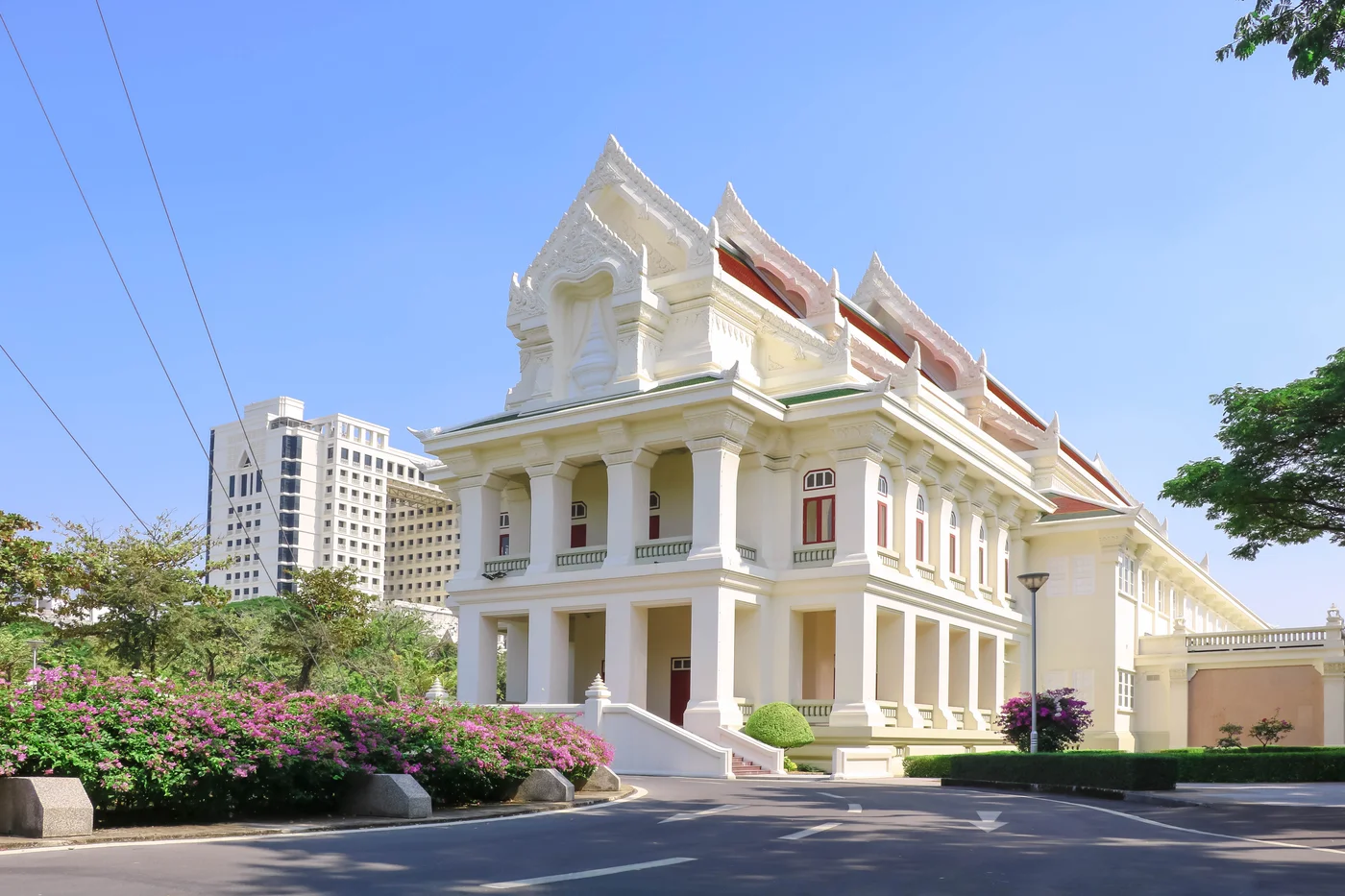
The opening year refers to the institution, and the campus continued to develop after 1917. Buildings and individual faculties have their own dates, even when pictured to illustrate the university’s history.
The distinction matters in this case because Chulalongkorn later housed another identifiable school: the SEATO Graduate School of Engineering. That institution’s teaching lineage belongs to 1959, even though it began on a campus with a much earlier history.
Continue the chronology
Related history guides
How a SEATO Engineering School Became AIT
Follow the later graduate school that first taught on Chulalongkorn’s campus.
Read the timeline1932–1934How Pridi’s Open University Changed Access to Higher Education
Compare a later Thai university with a different admissions and educational mission.
Read the timelineConnected biographies
People connected to this history

1853—1910
Chulalongkorn
King of Siam, 1868–1910The Siamese king known as Rama V, whose long reign built modern ministries, expanded education and transport, and restructured labour and law.Read biographyQuick answers
Common questions
- Who founded Chulalongkorn University in 1917?
- King Vajiravudh elevated the Civil Service College and named the university for his father, King Chulalongkorn.
- What were its original faculty fields?
- The university lists public administration, engineering, medicine, and arts and science.
Primary and institutional sources
How this history was checked
Dates, legal milestones and historical claims are checked against the official and institutional records below. This article was reviewed on 19 November 2026.
- Chulalongkorn UniversityInstitutional history: college predecessors and the four faculties
- Chulalongkorn University Office of Academic ResourcesMarch 26 in the university’s institutional history
- Chulalongkorn University Faculty of EngineeringHistory of Yantara Suksa and the engineering faculty
- Chulalongkorn University Faculty of ArtsHistory of the Faculty of Arts and Science
- Asian Institute of TechnologyMilestones: early teaching at Chulalongkorn University