
The short answer
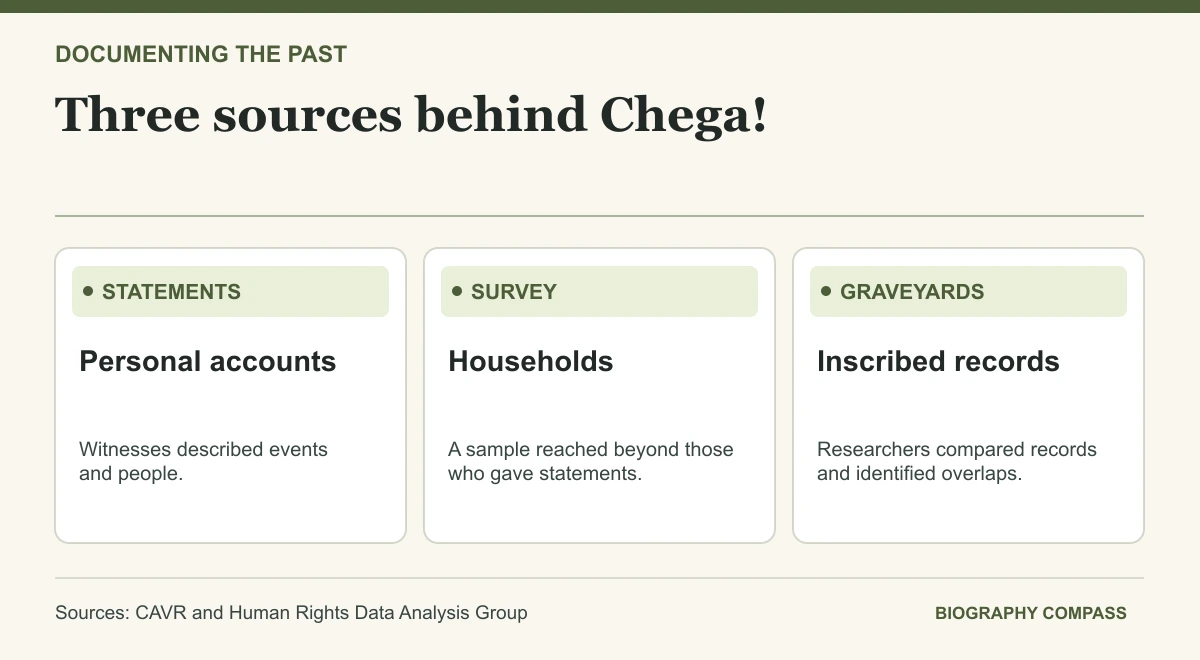
How can a truth commission write about people who never came forward to make a statement? Timor-Leste’s Commission for Reception, Truth and Reconciliation gathered thousands of testimonies. It also worked with researchers to collect evidence independently of those statements. The distinction matters for understanding the final report, Chega!
Compare the records
Three bodies of evidence
The commission’s research partner explains how the different collection methods affected the questions each dataset could answer.
| Material | How it was collected | Why the distinction matters |
|---|---|---|
| Personal statements | Nearly 8,000 narrative testimonies, from across the country. | They preserve experiences people came forward to describe. |
| Household survey | A probability sample of approximately 1,400 households. | It could include households whose members gave no individual statement. |
| Graveyard records | A survey of public graveyards and approximately 319,000 gravestones. | An inscription is a record of a burial, not automatically a conflict-related death. |
Chronology
A timeline of the turning points
Commission established
Regulation 2001/10 defined a mandate covering the period from April 1974 to October 1999.
Collection of evidence
Timorese statement takers and researchers assembled testimony, survey and graveyard records.
Report submitted
The chair presented the report to President Xanana Gusmão. It was presented to Parliament in November.
What the mandate covered
The commission was created in 2001 to examine a past period stretching from April 1974 to October 1999. It also had a reception and reconciliation function that included community processes for less serious offences. The date when someone spoke to the commission and the date of the event they recalled are therefore different parts of a record. Both matter when comparing an interview with a contemporary document.
Why the statement count cannot be a death toll
One statement can describe several people, a surviving person can describe their own experience and more than one witness can report the same death. Many families may never present a statement. The research team therefore compared narrative material with a household survey and a graveyard census. Linking reports across sources helped identify overlaps. Treating every gravestone as an additional victim would discard the distinctions that made the comparison possible.
Submission and public memory
On 31 October 2005 the chair submitted Chega! to the president. The United Nations records a presentation to Parliament in November. These were stages in the report’s institutional history, alongside the longer work of publication, translation and preservation. The research partner’s account of protecting copies of interview data shows why the underlying evidence and the report itself required separate care. A printed conclusion cannot replace the records from which it was drawn.
Continue the chronology
Related history guides
Connected biographies
People connected to this history

1946—
Xanana Gusmão
Resistance leader, president and prime ministerA resistance commander, political prisoner and state-builder who became Timor-Leste’s first elected president and later returned to government as prime minister.Read biographyQuick answers
Common questions
- What does CAVR stand for in English?
- The Commission for Reception, Truth and Reconciliation in Timor-Leste.
- When was Chega! presented to the president?
- The chair submitted the report on 31 October 2005.
Primary and institutional sources
How this history was checked
Dates, legal milestones and historical claims are checked against the official and institutional records below. This article was reviewed on 19 November 2026.
- United Nations Transitional AdministrationRegulation 2001/10 establishing the CAVR
- Office of the UN High Commissioner for Human Rights2006 report on the submission of Chega!
- Human Rights Data Analysis GroupTimor-Leste commission research and statistical analysis
- Commission for Reception, Truth and ReconciliationChega! Final report