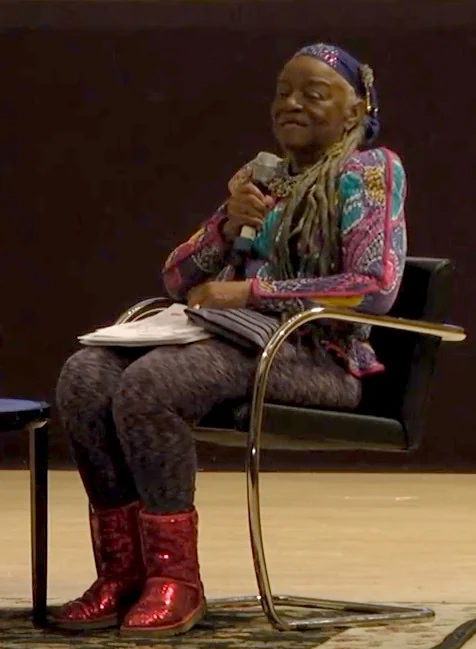
In this biography
Quick facts
- Born
- 1915
- Died
- 2012
- Birthplace
- Washington, D.C., United States
- Country
- United States
- Nationality
- Not independently established
- Known for
- Black women, labour and dignity
- Practices
- Sculpture and printmaking
- Working communities
- United States and Mexico
Why this life matters
Her career joins reproducible prints, substantial sculpture and teaching without collapsing their different audiences.
Timeline
Key moments
Mexico
Began working with the TGP community.
Citizenship
Became a Mexican citizen.
Death
Her cross-border working life ended.
Education and the classroom
Elizabeth Catlett grew up in segregated Washington, D.C. She studied at Howard University and then pursued sculpture at the University of Iowa, where Grant Wood encouraged her to draw on subjects she knew. From 1940 to 1942 she chaired Dillard University’s art department. She arranged an exceptional closed-day museum visit for students excluded by segregation.
Teaching and access were connected concerns. A museum visit could be part of artistic education while also exposing the restrictions placed on the students who sought it.
Sources for this section: [1]
Building a life in Mexico
Catlett went to Mexico in 1946 with Charles White. At the Taller de Gráfica Popular she worked within a politically engaged printmaking community. After their divorce she married painter Francisco Mora and raised a family. U.S. authorities investigated the workshop and classified her as an undesirable alien, restricting her return. She became a Mexican citizen in 1962; U.S. citizenship was restored in 2002.
At UNAM she became the first woman to teach sculpture and later headed the department. Raúl Anguiano introduced her to the workshop’s use of series, a format suited to connecting individual images with a broader political account.
Prints, sculpture and later collaboration
Her fifteen-part linocut sequence, originally The Negro Woman and later The Black Woman, made Black women’s lives its subject. A block was subsequently lost, so the 1989 edition represented in MoMA contains fourteen prints.
Her practice also included sculpture and later collaborative print production. The National Gallery’s records credit Joseph Kleineman and Maureen Turci on Links Together and Randy Hemminghaus and Anne Q. McKeown on Gossip.
She continued living and working between Cuernavaca and New York into her later years, dying in 2012.
Her political commitments matter, but they do not make every work interchangeable. A carved surface, a printed impression and a sculpture occupy different spaces and reach viewers in different ways.
Quick answers
Frequently asked questions about Elizabeth Catlett
- Who was Elizabeth Catlett?
- Elizabeth Catlett was a sculptor, printmaker and teacher. Her career joins reproducible prints, substantial sculpture and teaching without collapsing their different audiences.
- What is Elizabeth Catlett best known for?
- Elizabeth Catlett is best known for black women, labour and dignity.
- When and where was Elizabeth Catlett born?
- Elizabeth Catlett was born in 1915 in Washington, D.C., United States.
- When did Elizabeth Catlett die?
- Elizabeth Catlett died in 2012.
Keep exploring
Lives connected to this story
- Charles White
Compare another working life shaped by making and teaching.
- Jacob Lawrence
Explore a different relationship between studio practice and public life.
- Arthur Boyd
Compare a collaborative making record with another working career.
Sources and further reading
Explore the evidence
These references support the biography and offer further reading. Official records, first-person accounts and independent reporting provide different perspectives; image records document attribution and licensing.
- 1. National Gallery of ArtWho Is Elizabeth Catlett? 12 Things to Know
- 2. National Museum of African American History and CultureElizabeth Catlett
- 3. National Gallery of ArtElizabeth Catlett: artist and collection entries
- 4. The Museum of Modern ArtElizabeth Catlett: artist essay
- 5. Whitney Museum of American ArtI have always worked hard in America