
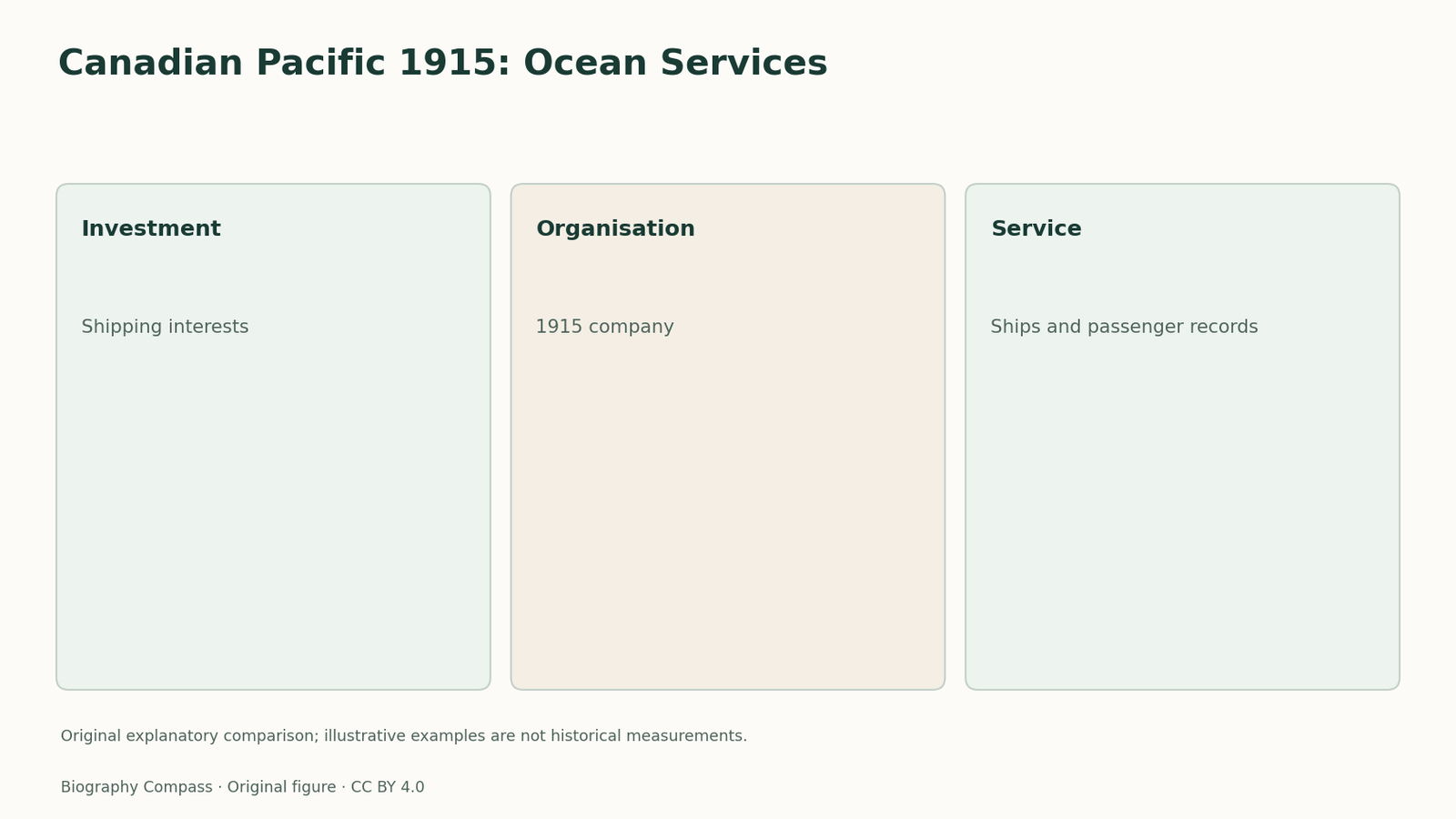
The short answer
How did an ocean-services company fit inside a railway group?
A worked comparison
What each part contributes
Use the specific distinctions developed in the study.
| Part or record | What it establishes | Why the distinction matters |
|---|---|---|
| Acquisition | Obtaining an interest | May precede a subsidiary |
| 1915 organisation | Grouping maritime interests | Not the first sailing |
| Passenger document | Operating identity | Not a complete ownership chart |
How did an ocean-services company fit inside a railway group?
Canadian Pacific Ocean Services offers a specific study of corporate organisation beyond track construction. Canadian Pacific had already developed shipping connections before the First World War, and Shaughnessy participated in the expansion of its Atlantic business. A contemporary financial description states that the ocean-services company was organised in 1915 to take over steamships and an interest in the Allan Line. The question is what that new organisation represented: a way of holding and managing maritime interests, rather than the first moment at which a Canadian Pacific-associated vessel sailed.
Earlier acquisitions and the 1915 organisation were different stages
The Dictionary of Canadian Biography places the Beaver Line and Allan Line transactions within the development of an Atlantic service after 1902. Its acquisition chronology should not be silently replaced by a later date for consolidation or branding. The 1916 financial account, written close to the events, identifies the company formed in 1915 and its intended relationship to existing ships and interests. Reading those statements together creates a sequence of investment and organisation. It does not justify treating an acquisition, a transfer to a subsidiary and the disappearance of a trading name as synonyms.
Ownership of an interest differed from operating a particular voyage
A company can hold shares in another undertaking while a ship continues to sail under an established service identity. Conversely, a passenger document may use the name of an operating organisation without recording every level of ownership behind it. The Canadian War Museum preserves a passenger-list item bearing the Canadian Pacific Ocean Services name. Its catalogue establishes a surviving example of that service identity, not the complete legal history of the Allan business. This makes a practical comparison between the financial description of the group and a document encountered by a traveller.
A railway connection expanded the possible journey
The industrial logic was a transport chain joining ocean passage to inland rail travel. The ship, port and railway segment performed different functions, even when one corporate group coordinated them. The arrangement could simplify the marketing and management of a through journey, but the existence of a group structure does not prove that every connection was seamless. Timetables, tickets, transfer instructions and operational records would answer that more specific question. The present evidence positively establishes the extension of the group’s maritime organisation and the distinct documentary forms through which it appeared.
Corporate-sequence exercise and checked answer
Arrange three fictional events: buying an interest in a shipping line, transferring maritime assets into a subsidiary and issuing a passenger list under the subsidiary’s name. Must all three occur on the same date? No. They concern ownership, internal organisation and operation or presentation. The checked answer explains why a 1915 company can administer interests acquired earlier and leave passenger documents later. Apply that distinction to the inspected records before deciding that two historical dates conflict. A genuine contradiction would require both sources to describe the same legal or operating event, rather than merely mention the same group.
Continue the chronology
Related history guides
Castle Line 1876: Ships and the Cape Mail
Explore the 1876 Cape mail arrangement, alternating sailings and the later Union-Castle merger, distinguishing a contract from a combined company.
Read the timeline1901–1904Northern Securities 1904: Shares and Competition
Read the Northern Securities decision through share control, competition and the decree, separating a holding company from a physical railway merger.
Read the timeline1880–1888Canadian Pacific Railway Company: 1881
How was the CPR company formed in 1881? Examine the syndicate, its government contract, cash and land grants, financing crises and construction’s human costs.
Read the timelineBiography context
Explore Canada through connected lives
Connected biographies
People and wider context
1853–1923
Thomas Shaughnessy
railway administrator and Canadian Pacific presidentThomas Shaughnessy was a railway administrator and Canadian Pacific president, known for purchasing controls and the expansion of Canadian Pacific’s shipping business.Read biographyQuick answers
Common questions
- Did creating Ocean Services in 1915 mean Canadian Pacific had no earlier shipping business?
- No. The company organisation followed earlier shipping activity and acquisitions.
Primary and institutional sources
How this history was checked
The source notes distinguish original records, institutional descriptions and later historical interpretation. Exercises and comparisons are original editorial analysis. This article was reviewed on 8 November 2026.
- Theodore D. Regehr, Dictionary of Canadian BiographyShaughnessy, Thomas George
- Commercial West, FRASERCanadian Pacific: obituary, 15 December 1923
- Commercial and Financial Chronicle, FRASERCanadian Pacific Ocean Services, railway and industrial section, 26 February 1916
- Canadian War MuseumCanadian Pacific Ocean Services, T.S.S. Metagama passenger list