
The short answer
What did a shared mail contract change?
A worked comparison
What each part contributes
Use the specific distinctions developed in the study.
| Part or record | What it establishes | Why the distinction matters |
|---|---|---|
| Fleet | Ships under an operator | Not the whole service timetable |
| Shared contract | Two contracted operators | Alternate sailings |
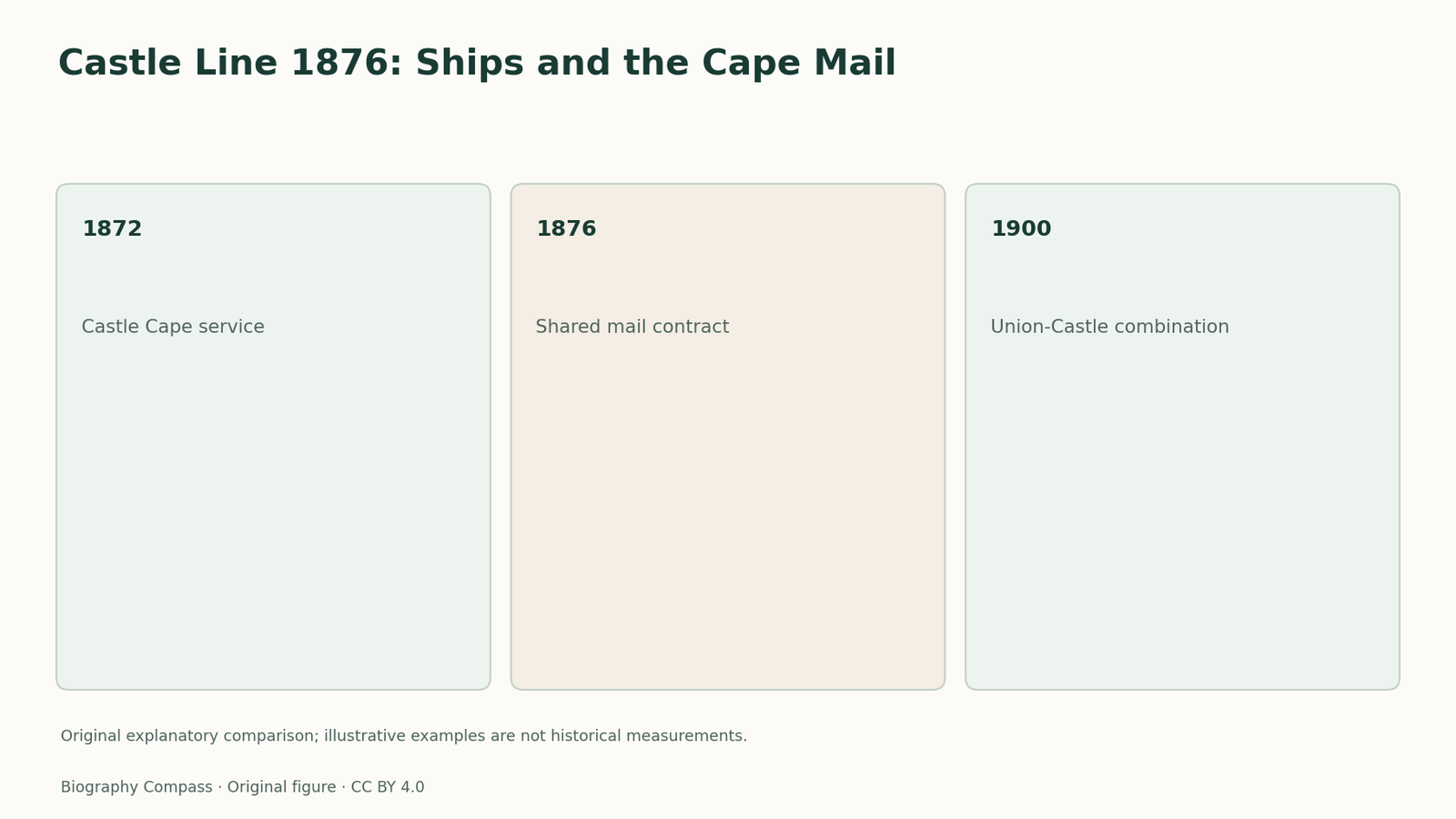
| Union-Castle in 1900 | Combined company | Later than the 1876 agreement |
Alternating sailings connected two fleets
The historical accounts describe the companies taking alternate sailings. That arrangement enabled a weekly mail service without requiring each company to provide every weekly departure by itself. The timetable is a useful unit of analysis because a ship’s speed alone does not establish how often letters can leave port. A fast passage followed by a long wait for the next sailing may produce a different service from frequent departures with a slightly longer passage. The contract connected voyage performance to a continuing sequence rather than celebrating one exceptional crossing.
Sources for this section: [3]
Competition was deliberately preserved
The Cayzer Family Archive states that the shared agreement forbade amalgamation. This qualification makes the later Union-Castle name potentially misleading when applied backwards. In the earlier arrangement, a public customer divided service between two businesses while restricting their combination. That structure preserved separate operators, although it did not make their finances or vessels identical. A contract clause concerns the rules under which a service is supplied; it should not be mistaken for evidence that every sailing met the timetable or that all customers experienced the same journey.
Sources for this section: [2]
The 1900 merger was a later institutional change
By the end of the century the contracting environment had changed. The archive records a proposal for a new award to the company offering the best terms, followed by the registration of the combined Union-Castle company in March 1900. The historical biography likewise separates the 1876 division from the later amalgamation. These records show a change in organisational form. A reader comparing the two periods should ask who held responsibility, which companies remained separate and what timetable was promised, rather than treating a familiar brand name as a continuous legal entity.
Worked timetable comparison and answer
Imagine an illustrative service in which operator A departs on the first and third Mondays and operator B on the second and fourth. How frequently is a departure offered, and how frequently does each operator sail? The combined service is weekly, while each operator supplies one departure every other week. The answer explains the logic of alternate sailings without reconstructing an uninspected 1876 calendar. It also shows why two companies could jointly support a more frequent public service while retaining separate ships and accounts. Whether the actual contract’s other promises were met would require sailing and performance records for the dates in question.
Sources for this section: [3]
Continue the chronology
Related history guides
Biography context
Explore South Africa through connected lives
Connected biographies
People and wider context
1825–1909
Donald Currie
shipowner and parliamentarianDonald Currie was a shipowner and parliamentarian, known for the Castle shipping service and its role in the Cape mail trade.Read biographyQuick answers
Common questions
- Was Union-Castle already one company when the mail service was divided in 1876?
- No. The shared contract involved separate operators; the Union-Castle combination followed in 1900.
Primary and institutional sources
How this history was checked
The source notes distinguish original records, institutional descriptions and later historical interpretation. Exercises and comparisons are original editorial analysis. This article was reviewed on 8 November 2026.