
The short answer
Canada and the European Union signed the Comprehensive Economic and Trade Agreement in Brussels on 30 October 2016. The ceremony followed years of negotiation and a late dispute within Belgium. Signature mattered, but did not put every provision into effect that day. The episode explains how trade diplomacy, domestic consent and legal implementation can follow different timetables.
Chronology
A timeline of the turning points
Negotiations launched
Canada and the EU begin formal negotiations.
Agreement and text
An agreement in principle is followed by a completed public text.
EU decisions adopted
The Council approves a package covering signature, provisional application and parliamentary consent.
Leaders sign in Brussels
The EU–Canada summit records signature of CETA and a separate Strategic Partnership Agreement.
Canadian legislative process
Trade Minister Chrystia Freeland tables the treaty and introduces implementing legislation.
Provisional application
Most economically significant provisions begin operating, with some investment provisions excluded.
The signed agreement had several earlier political stages
Negotiations began in 2009, well before Chrystia Freeland became international trade minister. Canada and the EU announced an agreement in principle in 2013 and a completed text in 2014. Legal review and translation followed. These stages explain why the 2016 event was the culmination of a longer process rather than the start of negotiations.
The agreement extended beyond tariffs to subjects including services, government procurement and investment. Different officials and governments contributed at different points. For Canadian readers, that chronology prevents a change of government in 2015 from erasing earlier work, while still recognizing the responsibility of Trudeau’s government for bringing the agreement through its final political stages.
Belgian consent exposed the importance of domestic institutions
The proposed signing encountered opposition in Wallonia, a Belgian region whose approval mattered to Belgium’s consent. The dispute concerned issues including investment protections and their relationship to public decision-making. Freeland participated in the final discussions, but Canadian negotiators could not simply decide Belgium’s internal constitutional arrangements.
IISD’s contemporary account describes the cancelled 27 October ceremony and a subsequent Belgian agreement. Wallonia received assurances concerning agriculture and investment dispute procedures, including a proposed request for European judicial scrutiny. The disagreement was thus more than a scheduling mishap. It showed how an international agreement could depend on approval within a participating state as well as negotiations between the larger partners.
Sources for this section: [6]
An interpretative instrument addressed public concerns
On 28 October the Council adopted decisions concerning signature, provisional application and seeking the European Parliament’s consent. Representatives also adopted a joint interpretative instrument with Canada. The Council described it as providing a binding interpretation of particular provisions that had generated debate.
The instrument affirmed governments’ ability to regulate in the public interest and to provide public services. It stated that CETA did not require privatization or prevent a service being returned to public control. It also described regulatory cooperation as voluntary. These statements help explain the assurances offered at signature, without implying that a short interpretative document contains the complete treaty or settles every possible future dispute.
Signature in Brussels was followed by legislation in Ottawa
The European Council’s summit record identifies Justin Trudeau, Donald Tusk and Jean-Claude Juncker meeting in Brussels on 30 October and signing CETA and the Strategic Partnership Agreement. The latter was a separate framework for wider political cooperation; it should not be confused with the trade treaty itself.
The next day Freeland tabled CETA and introduced implementing legislation in the House of Commons. The Canadian announcement explicitly said the bill remained subject to the legislative process. A ceremonial signature and the enactment of domestic measures therefore answered different questions: governments could endorse the agreement internationally before the necessary legal steps for its operation had been completed.
Provisional application had a narrower meaning than full ratification
The European Parliament approved CETA in February 2017 and Canadian implementing legislation received royal assent in May. Provisional application began on 21 September 2017. Global Affairs Canada distinguishes that operating framework from full effect, which requires formal ratification by all EU member states.
Some investment provisions were excluded from provisional application. Accordingly, saying that CETA began operating in 2017 does not mean every investment mechanism took effect then. Nor does the long ratification process erase the significance of provisions already applied. The useful distinction is among signature, domestic approval and the scope of actual application, rather than a single date labelled simply as when the agreement happened.
Continue the chronology
Related history guides
Biography context
Explore Brussels, Belgium through connected lives
Connected biographies
The trade minister’s wider career
1968–
Chrystia Freeland
Rhodes Trust leader, author and former deputy prime ministerAn international journalist and author who moved into Canadian cabinet, helped negotiate major trade agreements and became Rhodes Trust Warden and CEO in 2026.Read biographyQuick answers
Common questions
- Was Chrystia Freeland the person who signed CETA for Canada?
- The summit record identifies Prime Minister Justin Trudeau at the signing. Freeland was the trade minister involved in the final stages and introduced implementing legislation the next day.
- Did CETA take effect on 30 October 2016?
- That was the signature date. Provisional application began on 21 September 2017 after further Canadian and European approvals.
- Was the Strategic Partnership Agreement another name for CETA?
- No. The leaders signed two distinct agreements: CETA addressed trade and economic relations; the Strategic Partnership Agreement concerned broader political cooperation.
- Did provisional application include every investment provision?
- No. Some investment provisions were excluded. Provisional application and completion of all member-state ratification requirements are distinct.
Primary and institutional sources
How this history was checked
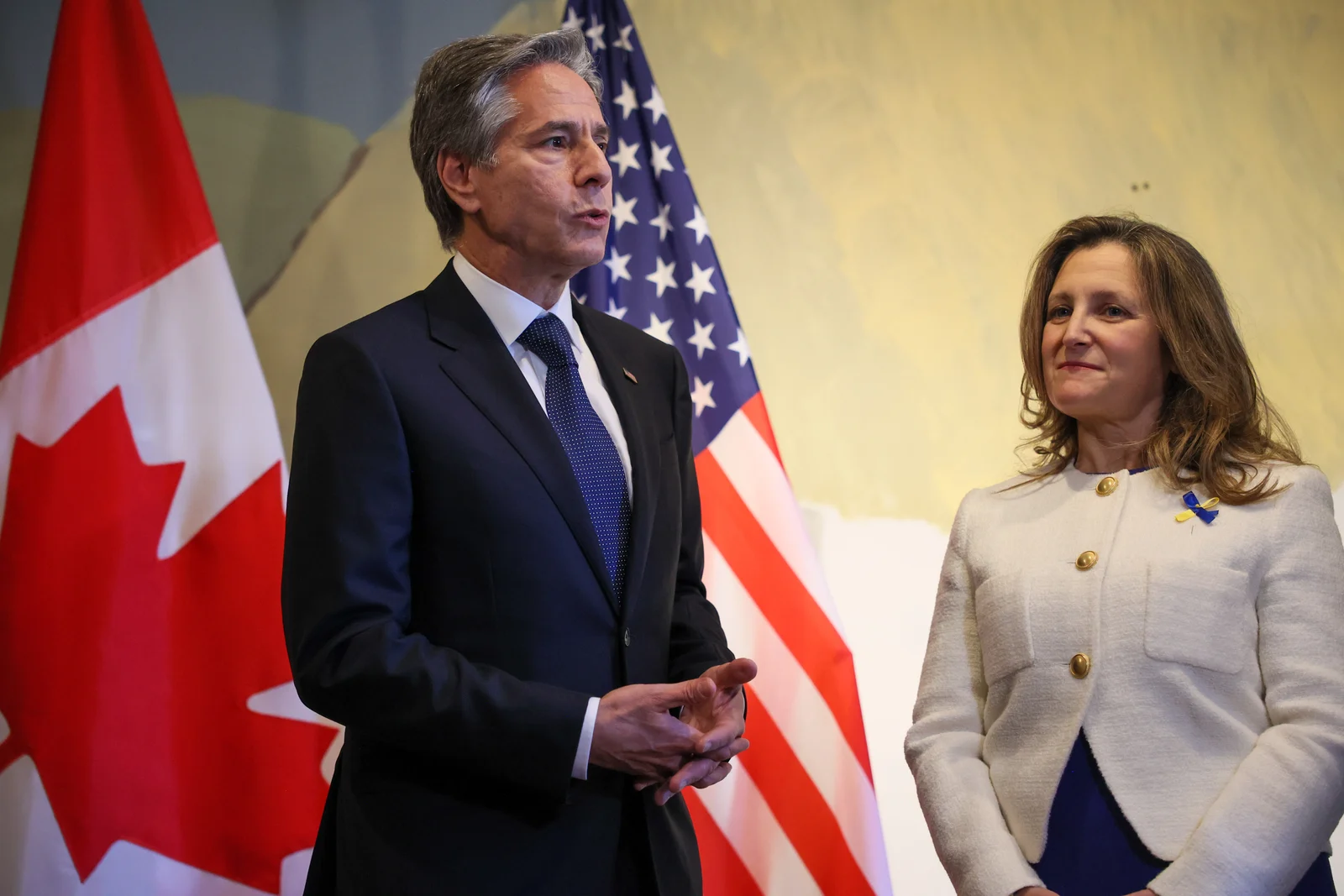
The Canadian timeline and releases, Council decisions and summit record establish the sequence. Selected provisions of the interpretative instrument were read, not the entire treaty and annexes. IISD supplies contemporary independent context on Wallonia and investment provisions. The 2022 Embassy photograph illustrates Freeland’s later diplomacy and is not a photograph of the 2016 signing. This article was reviewed on 23 October 2026.
- Global Affairs CanadaCETA timeline: 2009 launch, 2014 text, 2016 signature and 2017 provisional application
- Council of the European UnionCouncil adopts decision to sign CETA, 28 October 2016
- European Council16th EU–Canada summit: signature and joint declaration, 30 October 2016
- Global Affairs CanadaInternational Trade Minister introduces legislation to implement CETA, 31 October 2016
- Council of the European Union / CanadaJoint Interpretative Instrument: selected provisions on regulation and public services, 2016
- International Institute for Sustainable DevelopmentInvestment Treaty News: CETA signed and investment court issues, 12 December 2016
- Wikimedia Commons / U.S. Embassy and Consulates in CanadaSecretary of State Antony Blinken at Café Ukraine: complete 27 October 2022 photograph
- Flickr / U.S. Embassy and Consulates in CanadaSecretary of State Antony Blinken at Café Ukraine: official publisher’s Public Domain Work mark