In this biography
Quick facts
- Born
- 25 December 1971
- Birthplace
- Ottawa, Ontario, Canada
- Country
- Canada
- Nationality
- Not independently established
- Known for
- The 2015 Liberal majority, social-policy changes and a decade as prime minister
- Prime minister
- 4 November 2015–14 March 2025
- Parliamentary riding
- Papineau, Quebec
- Earlier profession
- Schoolteacher
- Electoral sequence as leader
- Majority in 2015; minority governments after 2019 and 2021
Why this life matters
Trudeau’s career connects an unusually rapid party revival with a long period of governing responsibility. His promise of more open government must be assessed alongside policy changes, minority-parliament constraints and a formal finding of improper attempted influence over the attorney general.
Timeline
Key moments
Born in Ottawa
Born on 25 December, the eldest son of Pierre and Margaret Trudeau.
McGill degree
Graduates in English literature, later training as a teacher and working in Vancouver.
Parliament and party leadership
Wins Papineau in 2008 and becomes Liberal leader in 2013.
Majority and premiership
The Liberals win 184 seats on 19 October; he is sworn in on 4 November.
Domestic-policy changes
The Canada Child Benefit begins in 2016; regulated adult-use cannabis legalization follows in October 2018.
Ethics report
The commissioner finds a section 9 contravention in the SNC-Lavalin matter.
Minority elections
The Liberals continue in office without a Commons majority after both elections.
Leaves office
Mark Carney succeeds him on 14 March.
A political family did not make teaching an incidental early career
Trudeau was born in Ottawa on 25 December 1971, the eldest son of Pierre and Margaret Trudeau. His father’s premiership made the family unusually visible, but Justin’s early adult career was outside elected office. He completed an English-literature degree at McGill in 1994, later trained as a teacher and worked in Vancouver.
Teaching and youth advocacy became recurring parts of his public presentation. Family recognition offered advantages, but it did not itself provide a parliamentary seat or party leadership. Those positions came through separate electoral contests after he returned to Montreal.
Papineau and the Liberal leadership preceded the 2015 breakthrough
Trudeau entered the Commons as MP for Papineau in 2008 and became Liberal leader in 2013. The party had fallen to third place in 2011. Its revival therefore required winning back a governing position, rather than merely defending an existing Liberal majority.
On 19 October 2015 the Liberals won 184 of the enlarged House’s 338 seats. Trudeau became prime minister on 4 November, when the new ministry was sworn in. Election day established the political result; the later swearing-in transferred office from Stephen Harper. The distinction matters in a parliamentary system that does not hold a separate presidential election for prime minister.
His first government changed benefits and drug policy
The Canada Child Benefit replaced an earlier framework of federal children’s benefits in July 2016. Its income-tested structure became an important part of the government’s social-policy programme. Introducing the new benefit was a change in the design of family support, not the first time Canada had paid benefits for children.
The Cannabis Act came into force on 17 October 2018, establishing a regulated framework for adult access. Legalization did not mean that every form of sale, possession or use became unrestricted. Federal rules and provincial implementation made the reform a regulatory change as well as the removal of some criminal prohibitions.
The SNC-Lavalin finding exposed a gap between governing promises and conduct
The 2019 Trudeau II Report examined pressure concerning the attorney general’s response to SNC-Lavalin’s prosecution. Commissioner Mario Dion found that Trudeau used his authority to seek to influence Jody Wilson-Raybould, directly and through others, in a way that improperly furthered the company’s private interests.
The finding was a contravention of section 9 of the Conflict of Interest Act. It concerned improper attempted influence; success was not required. Trudeau disputed aspects of the account and maintained that he was concerned about jobs and the public interest. The commissioner rejected that justification for the conduct examined. This was an ethics-law finding, not a criminal conviction of Trudeau.
Sources for this section: [12]
Minority government, pandemic support and cabinet rupture changed the later years
The Liberals won 157 of 338 seats in 2019 and 160 in 2021, remaining in office without a majority. During the COVID-19 emergency, the government introduced the Canada Emergency Response Benefit. The temporary programme supported eligible workers whose employment or self-employment income was interrupted or substantially reduced because of the pandemic.
The later premiership also suffered a major cabinet rupture when finance minister and deputy prime minister Chrystia Freeland resigned in December 2024. Her departure intensified pressure on Trudeau’s leadership. These events distinguish the later years from the majority-government optimism of 2015 and help explain the political setting of his eventual resignation.
Resignation in January was followed by the actual transfer in March 2025
Trudeau announced in January 2025 that he would leave after the Liberals chose a successor. He remained prime minister during that leadership transition. On 14 March he presented his resignation to the governor general, and Mark Carney was sworn in.
He is consequently a former prime minister, not Canada’s current head of government as of this review. His legacy includes a major electoral revival and lasting policy changes, but also a decade’s accumulated disputes over accountability and leadership. The enthusiasm of 2015 and the circumstances of departure belong to the same political career.
Quick answers
Frequently asked questions about Justin Trudeau
- Is Justin Trudeau still Canada’s prime minister?
- No. His premiership ended on 14 March 2025, when Mark Carney succeeded him.
- Did he become prime minister on election night in 2015?
- No. The election was on 19 October; he was sworn in on 4 November 2015.
- What did the SNC-Lavalin ethics report find?
- It found that he contravened section 9 by improperly seeking to influence the attorney general. The report was not a criminal conviction.
- Was Trudeau a teacher before entering Parliament?
- Yes. After university study and teacher training, he worked as a schoolteacher in Vancouver before his elected career.
Keep exploring
Lives connected to this story
- Pierre Trudeau
Compare Justin’s career with his father’s different constitutional and political record.
- Stephen Harper
Read about the prime minister defeated in the 2015 election.
- Michaëlle Jean
Explore a governor general’s constitutional role during another contested parliamentary transition.
Sources and further reading
Explore the evidence
These references support the biography and offer further reading. Official records, first-person accounts and independent reporting provide different perspectives; image records document attribution and licensing.
- 1. LiPaD / University of Toronto parliamentary data projectJustin Trudeau: parliamentary biographical record
- 2. McGill UniversityBicentennial notable people: Justin Trudeau
- 3. House of Commons of CanadaJustin Trudeau: parliamentary roles and dates
The indexed official parliamentary chronology was read; direct access encountered HTTP 403. Its premiership endpoint is corroborated by the governor general’s actual 2025 handover record.
- 4. Elections CanadaReport on the 42nd General Election of October 19, 2015
- 5. Inter-Parliamentary UnionCanada House of Commons: October 2015 election
- 6. Andrew Heard / Simon Fraser UniversityCanadian federal election results, 1867–present
- 7. Privy Council OfficeGuide to Canadian Ministries since Confederation
- 8. Canada Revenue AgencyCanada Child Benefit and Related Benefits: programme background
- 9. Employment and Social Development CanadaMay 2020 parliamentary briefing: emergency worker support and CERB
- 10. Associated PressFreeland’s September 2025 departure and the earlier December 2024 rupture with Trudeau
- 11. Health CanadaCanada legalizes and strictly regulates cannabis, 17 October 2018
- 12. Conflict of Interest and Ethics Commissioner / Ethics CanadaTrudeau II Report, 14 August 2019
The old parliamentary PDF now redirects to Ethics Canada. The resolving official report’s summary, process, Trudeau’s position and section 9 findings were read.
- 13. Governor General of CanadaSwearing-in ceremony and Trudeau’s resignation, 14 March 2025
- 14. Associated PressMark Carney is sworn in as Canada’s new prime minister, 14 March 2025
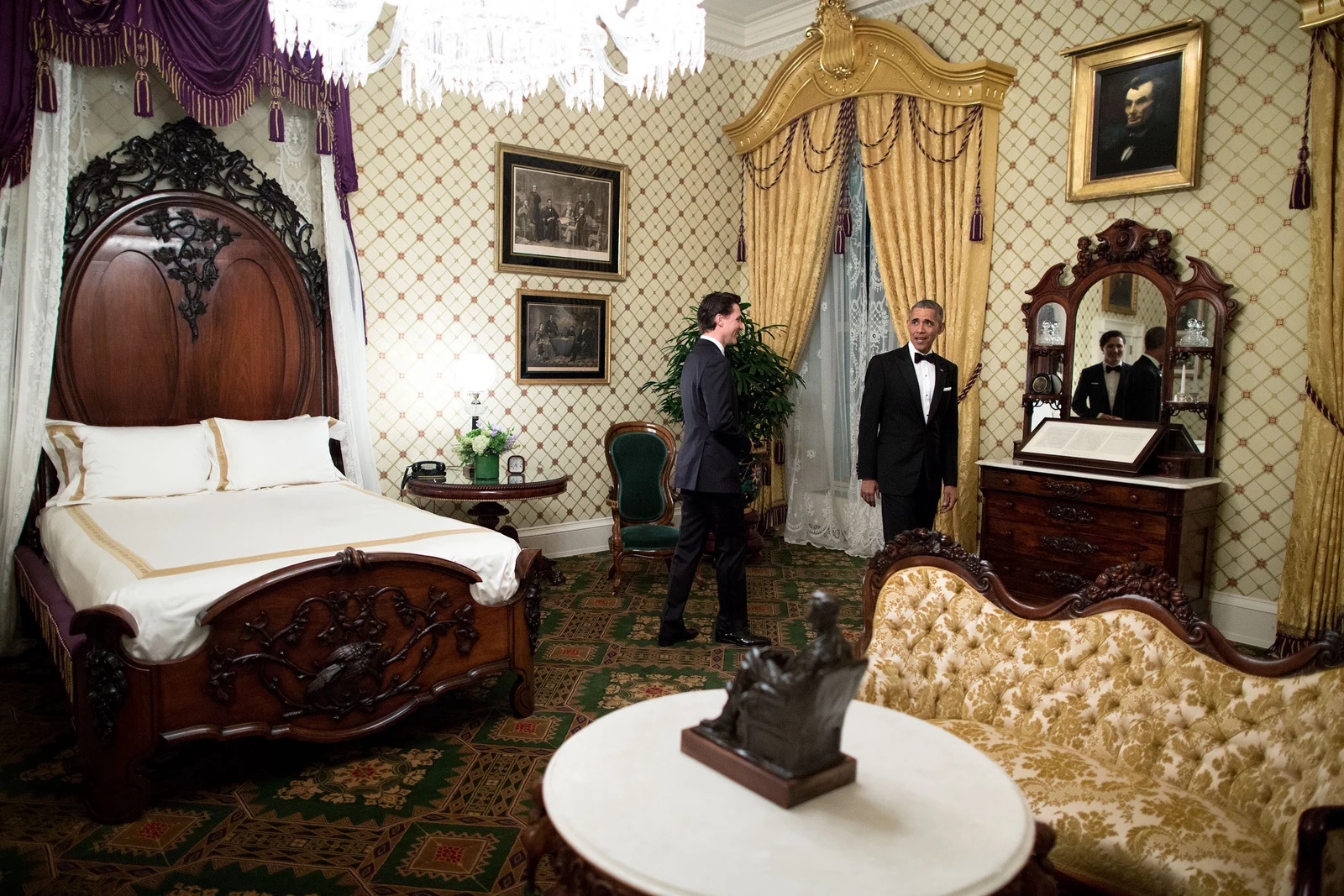
- 15. Pete Souza / White House / Wikimedia CommonsState dinner for Justin Trudeau 03: Lincoln Bedroom, 10 March 2016